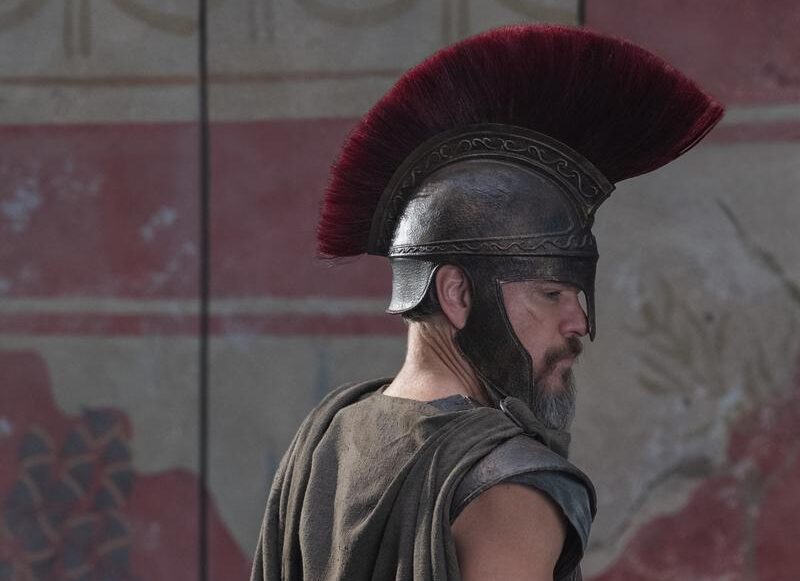
The director’s thirteenth feature proves that his budget-first approach to making movies has reached its limit
The Odyssey, written and directed by film auteur of the hour, Christopher Nolan, gets off to a strong start. Boldly asserting itself as a darker and psychologically real-feeling—if distinctly American—take on the epic, it will be no celebration of the mythological Trojan war. Imposing set pieces, moody but lavish interiors and stunning locations shot in gritty cinematography abound—all that Nolan’s whopping $250 million dollar budget can afford.
All of Nolan’s trademarks present in his adaptation: The Odyssey is fast-moving and grandiose, uber-slick and bone-rattlingly loud; it boasts a propulsive energy that pulls the rug out from under your feet with each scene change and each time jump; and it is hypnotically watchable, wielding a sleight of hand that keeps our eyes fixed to every frame.
Which is precisely why, confronted suddenly with the lithe, Hollywood physique of Charlize Theron in the role of Calypso, the sea nymph who keeps hero Odysseus (Matt Damon) captive on the island of Ogygia for seven years and who we meet some 25 minutes into the film, something feels immediately off. The Odyssey has so far been a predictably high-calibre affair. So why is Homer’s infamous sea Nymph dressed in fish-net tops, canvassy wrap-skirt and gladiator sandals, items of clothing you’d find in any T.K. Max outlet circa 2012?
Writing complex female characters onto the screen has never been Nolan’s strong point. Ever the champion of ultra-smart and beleaguered men (his adaptation takes inspiration from Odyssey translator Emily Wilson’s opening line, “Tell me the story of a complicated man…”), his films can be trusted to steer in the opposite direction of flesh-and-blood female characters. Yet Calypso—a human-form goddess conflicted between her desire to hold Odysseus captive and respect the gods and allowing him to leave—is certainly complex.
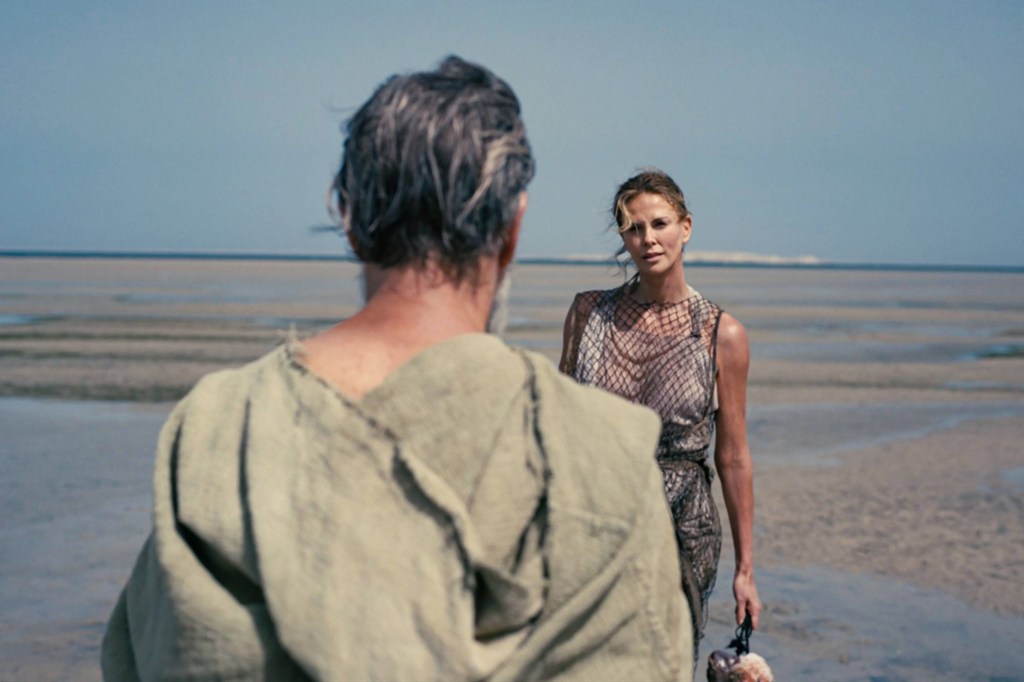
As a workaround, Calypso is over-humanised, hence her lazy high-street getup. Far from the immortal goddess of Homer’s epic, she is blatantly Theron, her sultry American accent and drum-tight, glossy beauty ideals being key giveaways no one involved in the production ever thought to disguise. Consequently, we’re immediately removed from the film’s ancient setting and left with the sensation of watching a high-budget perfume commercial.
But as we quickly learn, Calypso isn’t the only female character to be fudged. Women in Nolan’s adaptation are, on the whole, frustratingly two-dimensional, serving little more than to coax Odysseus forward, reinforce his manhood, or stand in his way.
Take Zendaya’s portrayal of Athena, the mortal goddess who enjoys a central role in Homer’s text as guide and moral compass to Odysseus and son Telemachus (played by Tom Holland in the movie). Far from Homer’s autonomous and engaging character, Nolan reduces Athena to a saintly vision that crops up a handful of times either to chastise Odysseus with stern looks when he errs, or spout garbled aphorisms when he seeks guidance. And though she carries force as Odysseus’ imagined victim of war during the sack of Troy, depicted in a flashback, in the end it’s all too difficult to separate her from Chani, Zendaya’s counterpart in Denis Villeneuve’s Dune saga (a quality compounded by the fact that the filming of Dune‘s third installment coincided with The Odyssey‘s).
As for Circe—the infamous witch-goddess who turns Odysseus’ men into pigs—Nolan likewise disappoints. It’s true that Samantha Morton offers a bewitching and edgy performance as the sorceress, whose grounds are stalked by wildcats seemingly under her sway. But the film’s vision of Circe is a wasted opportunity to offer her a renewed psychological depth and subvert age-old fears surrounding intellectually powerful women. Like Calypso, she merely stands in Odysseus’ way, ultimately functioning to spotlight the latter’s cunning when he forces her to reverse her spell. Stellar acting and pioneering animatronics—impressive though they may be—can’t hide the fact that Circe offers us little more than a man-hating crazy-cat-lady trope.
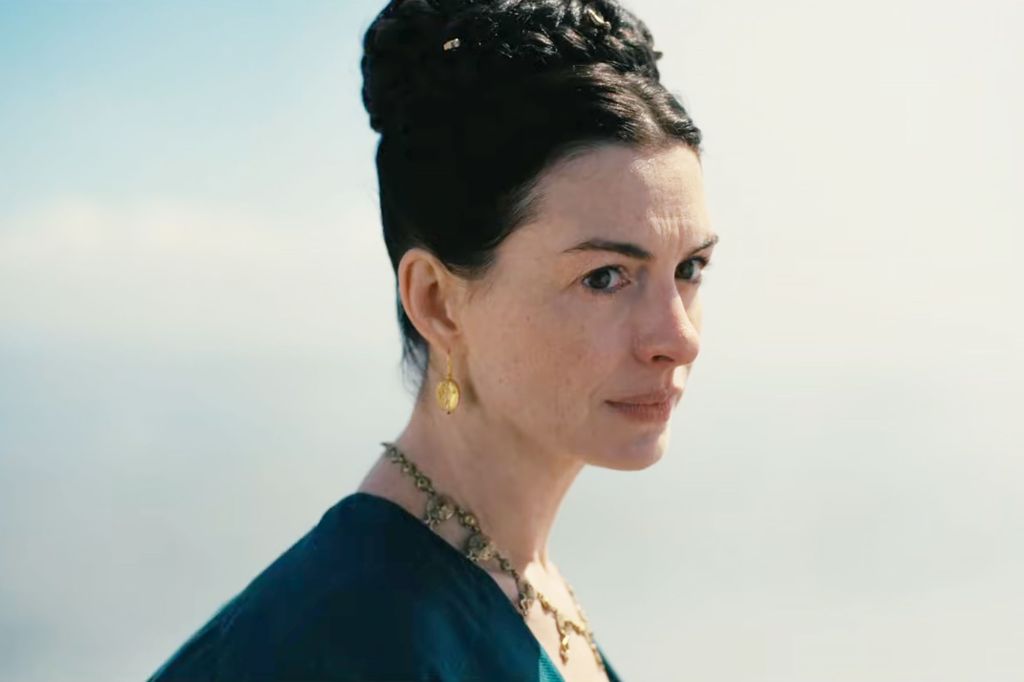
In the absence of convincingly realised female characters, it falls on Penelope to offer up some box-ticking girl power feminism. She’s portrayed as a weary, distrusting and rightfully angry woman, whose fierce maternal power makes up for the power she lacks as a woman existing in a patriarchal society.
However we mustn’t confuse Hathaway’s portrayal of a distinctly fiery version of Penelope for a show of genuine female autonomy. Confined to two or three domestic spaces at best, she represents yet another tired stereotype: the wife at home waiting patiently for her husband to return. With too much riding on her as the film’s feminist torchbearer, but so little time, space and agency to achieve anything Penelope adds nothing of value to The Odyssey.
There was frustratringly more to be done with Penelope. A more interesting take would have been to lean into her position as a presumed widow who had better take action to protect her home and wed. As a meaningful extension of her funeral shroud charade, why not have her explore a relationship with the suitors, forestalling her nuptials by putting them through tests before eventually arriving at the slippery Antinous (Robert Pattinson, with whom Hathaway shares a brilliant on-screen chemistry)—a courtship she might use to her political advantage in shaping the future of Greece?
As it is, Hathaway’s Penelope is the made-again-virgin falling into the more agreeable column of the tried virgin/whore binary most female characters in the film fall into, from the angelic and sublime Athena down to the troublesome Melanthos (Mia Goth) who, working in league with Antinous (her secret lover), is the embodiment of the meddling whore.
· · ·
Yet don’t mistake the above grievances with The Odyssey’s female characters as feminist outrage. Though he could have done better, at this point we can never expect Nolan to ever move the needle on feminism, let alone write flesh-and-blood women into his films. Male characters in The Odyssey likewise leave a lot to be desired; beyond the visceral guilt that haunts him following the war, Damon’s Odysseus is as conventional as heroes come, and can scarcely stand out amongst the film’s large cast of A-listers.
Nolan is a bulldozer of a filmmaker. He’s made his name crafting densely-packed and high-octane films that prioritise visual panache and technical excellence over characterisation and script. Nolan’s thirteenth feature is no exception, for as well as shallow secondary characters, the writing is cheesy, bombastic and forgettable. (Banded about so much, the thinly constructed “Zeus’ law,” based on the Greek concept of xenia, quickly becomes the sort of buzzword you’d expect to hear uttered by gym-bros).
Hammy writing and two-dimensional female characters are a problem for a film based on a literary, 12,109-line epic poem in which women are unusually numerous and complex. One doesn’t simply walk into Greek mythology, to coin a phrase. Entering any literary cannon, not least one as vast and enduring as Homer’s, demands a considerable amount of world-building. Much time and sensitivity are needed in the construction of the finer shades and details—the fun, the humour, the colour—that make up a supernatural universe, as Peter Jackson got right in his Lord of The Rings trilogy.
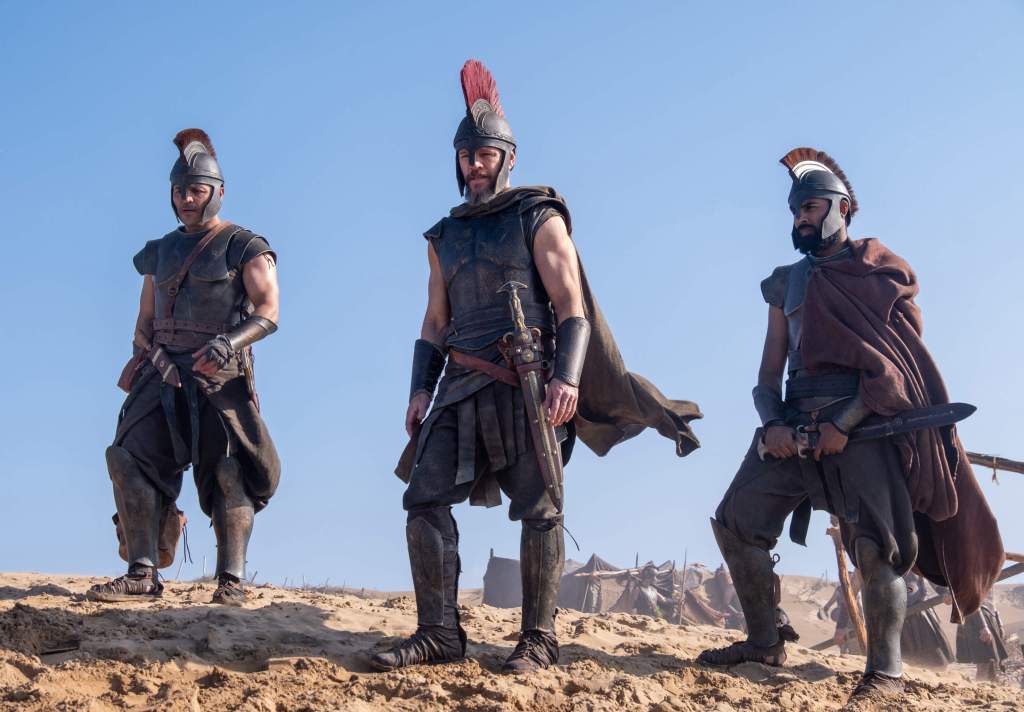
Perhaps The Odyssey really ought to have been divided into multiple installations, at least two. An Iliad-Odyssey two-parter might have fit the bill. But to franchise the epic would inevitably force Nolan to adapt it in its entirety, to capture the finer shades of the text—the sex, the crying, the adultery, the food, the waiting, the transmutations and, of course, the women. Indeed the constraints of shoehorning Homer into one feature film alone are convenient for Nolan, for they enable him to work with what he knows best: the action.
Action is the key word here. In The Odyssey, the supernatural-ness of Homer’s mythological world mostly fails to translate unless mediated through chivalry and violence. Naturally, this excludes women. The film’s male characters—humans, immortals and beasts alike—are outwardly powerful, be it the foes Odysseus and his men come up against on their journey home (such as the Cyclops Polyphemus and the giant Laestrygonians of Telepylus), as well as characters like “strong-thighed” Odysseus himself, the Machiavellian Antinous, or Benny Safdie’s blockade-shouldered Agamemnon, chief-in-command to the Greek army. Such figures are naturally primed for translation onto Nolan’s screen, while Calypso, Circe and Athena, being of a far subtler and more complex nature, are difficult to translate without sufficient time and effort alotted to them.
As it is, The Odyssey is a distinctly masculine affair, an old-school Hollywood outing with all the balls and bravado of spaghetti Western. It feels made by men, and skewed towards men—a quality reflected in the explosive online frenzy of male Nolan-stans fawning over the film’s technical accomplishments rather than focusing on the film itself as a finished product. Why lament Nolan’s axing of Homer’s pivotal Phaeacian chapter—one that introduces the powerful queen Arete and her daughter Nausicaä, key figures in Odysseus’ return home—when the whole thing was shot in IMAX? Why critique the lack of imagination put into Circe when show-stopping, how-did-he-do-that animatronics were involved in the transmutation of Odysseus’ men into pigs?
The Odyssey’s thematic interests similarly appeal to the masculine while also serving to distract. Your average Nolan outing will invariably centre around the phallocentric themes of time, memory, existence and free will—what feel like Big Important Ideas synonymous with the brandy-sipping naval gazers. War ranks high on this list, and Nolan predictably grants the fall of Troy far more time than it occupies in Homer’s poem by reimagining Homer’s tale as one fraught with war.
On the one hand, it’s understandable that Nolan should want to zoom in on Troy’s bloody fall. In his retelling, it has a bleakly familiar transactionalism to it that resonates with today’s global geopolitics: Helen’s elopement with Paris is used as a pretext for Agamemnon to invade Troy, by doing so dismantling the Trojan’s hold on trade routes. And it has to be said that The Odyssey’s eventual depiction of Troy’s fall through flashbacks, each incrementally taking us a step further towards the moment Odysseus and his men penetrate the walls of Troy, is masterfully done: boldly subverting the blood and conquer-hype peddled by a long list of war-glorifying productions since the turn of the century, Nolan’s Trojan scenes starkly reveal war to be the cruel, merciless and barbaric thing that it is.
On the other hand, Nolan’s inclusion of the sacking, brilliantly executed though it is, overcrowds a film already big on thrills and short on breathing space. To begin with, the war itself is referenced only in passing throughout Homer’s original, while the Greeks’ use of the Trojan horse features neither in the Iliad nor the Odyssey. In the end we’re left with the impression that the purpose of the film all along was to reproduce Greek mythology’s most feted moments in all the glory of IMAX—a war about which any meaningful commentary is undone by the egregiously violent and tediously long Ithacan showdown towards the film’s conclusion that sees Odysseus and his supports and the suitors fight it out to death.
· · ·
Watching the above showdown strangely feels like watching teenage boys play dress-up. Indeed there’s a juvinile naivety to The Odyssey, one that especially comes across in what can only be described as “beast mode” moments in the film—over-produced sequences such as Helen’s soap opera-esque retelling of the war to Telemachus or Odysseus’ gothy visit to Hades.
A spoof-like sincerity dominates such scenes, often emphasised by the garish techno vein of Ludwig Göransson’s confused, hit-and-miss score—clubby electronic motifs that add a bro-ish jacked-up energy to the film that jar with the film’s tasteful use of period instruments like the aulos and lyre. This energy culminates with a closing theme from Göransson, James Blake and Travis Scott, a hubristic and self-congratulatory mic-drop moment that would feel more at home in a Marvel slopbuster.
Speaking of hubris, it’s ironic that the The Odyssey‘s best moment is the Cyclops sequence. It’s here that the high-budget Hollywood slickness Nolan has until now adhered to is done away with, and Nolan is at liberty, for perhaps the first and last time in the making of the film, to embrace his source material.
The episode is markedly calmer, almost a film unto itself. Sound is paired down and the sheer suspense of the moment speaks for itself as Odysseus and his men, having discovered an occupied cave on a seemingly uninhabited island, roam its interior in silence—blissfully unaware of its proprietor. We know what awaits, and those not in the know are nonetheless struck with an overwhelming sense of foreboding.
Witnessing Polyphemus’ eventual reveal is a thing to behold. Its brilliantly ominous figure (played by Bill Irwin, shot separately; Damon et al worked with a giant puppet in his place) emerging through the cave’s mouth and approaching Odysseus and his men is a perfect symbiosis of technical achievement, directing and cinematography.
Crucially, the surrealism of the events—a giant one-eyed cyclops aware of the presence of intruders yet picking them off only at whim before settling down for periodic snoozes—is wonderfully singular in a way many instances are in the epic itself, and perfectly situates Odysseus and his men as the ants in a world ruled by gods and monsters that they are.
And it works on the screen, standing out as a terrifying piece of film making inspired by the Goyan grotesque. It’s perhaps no surprise that whole thing for me recalls the giddy hysteria of Robert Bobroczkyi’s Captain Clark, the supersized demonic incarnation of exasperated salesman Clark (Chiwetel Ejiofor) from this year’s horror-hit Backrooms, whose wonderfully unsettling score from Edo Van Breemen and director Kane Parsons conjures the deranged, feral sounds of Göransson’s Cyclops number.
The episode demonstrates that it is possible to faithfuly translate the Odyssey’s stranger episodes. But it’s no doubt made all the more special next to the comparative blandness of the film as a whole. With so little space—or desire?—to construct Homer’s mythological context in a way that is worthy of his epic, Nolan douses his adaptation with a cool psychological realism that appeals to modern sensibilities but that isn’t really found in the text. The result is a film that is all too sincere, all too one-note in its approach to a text that is so layered, genre-less and dare I say it, fun.
Where’s the nuance, the introspection and the mystery that lie at the heart of Homer’s epic? Where’s the magic of this strange world where gods in the sky have the final say? Where’s the fun in it all? Just as a hubristic Odysseus himself can’t resist looking back at Polyphemus and firing an arrow in his only eye, Nolan can’t resist loading his adaptation with Oscar-eyed technical mastery that distracts from his reluctance to capture a classic in earnest.


Leave a Reply