HBO’s hypnotic miniseries is a masterful exploration of two men in search of a new masculinity
It’s a first for me that a mystery series has had me wondering who dunnit and why with as much eagerness as it had me wondering what, exactly, happened to a particular character’s penis so that it ended up permanently bent to a near 90-degree angle—a fact revealed only in the show’s final episode. Yet this is exactly what HBO’s brilliantly off-kilter miniseries DTF St. Louis, written and directed by Steven Conrad, gives us.
The show is, much like today’s world, surreal yet mundane, dark yet bleakly comical—the gritty realness of it all scored by an overcast wash that bathes each and every episode. And there’s no sun in forecast for weatherman Clark Forrest (Patrick Bateman), despite what the oversized billboards of him holding a sun emoji in the palm of his hand, dotted around the Missourian city of St. Louis, might suggest. Instead Clark is tired of his uninspiring, largely redundant job, and at home is adrift from his wife Eimy (Wynn Everett) and their children. Lost and lonely, he yearns for something more.

It seems like fate then when Clark meets the studio’s newly-hired ASL interpreter, he of the crooked penis, Floyd Smernitch (David Harbour), a man as unhappily married and seemingly lost in life as himself.
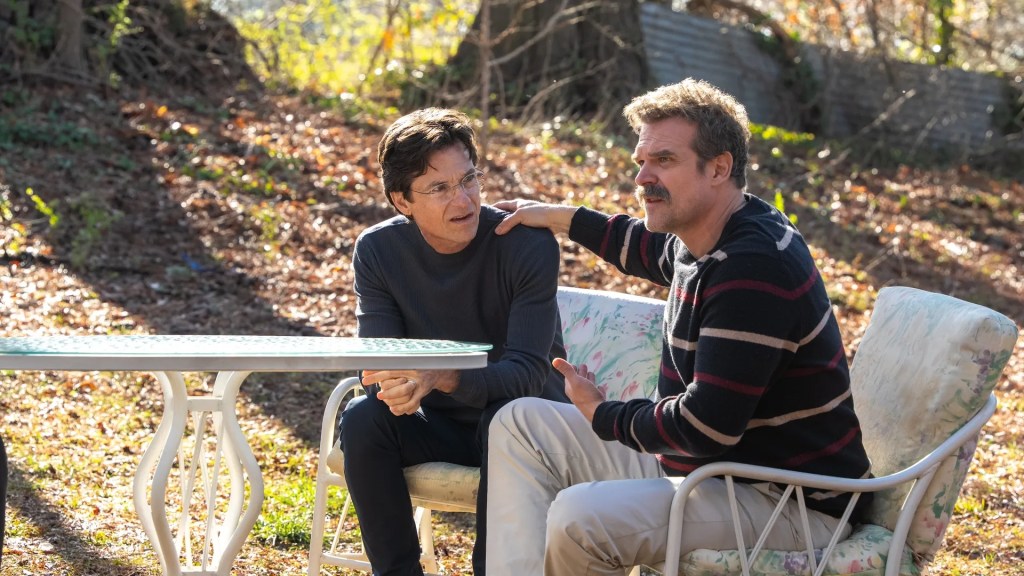
Clark is drawn to Floyd’s unique skills as an interpreter for his network’s hard-of-hearing viewers, while Floyd himself gravitates towards Clark’s kind, avuncular nature. Hitting it off like newly-acquainted childhood neighbours, they recognise one another’s pain and the pair embark on something of an unspoken arrangement: Clark will help the overweight Floyd get into shape if Floyd helps Clark, who is seeking to add more meaning to his life, learn to sign.
Clark and Floyd hit the ground running with the ease of two best buddies communicating by way of a secret code: ASL. It’s heartwarming to witness, on the one hand; but on the other, watching Clark and Floyd be open with one another, cultivate safe spaces and above all have each other’s back, feels uncanny somehow.
Depictions of healthy adult relationships between men across film, TV and fiction are scarce, the default being to depict men in states of conflict, competition and various states of dysfunction. Clark and Floyd’s newfound bond is therefore a peculiar thing to witness, the levels of intimacy they reach—in a world that systemically prevents close relationships between men and ridicules them when they flourish—feeling off.
But there’s another reason why witnessing Clark and Floyd’s bond flourish feels especially awkward. There’s a strange adolescent quality to the characterisations of Clark and Floyd, seen as they stumble their way through life. Watching these two middle-aged men meet and grow closer thus feels like watching two young teens, newly neighbours, meet and form an instantaneous bond—the whole of the summer holidays ahead of them.
Indeed without the social skills typically fostered more readily in women, without recourse to anything else, Clark and Floyd default to their child selves. Hence the juvenility of their shared activities: shooting hoops, riding bikes, rapping and having heart-to-hearts together. Clark and Floyd each discover not only a new friend in one another, but something they haven’t felt since adolescence.
And what better to complete the bond between two best friends than a secret project? Clark reveals to Floyd, both perched on his children’s swingset in the garden one grey afternoon, his interest in trying out the location-based app DTF St. Louis (that is, down-to-fuck in the St Louis area). A hook-up site for married individuals, Clark explains sotto voce, DTF St. Louis allows users to create profiles of themselves and rendez-vous with fellow married users seeking extramarital sex. They discuss the app with all the bottled-up excitement at the prospect of finding nude images on the web.

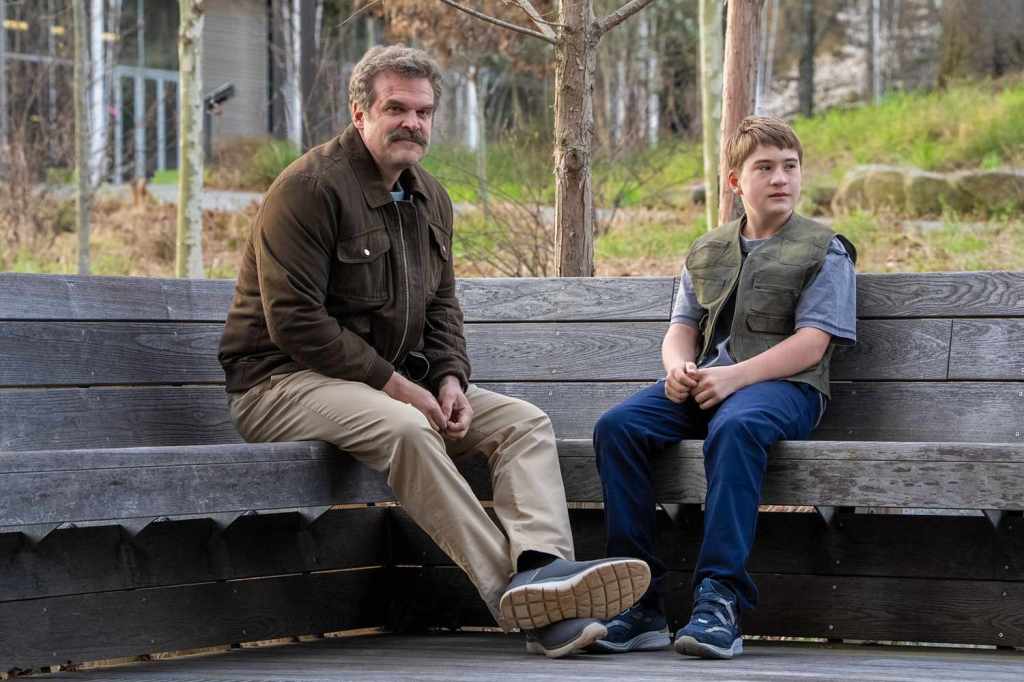
Floyd is immediately interested, seeing in the app a means of outsourcing the sexual components lacking in his faltering marriage to wife Carol (Linda Cardellini). For as well as being in dire need of a confidence boost—he is haunted by the India Jones-inspired nude photoshoot he starred in many moons ago—Floyd is tired of Carol’s libido-snuffing fixation with saving money. (She’s even taken up umpiring baseball matches to boost income, the grotesquely oversized protective gear the stint requires her to wear, comically donned around the house, proving a particular turn-off).
Yet it’s when Carol herself enters the fold that things become complicated. Clark meets her at one of Floyd’s cornhole barbecues one afternoon, all with the sense that he’s meeting a schoolyard crush during an arranged playdate. The pair hit it off, and the beginnings of TV’s bizarrest love triangle are set in motion—one that will bring deadly consequences.
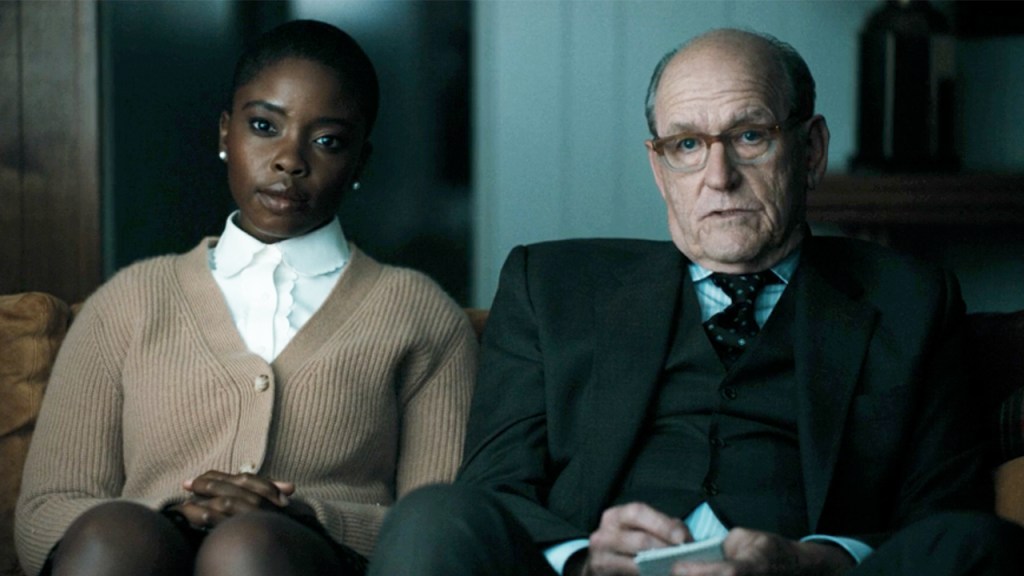
Indeed by the end of episode one, one of these three—Clark, Floyd or Carol—will be found dead in a public pool house. Enter detective Donoghue Homer (Richard Jenkins) and crimes officer Jodie Plumb (Joy Sunday). Two of a handful of genuine adults in the series, it’s their role—as much as it is ours—of sifting through what went down between all three characters, including their shady financial shenanigans and interactions with others on the DTF St. Louis app.
The series initially appears to raise more questions than it can believably answer: is a life insurance job at play? Is one of, or perhaps both Clark and Floyd gay? What can the industrious Carol stand to gain from the dynamic? What can the relevance of a crooked penis be in all this? Yet answers to these and many other questions are masterfully drip-fed to us as the series progresses, never losing our attention or curiosity thanks chiefly to the show’s stellar performances.
Bateman and Harbour are utterly engrossing as newfound friends venturing boyishly into uncharted sexual territory, their regressively childlike but enlightening rapport a joy to watch. Cardellini, meanwhile, “snags it” in her performance as the chameleonic and unknowable, but loving and desperate Carol—soft and nurturing in her care for her troubled son Richard (Arlan Ruf) but flirtatious or fanged where appropriate. The onscreen chemistry between all three, matched by that of Jenkins and Plumb who excel in a play on the good-cop/bad-cop dynamic, will be hard to beat.
But DTF St. Louis’ brilliantly stylised eccentricity also works to keep us gripped. Repetitive, quirky dialogue abounds keeps us guessing at the relevance of seemingly mundane language, while surrealist visual motifs (adults on swings, peddling idly along on recumbent bicycles or rehearsing umpiring techniques) are strangely addictive and truly ask: just how grown-up are the grown-ups? The overall effect is like watching three children play house and neighbours.
Most striking of all, however, is the show’s editing. Rather than moving in a linear trajectory, as is the format for conventional murder mysteries that might at most make use of flashbacks and flashforwards, DTF St. Louis unfolds in a heavily fragmented fashion. Scenes, small or large, are repeated time and time again, their meaning changing depending on whose side of the story we’re hearing. With each repeat, jumping back in time, the detectives (who hold one of our trio under questioning throughout most of the series), uncover more, and we slowly, rewardingly build a picture of what happened on that fateful night.
The show’s masterful remixing forces us to question what, exactly, is taking place on screen, compelling us to reconsider seemingly commonplace scenarios (two friends riding bikes, a wife meeting her husband’s friend). Indeed to watch DTF St. Louis is to watch a camera zooming out slowly from the centre of a Picasso painting, raising more and more questions in the process. The key to understanding both a complex work of art and a mysterious death lies less in putting two and two together than it does forgetting everything you know.
Hence the show’s unofficial motto, gleaned from a witness (the brilliant Peter Sarsgaard as gay guru of modern sexual dynamics, Christopher Spurce): “No one’s normal. It just looks that way from across the street.”
His words echo throughout the series, reappearing in unexpected places. They’re mused over especially by the more conservative detective Homer—who is dubious of, before being dismayed by the heights of complexity the lives of three suburban middle-agers might reach—but instantly understood by the younger “porn-positive” detective Plumb. For Homer, a motive is a motive. For Plumb, a motive merely looks like a motive.
Yet beyond “whodunnit,” DTF St. Louis is very much about male-male relations in an age where men increasingly lack a fixed social place in the home. In the show, as in life, the very concept of the male head of the household is collapsing. Clark’s role in the household begins and ends in his quality assurance testing of the family’s leisure equipment. Floyd, for his part, is no match for Carol’s grip on household affairs and overall decision-making. “No-way, Jose,” she quips often, batting off Floyd’s typically masculine, and therefore costly, displays of affection like baseballs, while her comical umpiring suit—concealing her breasts and transforming her torso from that of a woman’s to a grotesquely macho cliffedge—confirms her role as head of the household.
These are times of shifting gender roles, for which deeply regressive concepts like the manosphere and tradwife-ism are the exceptions that prove the rule. Yet where women and queer people alike are able to experiment with gender roles more freely, options have historically been scant for straight men. A man, simply put, is a man.
Men like Clark and Floyd have traditionally lacked both the means and the knowledge as to how or what alternative forms of masculinity might look like. But is the online world perhaps creating opportunities for men to experiment, for better or for worse?
Take DeYoung’s Friendship (2024). A first of its kind, like DTF St. Louis, it follows the ups and downs of a newly-formed friendship between the lonely, uncool Craig (Tim Robinson) and the uber-cool Austin (Paul Rudd)—who, like Clark, is also a weatherman. DeYoung’s film nimbly explores the ways in which male identities are increasingly being shaped by performative modes of masculinity popularised on social media, and is a timely look at masculinity in an age in which women find men, ever failing in the confines of their toxic manhood, simply “cringe.”
For Clark and Floyd, clearly unappealing to both themselves and their wives, their quest for manhood finds itself grounded in queer sexuality. Spurce’s words (“No one’s normal…”) are undoubtedly a play on the tagline for Sam Mendes’ midlife-crisis satire American Beauty (2000), “Look Closer.” It’s perhaps not a coincidence that Kevin Spacey’s protagonist Lester Burnham takes his queue for wanting to “look good naked again” from the uber-fit gay couple down the road of their suburban neighbourhood, just as gay men like Spurce in DTF St. Louis function as mentors or even resources for characters.
It’s for this reason that the show feels decidedly gay-coded. The location-based DTF St. Louis itself, like the growing number of such real-life straight equivalents, is a descendant of Grindr. No longer desirable to their wives, nor at the head of the figurative table, Clark and Floyd turn to the unfamiliar, but seemingly long-sought after submissive activities they engage in (pegging, cucking, rimming—activities common to the gay scene and often advertised on the profiles of apps like Grindr as encompassed under certain “tribes”). They do so less in the pursuit of simply spicing up their sex lives, but in the search for markers of a new identity.
The pair’s friendship itself—its softness, its openness, its kindness so uncommon among male relations—teeters on becoming all-out gay, and does so perhaps in the search for a socio-sexual framework to exist upon. They are adolescents once again, As their secret communication via ASL implies, theirs is an unprecedented friendship without road markings, without a language.
Presented with the opportunity to rebuild their identities in a society that increasingly rejects their manhood, Clark and Floyd—perhaps like many men today—find themselves suddenly at liberty to redefine what it means to be a man. Yet while queer dynamics might serve as blueprint for both to improve communication, exploration and self-discovery, how successfully such forays will sit with their wider responsibilities—their careers, their families—only time will tell. After all, we live in a world that refuses to zoom in, look closer, and see the bigger picture—often costing lives.


Leave a Reply