Though Oliver Hermanus’ love letter to early record making has its moments, it isn’t half the film it could have been
For most, music offers a relief from verbal communication. Played in the background at social events, it’s a substitute for talking, filling in the gaps between conversation. Through live performance, it does away with the need for chatter altogether. Yet for Lionel (Paul Mescal) and David (Josh O’Connor)—the two gifted musicians in Oliver Hermanus’ time-hopping The History of Sound, written by Ben Shattuck, whose work the film is based upon—music is a divine language.
For both, sound is the purest form of communication that exists, transcending spoken language to communicate things words alone can’t convey. Music is birdsong: Lionel meets David at a dark and crowded New England bar in 1917 when he hears the latter playing a tune on the piano, his soft voice singing a folk song familiar to his childhood that breaks through the rabble and din to communicate with him like physical touch, like a gentle brushing of unknown hands.
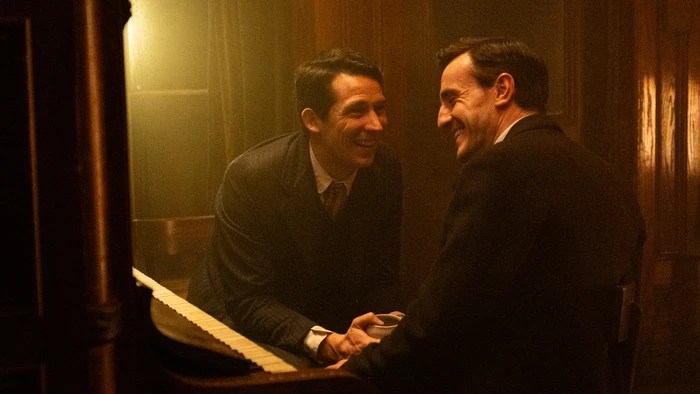
Lured across the bar, towards the piano, Lionel introduces himself; there’s the sense the pair are somehow already being acquainted, their grins suggesting a long-overdue reunion. Later that night, having gone back to Lionel’s, the pair fall for each other less through their words than through singing the songs from their youth, through the shared language of sound.

A quiet love affair begins, one afforded precious little time to develop, however, when David is drafted and forced to fight in World War One (a fate Lionel evades on account of his poor vision). Lionel takes a break from music and moves back home to Kentucky to help run the family farm, maintaining his relationship with David through letters. An escape presents itself when David informs Lionel of his return from the front: employed by Maine university, he intends to travel through America’s rural communities with the goal of finding and recording folk music on a set of wax cylinders—one of the earliest forms of sound recording technology.
Ever keen to avoid his family’s harsh agricultural existence, Lionel accepts David’s invite to join him and the pair begin their journey.
Through the first encounter with locals we witness, Hermanus gently impresses the historical significance of David and Lionel’s work—work we today take for granted but which The History seeks to reexamine. The scene takes place at night in a small rural home, where the flickering flame of a lantern softly illuminates the faces of the participants (a group of children and what is perhaps their mother). Grinning nervously at the strange contraption before them (the recording device), they directly recall the variously fearful, engrossed and incredulous faces of those depicted in Joseph Wright of Derby’s chiaroscuro-rich masterpiece, An Experiment on a Bird in the Air Pump (1768), one of several candle-lit works famous for capturing the burgeoning 18th-century industrial revolution.
Echoing the giddy trepidation that leaps Derby’s painting, the mother, asked to sing, nervously wonders if the device will hurt her. A far less imposing tutor than Derby’s scientist, Lionel kindly explains how the contraption works: as she sings down the device’s funnel, her voice will move a small needle at the funnel’s base, etching the vibrations of her voice onto the rotating wax cylinder below it. Reassured, she begins to sing, and the children join her in what feels like history in the making, the very birth of technological advancements that will alter the way music is shared and disseminated for the century to come.
Where the painting’s participants, guided by an impassioned natural philosopher, are assembled to learn more about the mechanisms of the painting’s titular air pump (whose purpose, among many, was to study the transmission of sound), those in the above scene are similarly gathered to witness history in the making—namely the birth of recording technology that will pave the way for a booming 20th-century music industry.

The scene is central to Hermanus’ discussion of sound, and where the film triumphs. As Lionel states, explaining the physics to the young folk singers, “The sound is invisible, right? But it can be physical.” Sound, in other words, is a language through which queer love can flourish, is an invisible yet physical plane of existence Lionel and David can quietly exist upon.
The invisible physics of acoustics mirror the hidden magnetism of the love David and Lionel share. Thus when David returns to work, putting an end to pair’s research, their stilted adieu in a train station waiting room is mediated through sound: David places the tips of Lionel’s fingers on his throat and hums a tune (the folk song of their first meeting), and the vibrations of vocal chords communicating the farewell early 20th-century society forbids them.
· · ·
But if sound can transmit beauty, it can also portend brutality. Just as David reaches the end of his crooning, the cold, industrial whistle of an approaching steam train is heard—a stark reminder of their impending separation.
Though subtle, this beautiful moment in the film hints at a broader tension between beauty and brutality that runs quietly through The History, between that which brings us together as humans (music, art, connection, love) versus that which wrenches us apart (war, societal oppression, harsh industrial labour).

It’s these latter forces that pull Lionel and a shell-shocked David apart. Soon after David’s return to work, Lionel mysteriously ceases to receive replies to Lionel’s letters and a chasm is erected between both. After brief sojourns in Rome and Oxford, Lionel returns to the family home before embarking on finding David’s whereabouts—now unknown to him—and with it the ghost of their love.
Lionel’s lonesome search for David and the memories of their shared past forms the central premise of The History. But far from being the poignant mediation on loneliness and longing Hermanus and Shattuck no doubt intended it to be, Lionel’s aimless odyssey takes the plot nowhere. In fact, very little happens in the film to compel us beyond Lionel and David’s work together visiting rural communities. Instead, a hollow sense of mourning reigns, which, though intended to drive home the sad beauty of Lionel’s condition drifting from place to place, relentlessly mines for a melancholy that simply isn’t there.
It’s possible it was assumed Mescal’s starry presence alone would fill the gaps. Indeed Mescal has become the poster child for a hugely popular sad-boy aesthetic he hasn’t escaped since his turn as Connell Waldron in the BBC adaptation of Normal People. His latest stint as William Shakespeare in Chloé Zhao’s saccharine Hamnet, overlapping with the UK release of The History, offers no exception to this archetype (note how the frenzy for Connell’s infamous neck chain of Normal People was matched by a mania for the tiny hoop earring Mescal donned in his turn as the Bard).
Yet by now Mescal’s predictably forlorn presence feels prepackaged, recycled from a portfolio of (barring several brilliant outings) increasingly interchangeable performances. What’s more, the casting of two actors with star power as huge as Mescal’s and O’Connor’s against a revolving cast of largely unknown actors playing locals feels jarring, a feeling made worse by the fact that both are so under-used in the film. It would have made far more sense to recruit a lesser-known but up-and-coming (and gay?) actor in the lead role of Lionel, thus bridging the gap between unknown faces and the star that is O’Connor—whose celebrity alone would have added sufficient gravitas to the film.
Hermanus and Shattuck had scope to be far more imaginative than they were with this film, and in ways that were ripe for the picking. Their biggest charge is in neglecting to develop the film’s tension between beauty and brutality, which very much remains a hint. Sound and technology, heavily present in the film, serve as fascinating sites for exploring our rather promethean proclivity towards destruction over creation. It seems a wasted opportunity not to contrast the inherent beauty of what we can create as humans (wax recording devices, records and gramophones) with the creation of some of the most most violent and aurally disturbing forms of technology (the machine guns, mortars, fighter planes and grenades of WWI).
This could have easily been achieved through insights into David’s life during and after the war, something Hermanus denies us. I yearned for shots of David feeling the vibrations of exploding shells, sounds felt from the trenches and perhaps edited through a low-pass filter to amplify their reverberant dread. Later, memories of such wartime trauma—experienced after his time as a soldier, wherever that may be—would have segued seamlessly into scenes depicting Lionel choir singing in Rome or Oxford, or blended into music emitted through the horn of a record player.
Doing so would have raised deeper questions about what it is we create as humans, while emphasising the David and Lionel’s bifurcated, separate lives: the one, stuck on a PTSD doom-loop of reliving the war; the other, exploring Europe’s quaintest corners yearning to relive his first love.
It also seems a shame not to have seen more of the brilliant Chris Cooper as Lionel’s older self (even if his arrival at the film’s conclusion, which takes us to the 1980s to meet Lionel, is a treat). Flash-forwards into his life, beginning later in the film and revealing little, would have neatly accompanied snapshots into David’s war-afflicted life following his separation from David. Weaving the lives of David and older Lionel around Lionel’s younger self—all of whom are bound together by the history of sound—would have granted Hermanus rich and layered ways of expounding The History’s central themes, while enabling the film to live up to its very name.
Stylistically, despite its period-faithful and atmospheric mise-en-scène, The History fails to invent where other recent similar works flourish. Take Luca Guadagnino’s underrated and beautifully haunting romance Queer (2024), which through psychedelic and surrealist visuals brilliantly captures the tortured mind of an opium addict in love with a younger man. Tragicomic and often mesmerising, the 1950s-set Queer expertly captures the inner turmoil of a lonely, tortured soul without resorting to meandering melancholy.

Equally inventive—and something of a would-be sister film to The History—is Netflix’s poignant and visually striking Train Dreams. Directed by Clint Bentley and based on Denis Johnson’s 2011 novella of the same name, the film takes place in deep rural America and is set in a similar period of American history to that of The History. Most striking of all is Adolpho Veloso’s gorgeously vintage cinematography, which, framed in a 3:2 aspect ratio, lends the film the quality of being a literal historical artefact not unlike the very wax cylinders used by Lionel and David. Grappling with themes of loneliness, loss, history and time itself, Train Dreams collapses the boundaries between memory, dream, in doing so adding a strong psychological component found lacking in The History.
As a measure of imagination, films like Queer and Train Dreams demonstrate the imaginative heights The History ought to have experimented with. Hermanus’ sixth feature is, ultimately, a lesson in the perils of relying on the forlorn faces of today’s handsome it-boys to do the work—something I find especially frustrating given that many of the right ingredients were there to begin with.


Leave a Reply