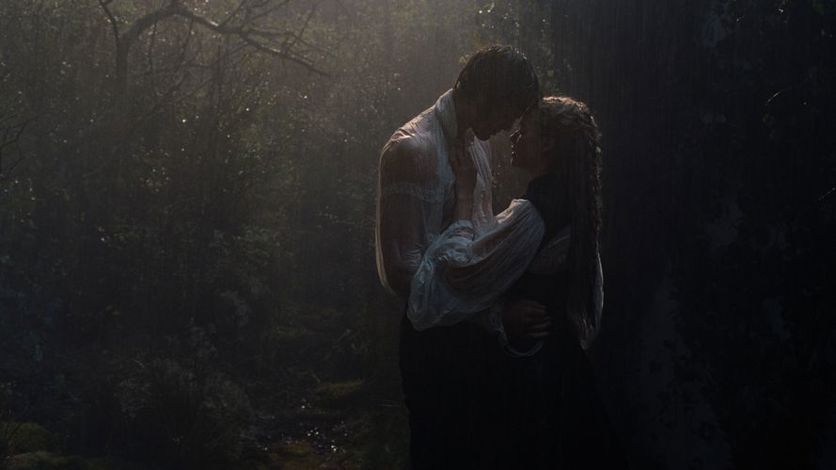
It’s not that Emerald Fennell has tried and failed to adapt Brontë’s novel. It’s that in today’s cultural climate, she didn’t have to try
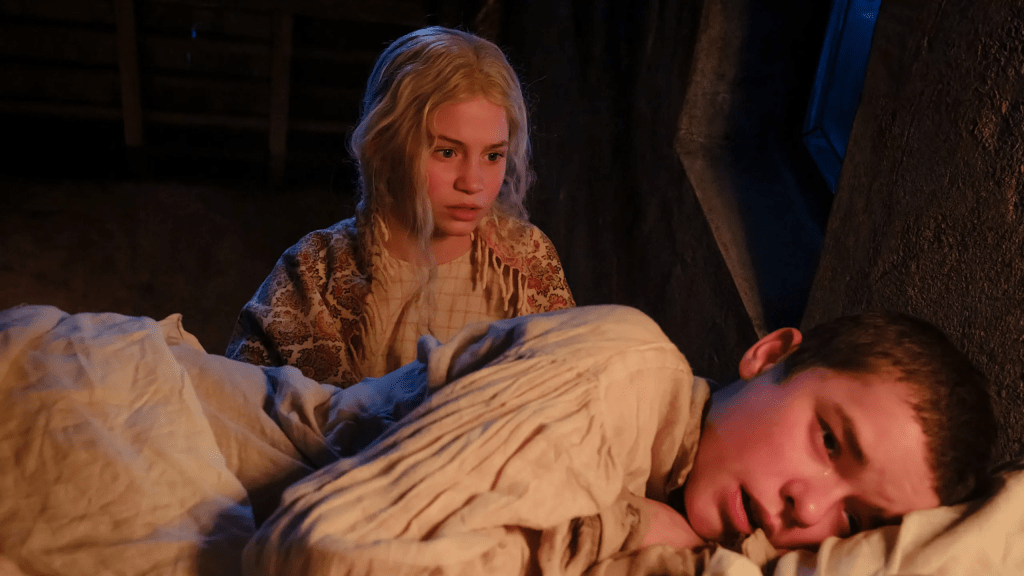
Doomed from the start though Emerald Fennell’s Wuthering Heights was, ironically it’s the film’s beginning that is its strongest and most energetic. We meet a rambunctious young Catherine Earnshaw (Charlotte Mellington), who, with her electric blue eyes and near-peroxide blond locks, enchants the feral young Heathclff (Adolescence’s Owen Cooper) from the moment he’s brought home by her impulsive drunkard of a father (Martin Clunes at his absolute best). Heathcliff quickly becomes her plaything and partner in crime, and an unshakeable love forms between the pair.
Mellington and Cooper shine in their young roles, making the sudden leap forward to join the now 35-year-old Margot Robbie in the role of what is a capricious young teenage Cathy feel all the more off. Though demonstrably game, Robbie is simply far too mature for the role and because of this fails to disappear into Cathy—a big problem for such a tricksy and frictious character. The decision to cast Robbie might have made sense had Fennell chosen to cover the later years over her life (the book spans generations while Fennell adapts roughly half of the novel). Yet this isn’t the case, and Cathy’s fluctuations between mild-mannered and violently feral in her treatment of Heathcliff—whether out on the Moors, in the rain-soaked grounds of the Heights or stowed away in his poky attic—feel jarring, clumsy and oddly panto.
While Robbie visibly strains to don the look of a precocious young brat, Elordi, at 28, equally tests the boundaries of acceptable age limits. But Australia’s leading man and first-time Oscar nominee could get away with murder. He has much fun with his did-you-think-it-would-stop-meh Yorkshire drawl and continues to command attention as the chameleonic tower with eyes-that-could-melt-steel that he is. And he does, to a degree, inhabit Heathcliff. Yet without the yin to his yang—a worthy Cathy to our Heathcliff—he ultimately lacks substance, a genuine purpose in the film.
Naturally, when the rich and enticing Edgar Linton (Shazad Latif) and his sister Isabella (Alison Oliver) move into the neighbouring Thrushcross Grange, and Cathy is pushed into a state of bratty coquettishness (again, incongruous and awkward on Robbie) at the prospect of being courted by the former, the resulting love triangle fails to convince. Admittedly, when Edgar’s proposal arrives at the worst possible moment for Cathy (just as her love for Heathcliff becomes too much to suppress), Robbie has her moment as Cathy caught in the Sophie’s Choice-torment of either accepting Edgar’s propitious proposal and the life of security it entails versus acting on her love for the low-born Heathcliff. For a brief moment, it seems like things might look up.
More fool me. Burned by Cathy’s decision to accept Linton’s proposal, Heathcliff upsticks and leaves with no word, only to return years later in possession of a mysterious wealth and now the proprietor of Wuthering Heights. With Cathy married to Linton and, along with servant Nelly (Hong Chau), residing at his opulent home, a suited and booted Heathcliff courts Linton’s oddball sister Isabella in a bid to avenge her treatment of him.
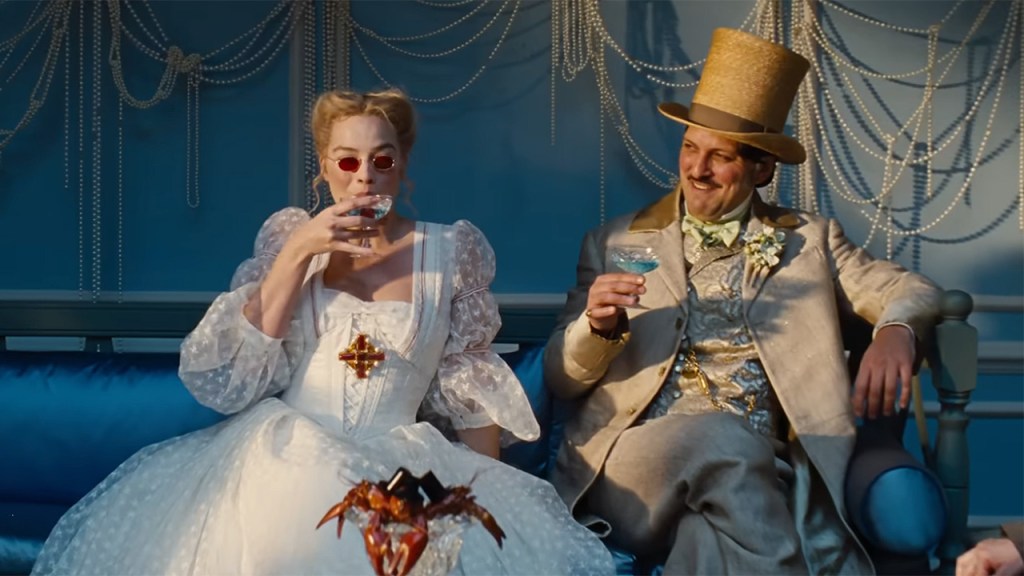
A trite and tedious pseudo-BDSM dynamic ensues between the trio, presumably intended to capture the self-destructive passion at the heart of their love but which ends up soiling it. Worse still is Fennell’s backdrop to the drama—a hyperstylised costume and set design used from Cathy’s arrival at Linton’s home onwards for the remainder of the film.
We first glimpse this in the design of the titular Earnshaw home itself: an inappropriately grimy locale whose overegged Mordorian misery fails to merge the natural but harsh beauty of the Yorkshire Moors—a landscape the film is duty-bound to capture but which it strangely never fully exploits. But nothing can prepare us for Thrushcross Grange, a setting that wholly eclipses the Heights (and whose name really ought to have been the title of Fennell’s adaptation). This is hardly a surprise given that aristocratic, old-money settings are evidently where Fennell is most at home—a background she herself comes from and which she quietly indulged in through 2023’s Saltburn with the thin pretence of satirising.
No such pretences are made here, and Fennell leverages Thrushcross Grange as a blank canvas to paint her wildest and most indulgent fantasies: from leather walls to blood-red floors, from Alice in Wonderland gardens to perversely abundant banquets boasting giant strawberries and fish-ensconcing jelly, anything goes. It’s a fever-dream aesthetic matched only by the latex bubble dresses and garish statement bling worn by Robbie (who is now emphatically not Cathy but a model for Fennell’s vision) that each and every scene, from the moment she arrives at the Grange, operates to spotlight.
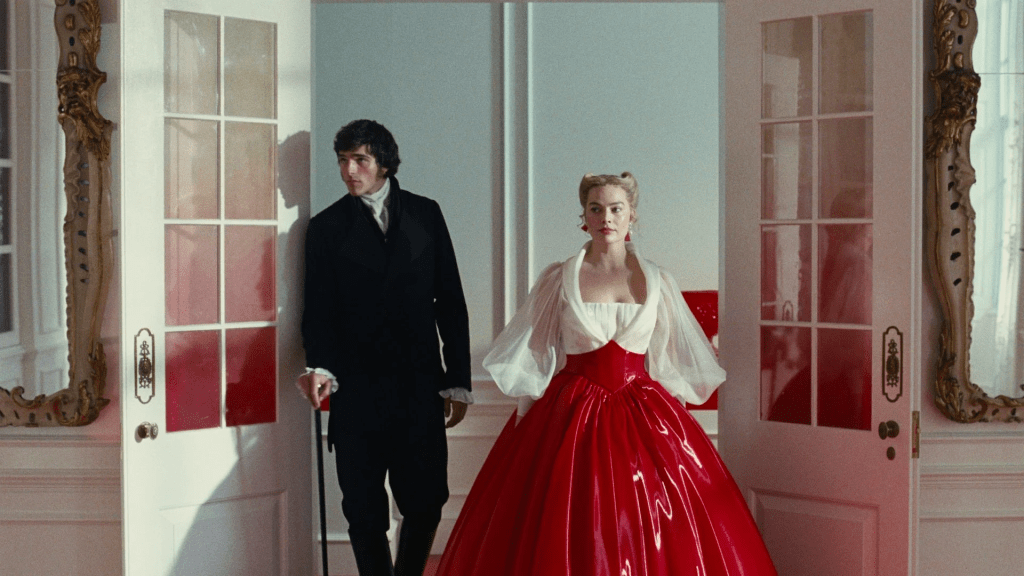
Yet neither costume nor set design can be a substitute for artistic depth and subversion, just as horny food-fingering and gratuitous BDSM dress-up can be a vehicle for storytelling. The end result is what feels like an insufferable fashion exhibition, one that maybe began as a critique of Linton’s wealth—and which is, for about ten minutes, easy on the eye—but which inevitably gave way to an indulgent frenzy of creative excess such wealth permits.
But was this an unconscious mistake on Fennell’s part? Of course not.
Cementing her name as the purveyor of noncommittal and vibey films that make no promises, Fennell is rather shrewdly capitalising on the mechanics of social media platforms and AI software to reach younger audiences. We’re becoming increasingly accustomed to short-form and disparate online content. AI has normalised the fever-dream aesthetic—making it less Dalian-surreal and more an everyday nightmarish slop. Wuthering Heights, reflecting this, trades in complexity and nuance for a disjointed mishmash of incoherent but easily digestible videobytes.
Yet not only has Fennell adopted the processes of platforms like Instagram and TikTok, but the viral Zeitgeists they have popularised. Think of those aimed at women that legitimise, whether rightly or wrongly, an unapologetic solipsism: main-character energy, princess treatment, it-girls and divas, and of course the brat-girl-summer aesthetic popularised by Charli XCX in 2024—the no-fucks breakout star that just so happens to have co-produced the (inevitably brilliant) soundtrack to this film. Wuthering Heights, appropriating the energy of these trends, is a project inspired by mood and feeling rather than creative integrity and craft—things that have traditionally been the reserve of only men. It’s a middle-finger to the rule book, dressed up, like some of the above trends, in a pop-feminist (or indeed anti-feminist) sense of freedom.
To top it all off, these are liberatingly post-woke times. Five years ago, we’d have balked at Fennell’s extremely nepotistic and affluent beginnings and her blatant whitewashing of a book explicitly concerned with race and class. But following the failures of hashtag-progressivism and the reelection of an emboldened tech-cosy Donald Trump, the digital landscape is far less accusatory as it once was. Indeed the ultra-rich are freer than ever to flaunt their masses of wealth online, knowing that the hashtag parade can pounce on them all they like—it won’t work.
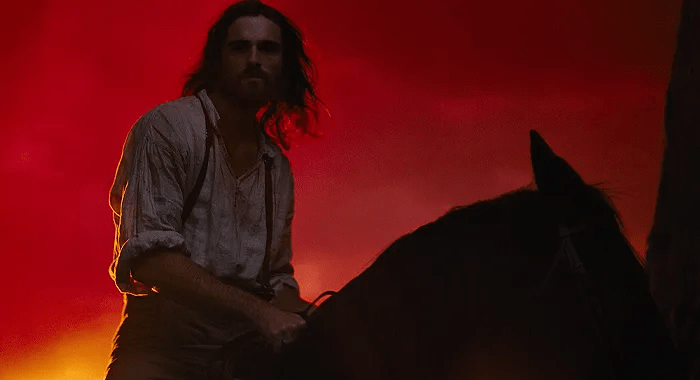
It’s for this reason that much of Fennell’s adaptation feels like swiping through an Instagram carousel of images—all seemingly AI-doctored—advertising an exclusive Wuthering Heights-themed manor party hosted by a home-county socialite. And in many ways, it is. Educated at the extremely elite Marlborough College, and from there Oxford, the rah-rah Emerald Fennell grew up rubbing shoulders with England’s creme in the Champagne-popping elite dos the glossies once jostled to have adorn their pages.
In Fennell’s world, filmmaking is an elongated dress-up party with a budget to boot and a “bad taste” dress code. Why not cast a then 34-year-old lead in the role of an adolescent girl, one half of a duo hailing from that well-known part of Yorkshire, Australia? Why not dip into BDSM larks and pretend we’re saying something edgy? Why not embellish death by childbirth to the point that it resembles a sexy Grok-made ad for bed linen? And why not have a conventionally handsome white man in the role of a character whose dark skin is central to the book’s racial critique? So long as it slays!
Fennell’s Wuthering Heights throws Brontë’s story—well, the half she adapts—in the blender, loads it with sugar syrup and serves up a conventionally palatable tragi-romance that goes down like strawberry milkshake. It’s not that anyone “can’t” adapt so large and complex a novel, as Fennell claims; it’s that she knows she didn’t have to and probably couldn’t be arsed to anyway.
In times when truth and meaning are fragile, subjective and scarce, we need complexity and nuance more than ever. Fennell’s adaptation of Wuthering Heights only adds to this problem, and is an eerie sign of just how far the desire for anti-intellectual, AI-coded material has reached. Perhaps the most radical thing we can do with Brontë’s only published novel is, ironically, to translate it as faithfully as possible, to embrace its themes of race, class and gender as part of an authentic, gnarly, beautiful story.
 Home
Home 
Leave a comment