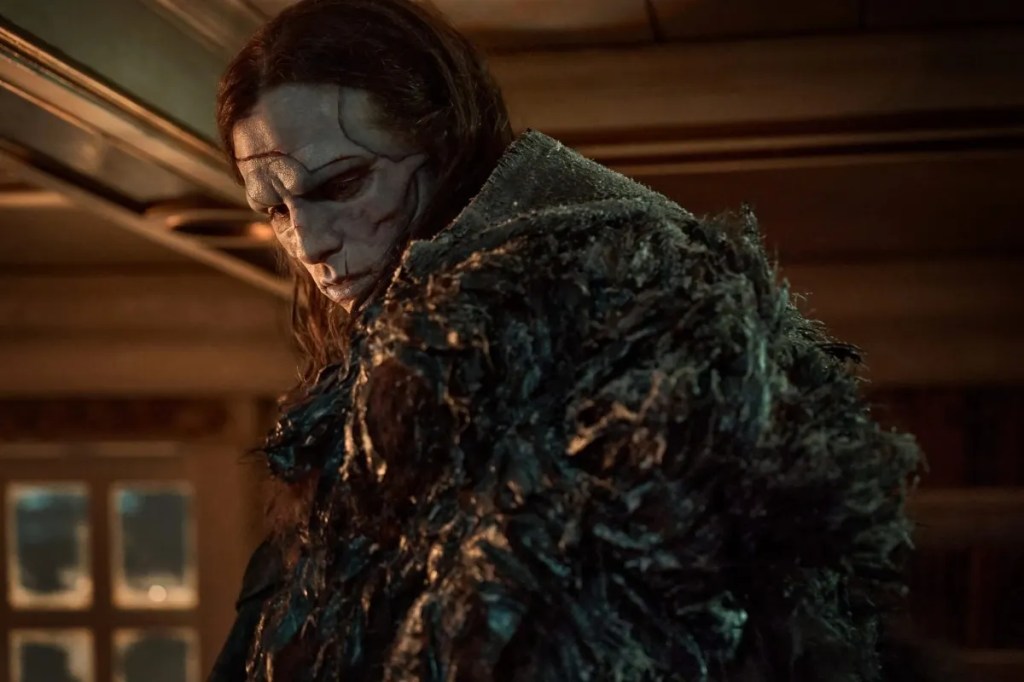
Though Jacob Elordi is magnificent as Shelley’s foe, Del Toro’s avoidance of grappling with modern technological ills is felt
’Tis the season to dwell on humanity’s fragile place in the world, and coming hot off the heels of Bigelow’s much fussed-about A House of Dynamite is monster-mad director Guillermo del Toro’s Netflix-produced Frankenstein, based on the 1818 novel of the same name. Big names, big questions, an existential trend started in earnest, perhaps, by Christopher Nolan’s 2023 Oppenheimer — based on the non-fictional biography titled American Prometheus.
Yet to make a film about Mary Shelley’s rather untranslatable 1818 classic — subtitled The Modern Prometheus — is to return to ground zero, the beginning of our fascination with the legendary titan who stole fire from the gods and bestowed it to humankind only to be sentenced to a life of torture as a result. The book’s timeless moral — cautioning against the dehumanising potential of human creation has — only come to fulfill itself time and time again, not least in our AI-plagued times. Yet Del Toro’s rather tame Monster (played by a committed Jacob Elordi) is a wasted opportunity to spotlight today’s technological and financial horrors.
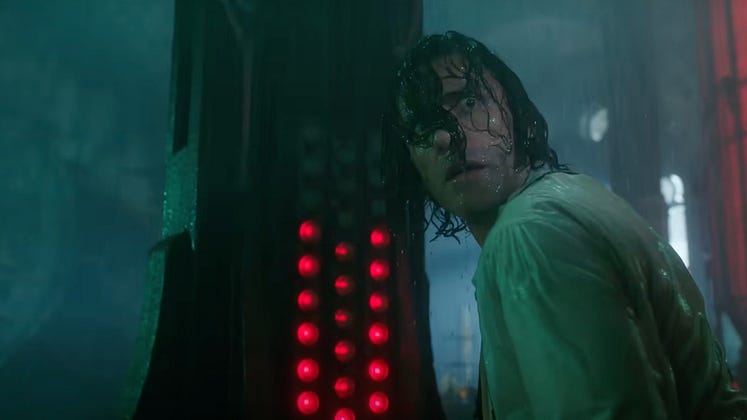
Creator/creation and parent/child are interlinking dichotomies at the heart of the original novel, themselves closely analogous with the themes of life and death, creation and destruction — themes Shelley’s novel cleverly blurs. Del Toro goes to great lengths to emphasise this, presenting the Monster’s very creation as though a birth: when scientist Victor Frankenstein (Oscar Isaac) torches his remote tower in a rage at his creation’s apparent lack of intelligence, the Monster breaks free from his shackles and escapes the tower’s watery undercroft (a womb) by sliding down the building’s drainage conduit (a birth canal).
Progeny, viewed in the highly patriarchal context of 19th-century Europe, is a ceaseless, toxic continuation of suffering — something Del Toro, like scholars, have drawn from Shelley’s own life. Frankenstein the novel contains light autobiographical elements, chief among them being the death of Shelley’s mother — legendary feminist writer Mary Wollstonecraft — 11 days after her own birth. Del Toro draws from this experience to embellish the life of young Victor (played by Christian Convery), editing plot elements to emphasise the novel’s patriarchal critique: though in the novel Victor’s mother dies of scarlet fever, Del Toro has Baroness Frankenstein (played by Mia Goth in one of two thematically linked roles in the film) die of childbirth to Victor’s younger brother, William (Felix Kammerer), foretold in the blood-red scarlet gown she dons during her short time in the film’s first part.
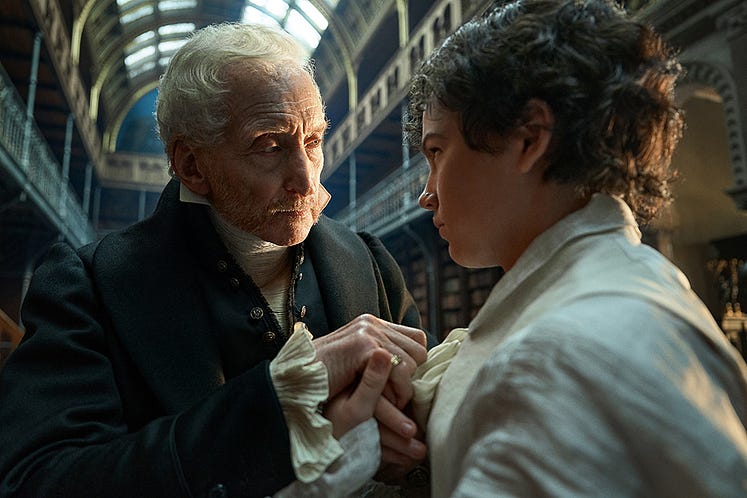
Moreover, the novel’s relatively stable father-son rapport is replaced with an exaggerated rendition of Shelley’s relationship with her own dogmatic father, so that Baron Leopold Frankenstein (played by a chilling Charles Dance) is a physically abusive tyrant. In the film, Victor restages this dynamic as a “father” to his own child by beating his seemingly dumb Monster with a rod in the same way his father caned him if he failed to answer his academic grillings as a child.
This explicit doubling of the father/son relationship places a legacy of destructive male ambition as the driving force of Del Toro’s adaptation — aligning it with a glut of recent films to explore flavour-of-the-month toxic masculinity. By doing so, Del Toro builds on gender commentary already baked into his source material. Shelley critiques the gendered dynamics of 19th-century industrialisation and exploration by positioning human “progress” as a masculine domain, and Nature as a feminised force to be subdued and exploited in the name of advancement. Hence the remarkably sexualised analogy Shelley uses to describe her protagonist’s thirst for knowledge — Victor’s “fervent longing to penetrate the secrets of nature.”
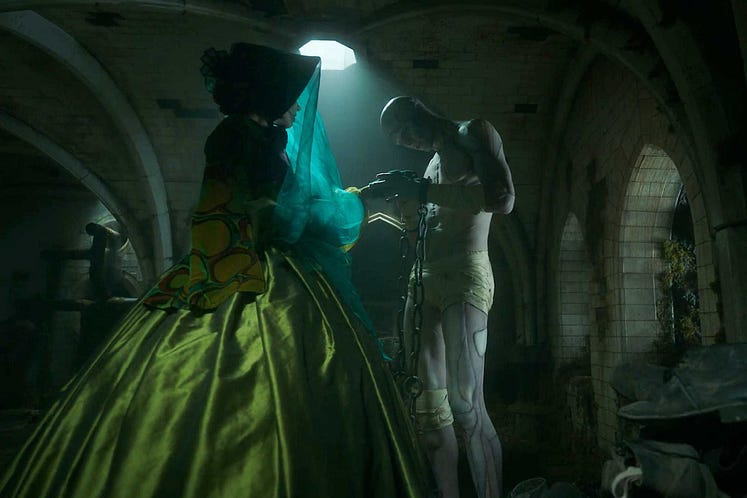
Writing Shelley into his film, Del Toro has nature-lover Elizabeth (Goth in her second role in the film) serve as Victor’s counterpart. A lover of nature and collector of insects, Elizabeth is concerned with addressing real-life troubles of the world over needless, chauvinistic enterprise, and so rebukes Victor’s plans in a short but sharp speech (even if, rather confusingly, she later develops an interest in them and the pair grow closer) and later forms an unlikely, queer-adjacent bond with his creation.
Colour in the film brilliantly illustrates this nature/man divide — despite Netflix’s customary steamrolling effect that altogether obliterates the gothy darkness Del Toro no doubt aims for (and which Robert Eggers’ Nosferatu of this year excelled at). The retroflective, vibrant green of Elizabeth’s crinoline — which, wearing it often, she becomes indistinguishable from — is the symbolic antithesis to the ruinous red of mankind found in the crimson dress Victor’s mother wears early in the film before her death by childbirth (that is, quite literally, man-made death). A colour synonymous with violence and death (as well as passion, ambition), red crops up again and again in relation to Victor and his unstoppable drive for success. Take the bright red gloves he dons as a toiling scientist — sheathing his destructive hands — or the giant electricity generators required to galvanise his Monster which, when used, light up in a fiery, foreboding red; it appears most obviously when, in a strangely homoerotic scene, Victor awakes to see his creation emerge at the foot of his bed, his red gloves matching the bright, silky red blanket that covers his near-nude body.
Man/men beget death even in creation. Is not birth, a bloody affair, itself often an intimate dance with death? Indeed, if necessity is the mother of invention, then patriarchal ambition is the father of destruction. Concerns around mothers and fathers — and specifically the sins of the latter, the very masculine drive towards this thing we called “progress” — are therefore at the core of Del Toro’s adaptation.
Our technologically monstrous age would have Shelley turning in her grave. The latest leaps in artificial intelligence — invariably funded and created by men — bring to the fore some of mankind’s toughest ethical quandaries, ominously blurring the lines between binaries like “God” vs man, natural vs unnatural, and sentience vs non-sentience. And this, of course, is to say nothing of AI’s potential to unleash all kinds of havoc upon the human race, nor the gargantuan drain on natural resources the technology requires in order to function.
It’s perhaps fitting that the horrid, legless prototype Victor showcases to the Edinburgh medical courts prior to being resembles — and even in movement sounds like — a humanoid robot in the early stages of creation, one not unlike the kind Big Tech seeks to usher into creation (being?) and perhaps one day will. Diverging from the novel, Del Toro’s Victor builds his creation from the bodies of fallen soldiers and hanged convicts — and therefore is, like the language-learning models (or LLMs) that enable AI to function as it does today, a product of theft, destruction and suffering. And in a nod to contemporary debates around the self-learning capabilities of artificial intelligence, upon the creature’s completion, a dismayed William asks his brother, “Is it intelligent?”
Such aspects of the film, set up in Part One, naturally position the Monster’s eventual creation as an analogy for contemporary developments in artificial intelligence (which Del Toro is outspokenly against), much in the same way Shelley’s creation spoke to the perils of untrammelled technological and scientific development in the hands of hubristic man in her time.
However, Del Toro’s ardent love for the misunderstood monsters of his films — those featured in Blade II (2002), Hellboy (2004) and The Shape of Water (2017) for instance — complicates this.
Artificial intelligence, as we know, poses a plethora of societal harms to both the human race and the planet. A staunch sympathiser of society’s outcasts, Del Toro cannot yield to this reality and have his Monster associated with such ugliness. Associations with AI aside, Del Toro tames the Monster’s more nefarious qualities — despite the fact that Shelley’s beast, once vengefully aware of his outsider status as a “monster,” demonstrates no shortage of evil by ruthlessly murdering innocent characters. Containing its malice to episodes of beastly, you-made-me-do-it slayings of wolves and insignificant characters, Del Toro exorcises the Monster’s darker side through (highly gratuitous) bloodshed so as to counterintuitively preserve the “true” innocence Del Toro would have us believe defines him. Herein lies the motivation for casting doe-eyed Elordi for the role of the beast: graceful, agile and brilliantly Adamic, Elordi seamlessly captures the exact brand of innocence Del Toro seeks to draw from Shelley’s Monster.
So where does this leave Victor’s creation if it is not to represent, as we thought it would, the perils of modern tech?
From Part Two onward, Frankenstein veers from a tech-critical commentary to embrace a gender-queer angling of Victor’s creation, asking less whether humanoids dream of electric sleep and more about human otherness. We see this as the creature matures and learns of his outsider status in the world by hiding in the disused mill of a farmstead, as per Shelley’s novel. Observing their lives, he grows increasingly aware that this is a world that doesn’t belong to him in a way a gender-queer person might (indeed the Monster’s homelessness parallels the homelessness transgender people experience today). And there’s a certain drag-like quality to the Monster’s styling that emphasises this gender-queer outsiderness — not least in the shaggy, “undone” hair of today’s style and the ragged undercoat he dons that billows skirt-like beneath the shabby-chic animal skins that adorn his shoulder.

While inevitably Elordi does justice to the Monster’s queering, the film’s abandonment of the technological angle set up prior is sorely felt. Ripe-for-the picking tricks were missed by not embracing the Monster’s darker side as a site for exploring the dangers of AI.
Waltz’s role, for instance, as financial backer Harlander is woefully underused (a fact of his being collateral to the film’s change in direction). Yet who better to capture the insidious greed of late capitalism — the earlier stages of which were thriving in mid-19th century Britain — than the seasoned actor? The disarming, cheeky brand of malice the Waltz often embodies — the type he brought to Tarantino’s Inglorious Basterds (2008) as Standartenführer Hans Landa — would have perfectly suited a more doggedly avaricious villain of Dickens’ England recognisable in today’s techlords of Silicon Valley.
Allow me to indulge in an alternative plot direction.
In his capacity as a more overtly villainous antagonist, Harlander is revealed to be an evil counterpoint to the innate goodness of his nature-loving niece, Elizabeth — intensifying Victor’s (rather tepid) ethical dilemma while adding animus to Elizabeth’s inert presence in the film. Escaping Victor’s tower and, having sojourned at the farmstead and learnt of his outsider status, the Monster falls prey to Harlander’s lure and becomes his dangerous pet weapon in his thirst for power — the investor’s endgame all along.
A nod to James Whales’ 1931 adaptation — famous for popularising the enduring trope of “pitchfork-wielding villagers” commonly associated with Shelley’s maligned Monster — was ripe for the picking here. Stay with me. Echoing the tactics of deception and rabble-rousing deployed by populist leaders and their acolytes today, Harlander exploits the Monster’s outsider status as a fear-provoking scapegoat in similar ways AI-created content — rapidly disseminated via controversy-hungry algorithms and deepfake media — have helped stoke riots in recent years across the West. Elizabeth, in seeking to liberate the Monster or beseech its creator, a now disgraced Victor, to help mitigate the damage, is a tragic victim to the unrest.
Spurred on by this loss, the Monster learns of his master’s ploy and eliminates Harlander, only to set eyes on his maker — mimicking how AI-enabled devices have been known to destroy their “creator” (a ramification that makes Shelley’s foresight all the more astounding). This would neatly bring us back to the Arctic, following Shelley’s narrative format while updating the novel’s core thematics to suit today’s technological-ethical climate.
Of course, I’m no screenwriter, and it’s easy for me to conjecture this and think that. And true, not all films concerned with the perils of man and his use of technology need serve as an analogy for the techno-financial evils of today. But to adapt a novel that is so synonymous with man’s insatiable thirst for innovation and not, in some way, allude to artificial intelligence is a crying shame, especially given Del Toro’s over-my-dead-body stance towards the technology. Besides, such a plot direction would help contextualise the film’s disembodied central theme of toxic male ambition by chiming with the patriarchal dynamics at the heart of Silicon Valley — an overwhelmingly male-dominated, nepotistic and ethically bankrupt institution.
Frankenstein is an enjoyable feat in visual storytelling, bolstered by captivating performances from Isaac, Goth and Elordi—and the latter’s nuanced, lithe performance breathes life to Shelley’s Monster, adding unprecedented depth to the famed foe by disappearing into the psychology of a life cast to the lonely recesses of society’s periphery. If only his talents were used for more consistent ends. Just when Del Toro hints at a fresh take of his source material in a way that might resonate with our uncanny age, he retreats to the safety of his own hackneyed style in a way that leaves us short-changed.
 Home
Home 
Leave a comment