
Trying to be something more than it is, familiar-feeling “conclusion” to The Conjuring saga dials up the emotions but leaves a lot to be desired
I have a soft spot for The Conjuring films —or more specifically, the first two of the James Wan-directed horrors to delve into the case files of real-life paranormal investigators Ed and Lorraine Warren. Sure, they deal in cliches, bottled up into pantomime depictions of the past. Sure, they’re derivative, dredging up and exploiting the front-page quackery of the mid-twentieth century craze for the pseudo-paranormal in a way that is perhaps problematic. And sure, they’ve spawned a series of frustratingly unimaginative, execrable spin-offs — the most notable being Annabelle — that continue to mire Wan’s original 2013 film.
Yet the core Conjuring movies (bar its paltry, admittedly more experimental third) are made with a campy self-awareness that sets them apart from other horror franchises. Like Wes Craven’s Scream saga (beginning 1996), The Conjuring brand is unapologetically tongue-in-cheek yet gleefully frightening, offering up the cinematic equivalent of your nearest fairground’s haunted house attraction — an uncanny experience that has us suspended somewhere between uncontrollable laughter, scepticism and abject fear.
Above all, The Conjuring wasn’t afraid to have good some old-fashioned fun, winning us over with chemistry-rich relationships steered by unusually strong casts — the backbone of which, of course, are Vera Farmiga and Patrick Wilson as the Warrens. The Conjuring is to the horror genre what the Mission Impossible series is to the action-thriller world: undeniably fun, predictable and reliably familiar-feeling productions done well.
But beyond its status as a mere blockbuster, 2013’s The Conjuring spoke to our appetite for something new. Contemporary “haunted house” successes Paranormal Activity (2007) and The Strangers (2008) were already hinting at this, both of which — even if not wholly successful productions — marked a welcome split from the gratuitous gore of (the often eroticised) slasher films that dominated the 2000s to focus attention instead on the home. In post 9/11 America, the object of our collective fear had evolved from the knife-wielding male relative/partner to an unspecified force threatening the family life, something mainstream horror was slow to pick up on.
Cue the financial crisis of 2008, a phenomenon that would turbocharge anxieties surrounding the home and ultimately baptise it as the theatre of our fears.
Thus, riffing off contemporary anxieties surrounding our worst nightmare— the violation and eventual destruction of the nuclear family — Wan took the psychological horror of both Paranormal Activity and The Strangers and did something clever: douse it with a morish melodrama, played out in a camp, victoriana mid-century setting (an aesthetic Wan flirted with in his more cerebral haunted-house horror, 2011’s Insidious). By doing so, Wan dislocated a communal nightmare from an all too familiar present and ensconced it in a cosily distant past viewers could safely enjoy from afar. It was a cathartic release worthy of the surreal-feeling, indescribable horrors of the recession (the case families included in the franchise are working class).
The Conjuring promised to be the first of a franchise whose very purpose was to be — every few years or so — the purveyor of well-crafted, cosy old-school chills and thrills we expect from a summer blockbuster that on some level tap into the hysteria of our unstable, volatile present. Its sequel, Wan’s 2016 The Conjuring 2: The Enfield Case, followed through on this, keeping things fresh with a change in location from the US to London, England (where the Warrens met with the real-life Hodgson family, infamously besieged by the “Enfield poltergeist”).
Yet as the franchise’s wayward third installment proved — Michael Chaves’ The Conjuring: The Devil Made Me Do It, which altogether shrugged off the haunted-house set-up in an unnecessary bid to keep things even fresher — Wan’s original recipe would prove one worth following strictly.
Indeed, Wan’s 2013 brainchild established a brand identity so rigid that any subsequent installment that strayed from the cosy, fixed locus of the family home was doomed to fail. This Chaves has taken quite literally in his “final” addition to the Conjuring core franchise, The Conjuring: Last Rites — a fourquel that reverts back to the safe shores of Wan’s original haunted-house formula in an attempt to undo the failures of its predecessor. But even as it does, as we’ll see, all the elements of which made The Conjuring so successful — its morish, thrilling spooks — feel bottled up, forced through begrudgingly with all the willingness of a chastised child.
In many ways, it’s understandable why Chaves would want to mix things up — not simply for the fact that he and Wan are two separate creators with separate visions. In a cinematic climate of endless repetition, any director worth their salt is wont to break the mould.
But it’s the winning formula of the first and second installments that keeps people coming back for more (and the reason why Last Rites was one of this summer’s most profitable blockbusters). There’s a satisfying repetitive quality audiences expect to enjoy in a Conjuring film, one that is ultimately inevitable due to the fact that each addition hones in on a particular case, the resolution of which naturally follows a strict manifestation-diagnosis-intervention pattern. (Regardless, you don’t stand in line for your favourite roller coaster expecting it to take you somewhere new).
Tightly bound up with this formula are certain successful creative elements which, established in the first movie, have become synonymous with The Conjuring brand — elements we know, love and enjoy seeing with release of each installment. Take the franchise’s famed title crawl, in which the lockup of each film rolls up slowly from the bottom of the screen in a nod to the vintage film-making aesthetic central to the saga — customarily accompanied the mounting, nerve-rattling crescendos of Joseph Bishara’s brassy scores). Or take the films’ inventive, mostly well-crafted jump-scare sequences, the anticipation of which keeps us guessing at how everyday objects — from vintage curios to TV sets — might later be used to terrify unknowing victims; indeed, if the The Conjuring universe has proved anything its that any old household knickknack can be used as a titillating Chekhovian gun, patiently waiting to serve its end.
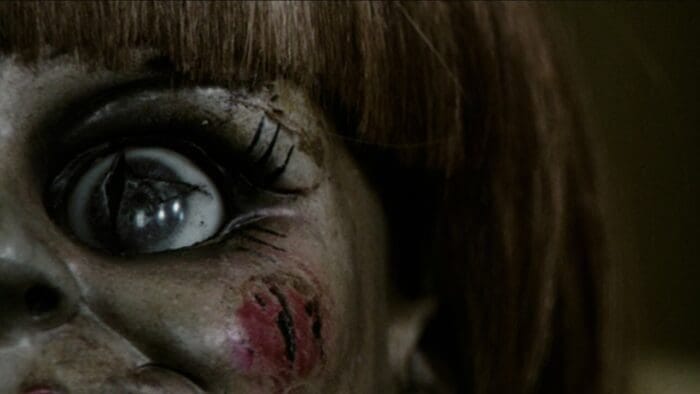
Crucially, each feature treats us to the bold, propulsive cold-opens Wan had down to a tee. These are barnstorming, throw-you-in-at-the-deep-end intros that do away with subtleties — fun, Hammer-House flashbacks that slip us squarely in The Conjuring world. Not for nothing, however, they typically depict the Warrens wrapping up a past case that may or may not, somehow, come back to bite them in the ass; in 2013’s intro, Ed and Lorraine visit the owners of demon-doll and eventual spin-off fodder Annabelle, who, it’s implied, continues to haunt the Warrens despite the fact that she’s stowed away — “safely” — in their room of haunted artefacts.
Last Rites’s cold open proves no exception — and suggests a strong start. In it, we flashback to join the younger Warrens in 1962 (here played by Orion Smith and Madison Lawlor) as they meet with the granddaughter of an antiques dealer who killed himself by hanging at the behest of a demon-harbouring mirror — a large vintage curio adorned with the faces of three putti along its top panel. Since then, the dealer’s granddaughter is left looking over her shoulder, ever haunted by the image of her grandfather’s body and — somehow — by the mirror itself, hence her need for professional help.
When a heavily pregnant Lorraine touches the mirror — thus gauging through her powers what, exactly, lies beneath the object’s surface — it cracks, causing her to go into labour and, moments later at the hospital, give birth to a stillborn daughter. Her baby’s death, it seems, is brought on by a malevolent force emanating from the mirror, it having latched itself onto Lorraine and followed the Warrens to the hospital. Tense minutes pass as Lorraine pleas to some divine, supernatural entity — pleas which are heard, it seems, as the death of her child is reversed; their daughter Judy — whom we know from previous installments — lives.

So far so intriguing. Launching into a clearly delineated first-, second- and third-act concoction, the film brings us forward to 1986 where we meet the with Smurl family, alleged “victims” of a haunting that spanned years and gained widespread media coverage throughout the US. And it’s here, however, that Last Rites ceases to be a latest addition to the franchise and becomes more of a forced, Conjuring-by-numbers rerun of the original in which the lingering, immersive elements of previous films is absent.
We meet the Smurl family, dog in tow, as they move into their new home situated in an emphatically rust-belt Pennsylvania town. Like the dog-loving Perrons of the first film (whose haunting took place in ‘60s Rhode Island), the Smurl family is large, religious and working class, and boasts a clan of rabble-rousing female children to parents Jack and Janet (Elliot Cowan and Rebecca Calder). Replacing The Zombies’ “Time of the Season,” played in the first over scenes depicting the Perrons moving into their new home, The Cult’s “She Sells Sanctuary” is the soundtrack to the Smurls’ move-in day in a now cheapened trope.
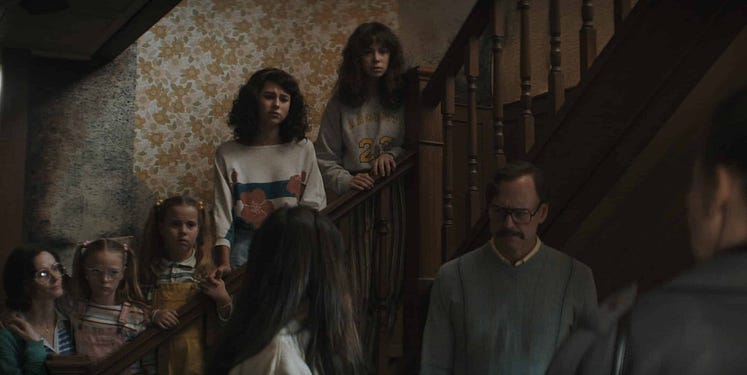
Eldest Heather (Kíla Lord Cassidy) is busy preparing for her confirmation ceremony — for which her grandparents (with whom they somehow manage to live under the same roof) gift her an antique mirror. Naturally, this is the large demonic relic we encountered in the film’s opening (it presumably having wound up for sale somewhere) and which here will continue its legacy as a conduit for mayhem.
A good old-fashioned haunting gets underway whose early telltale signs are blatantly transposed from the first film — again in a way that feels like a rushed exercise in box-ticking. As with the Perron case, the dog is the first to suspect something amiss in the air, who takes to barking at the mirror uncontrollably when it’s revealed in the kitchen. Unpleasant farty smells are detected, a sinister giveaway that evil spirits lurk.
To its credit, Last Rights then breaks away from the trope recycling to give us a glimpse at what it’s made of, treating us to some unique, Wan-level scares. Birthday candles are blown out of their own accord. Telephone cables are tugged at as if by no-one, mid-conversation. Wife Janet is woken one night to the sight of her husband levitating next to her in bed. Most terrifying of all, an axe-wielding, lantern-carrying menace dressed in old-school worker attire is seen stomping through the house — and when he’s not around, a gown-clad elderly woman of a ghost is there to do the scaring (sporting some egregiously poor CGI facial work, I might add). Heather, meanwhile, senses something iffy emanating from the mirror itself, its three little putti faces appearing to watch her every move.

These particular elements belong to the moreish variety of scares we expect of a Conjuring film, and for the most part they’re pretty effective (our grinning axe-man is a suitably sinister addition to the franchise, while I never imagined that a telephone cable could elicit such fear).
Yet emphasis is very much on the fact that these are only glimpsed. These spooks are strangely condensed, cramped into unusually small windows of time. Why? Ultimately to allow space to accommodate Last Rites’ painfully drawn-out narrative arcs into the Warrens lives, lengthy emotional tangents Chaves evidently thinks this final feature warrants.
Much screen time is thus given to the Warrens, where normally we’d be afforded ample time to become acquainted with our host family and their gradually worsening horrors — space, that is, for the movie to really show its teeth. This was always a crucial, slow-burn phase of the journey in which seemingly everyday household objects grew into something all the more sinister — like the antique wardrobe of the first film. It’s a shame such time isn’t afforded to drumming up similar levels of fear surrounding the antique mirror of Last Rites— whose inherent potential for inducing fear, being a large reflective surface, speaks for itself, but which past a certain point early in the film is largely absent and, with it, the horror’s gravitational pull.
Instead, Last Rites has us needlessly following after the Warrens as they go about life having hung up their paranormal hats. Lorraine has experienced enough demonic escapades for one lifetime (though Ed frequently gets the itch to investigate), and besides the occasional demonology lecture delivered to non-believing college students there purely for the laughs, the pair lead lives perfectly betting the middle-aged couple— focusing on family, celebrating birthdays, watching out for Ed’s problematic heart.
Topping their list is supporting daughter Judy (Mia Tomlinson) as she, like Heather Smurl, embarks on an important milestone: marrying her boyfriend of six months, Tony (Ben Hardy) — a filial link laying the foundations for an emotional bond between the Warrens and the Smurls we would expect to see developed in later in the film. Trouble lurks beneath the surface, however, when Lorraine begins to fret over the powers of clairvoyance Judy has inherited from her and which appear to be causing her mounting distress.
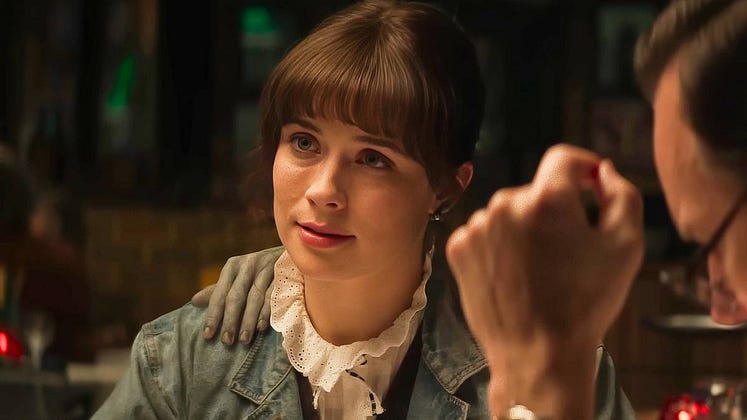
In previous outings, this first act would crisscross nicely between the developments both the Warrens and their future host family, and we’d keenly anticipate the moment at which the Warrens — eventually summoned — would meet the family in need and perform their duties of paranormal sleuths that care. This is a satisfying tension-release dynamic the Conjuring brand does well. However, in Last Rites, by the time the Warrens do eventually arrive at the Smurls’ (which only happens when Judy has visions of the imperilled family and takes it upon herself to travel to Pennsylvania) the tension has all but dissipated.
This means that precious little time remains for the film’s pivotal second act, with much of the run-time taken up by emotional tangents about a young woman we barely know nor recognise (a younger Judy was until now played by the perfectly capable Sterling Jerins).
During this middle section, we’d typically follow Lorraine carry out her paranormal assessments — reading the house and scouting out its dark corners (with what has always been a supernatural reification of female intuition). Ed and his team of (male) assistants would tend to technological side of things — temperature reading, ghost photography, handling tape recordings and such like. Throughout, the Warrens would form a crucial, often surprisingly touching bond with their host family (thanks in no small part to the highly talented Farmiga), and chilling moments of paranormal revelation would be balanced with moments of inter-familial kinship and light comedy before segueing nicely into a demonic bonanza of a finale.
In Last Rites, however, we’re lumped with clumsily condensed second and third acts. The Smurls are shamelessly pushed aside in order for the Warrens and their troubles to take centre stage. Lorraine, following Judy’s pleas to help them, delivers a rushed survey of the Smurl home to deduce the origins of the evil spirits that haunt it all too prematurely — an anticlimactic no-tension/no-release that is a disservice to the original film; Wan’s Conjurings weren’t afraid to linger, immersing us in the worlds of case families while dedicating ample space to constructing a fleshed-out lore viewers felt compelled to see out.
A mere ruse to lure Ed, Lorraine and their miracle daughter back in contact with the mirror — presumably so that the demonic presence sealed within it (which, if memory serves, isn’t specified) might finish the job it started, Final Destination-style — the backstory of the Smurls’ haunting feels contrived, and we can’t help but feel short changed when the promising chills of its first act aren’t followed out.
In the process, the rapport between the Warrens and their victim family that defined earlier installments is sacrificed — and with it arguably the film’s soul. The absence of Tomlinson, playing Heather, is sorely felt, and collapses any meaningful development of the communion-marriage/Heather-Judy link we were led to believe might blossom into something interesting. (Perhaps this was a stone Chaves was reluctant to turn over given the narrative arcs of both daughters stem from dated anxieties regarding women’s liberty and entry into society. These are concerns bound up with the loosely Victorian feel running through the franchise previously tolerated but which for post MeToo audiences doesn’t really sit right).
It’s ironic that for a film whose main antagonist is a demon-conduit mirror — the insidious effects of which are avoided by not looking into its glass, used in the film as an extended metaphor for burying one’s head in the sand — Last Rites’ undoing is its own inability to look at itself squarely in the mirror and accept what it is: part of an unserious franchise whose raison d’être is delivering viewers a rollicking good time. It’s a slip very much of the Freudian kind, and the reason that The Conjuring’s “final” installment misses the mark.
Such is Chaves’ dilemma: seeking to penetrate new emotional depths and add meaning to the franchise (meaning that was always there to begin with) while honouring Wan’s fun-filled original formula he knows works. As if to compromise, Last Rites rushes through this formula begrudgingly so it can focus — vainly — on elevating the franchise into something it never could never nor need be. And this is a shame. Given our uniquely turbulent times, Last Rites was primed to satiate an escapist itch begging to be scratched: witnessing the good guys vanquish our worst nightmares in a safely ensconced faraway past (the exact date of which is anybody’s guess).
This article was first published on Counter Arts
 Home
Home 
Leave a comment