
Veering from the psycho-gothic claustrophobia that made his name, Aronofsky shakes things up with a confused, balls-to-the-wall caper
In many ways, Darren Aronofsky’s Caught Stealing — based on the novel by Charlie Huston, who co-wrote the adaptation — feels like a companion piece to 2024’s Anora. Both star unlikely protagonists working in the city’s shadows — Hank (Austin Butler), a would-be baseball star-turned-boozey barman in one, and Ani (Mikey Madison), an exotic dancer and sex worker in the other. Both inadvertently become embroiled in the American crime world, forced to contend with its lackeys and kingpins. And both films offer a darkly entertaining whistle-stop tour along outer stretches of the criminal world existing beneath the surface of everyday New York life, together showcasing what happens when two people, whose social and professional lives put them in close, brush with crime.
Caught Stealing and Anora prove the immovable staying power of film and TV that probe society’s darker spaces, joining a long line of productions — from The Godfather trilogy to Netflix’s Ozark — that feed our fascination with the criminal world. For Hank — aka California-hailing Henry Thompson — it is less a titillating fancy, however, so much as a real-life threat. Once a promising young high school baseball player tipped to be the next best thing, Hank threw it all away when, loaded up on beers and the outsized pride of a rising star, he crashed into a telephone pole, killing his friend Dale and injuring his knee so severely that any illustrious baseball career was knocked on the head for good.
Haunted by that day years later, Hank is now dependent on booze to get him by and coasts through life in late-90s New York tending bar at a quintessential dive, a role that all too easily sees him switch from barman to barfly. Slinging beers to New York’s seediest one moment, he’s slugging them back in the next, subjecting those around him to the drunken baseball rants that are the bitter vestiges of a would-have-been career. There to steer him home is Yvonne, Hank’s effortlessly cool, jewellery-clad girlfriend only Zoë Kravitz could pull off donning. Ever willing Hank to turn his life around for the better (hence her symbolic job as a paramedic), Yvonne is the only guiding force in his life besides his California-based mother.
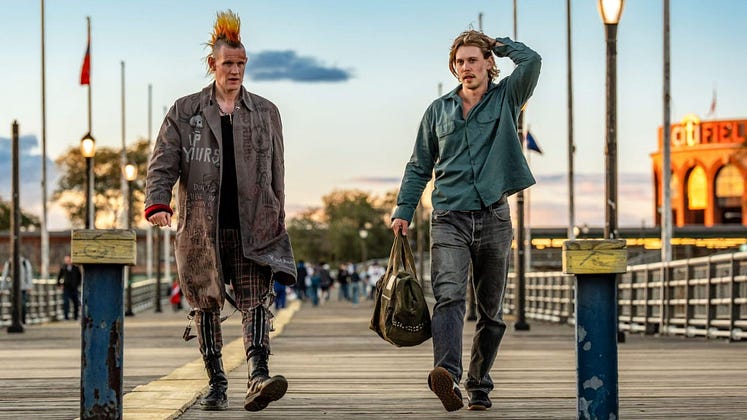
And thankfully she’s there to support him the day his life implodes once again. Hank’s somewhat-friend and neighbor Russ (Matt Smith) — the turbocharged, mohawk-sporting Britpunk with ties to the criminal world — skips town to visit his dying father in London, leaving his cat Bud and an in tray of seedy dealings in Hank’s care. When he crosses paths with Russ’s shady associates in his building’s stairwell — the scrappy, pugnacious Russian duo Aleksei and Pavel (Yuri Kolokolnikov and Nikita Kukushkin) — Hank is beaten to a bloody pulp and landed in hospital.
Back home and a kidney short, Hank is assured by the police that by steering clear he can avoid further trouble. Things worsen, however, when Hank finds hidden in Bud’s litter-tray a key — as it happens, one sought after by a handful of criminals representing separate but overlapping factions of the criminal world. What follows is a nigh-voltage cat-and-mouse pursuit in which Hank fights for survival against the growing tide of assailants around him — foes who threaten to harm the few cherished people (and cats) in his life with an endless supply of schadenfreude. Unsure of who to trust and where to turn to, Hank, along with cat Bud, is forced to take matters into his own hands — and in the process, finally face up to the event that stalks his dreams to this day: the drunken car crash that started it all.

Yet saddled with his newfound single-kidney state, Hank must evade the tightening grasp of the criminal underworld all while shunning the urge to drink. No coincidence, Hank’s abstinence is part-and-parcel of not just his flight from the underworld but his path to owning up to his actions and moving on from the past. That Hank unintentionally gets wasted one night post-op — the morning after which shit hits the proverbial fan in earnest — frames his ensuing journey in the film as an elongated, messy hangover, one twinned with the spiritual hangover that followed his high school car crash and which he failed to rectify.
There to do Hank justice is the wonderfully versatile Butler. Disappearing into Hank, Butler inhabits the conflicted character of a disgraced would-have-been with a seamless energy, resisting the cookie-cutter form of the “troubled buff” whose emotional range spans from sexily smouldering to violently vengeful (the type Butler was restricted to in 2024’s lacklustre Bikeriders). Diving deep to channel the bruised heart lying beneath the tough shell of Hank’s muscled exterior, Butler is no stranger to the vulnerabilities of Hank — the guy who calls his mother everyday without fail and feels compelled to ring the police in the face of trouble.
On the reverse side, it’s a joy to witness Hank muscle his way out of danger through a sly use of the tools around him — implements which, crucially, were tokens of his former life (empty beer bottles and baseball bats used as clubs, cigarette lighters used to set himself free). Indeed, the key to self-liberation often presents itself in the unlikeliest of places, even in a pile of fake cat shit. Moreover, the film’s tight, blink-and-you’ll-miss-it action sequences are a joy to watch, brilliantly fused with the giddy, farcical energy of the crime caper.
As a finished product itself, however, CS isn’t so polished. The film’s punchy, comedy-of-errors humour too often feels strained and rather try-hard — even if it delivers plenty of laughs in the right places. Equally forced is the punkish, grungey tonality Aronofsky aims for — about as transparent as the CGI’d World Trade Centre the film opens with in a not-so-subtle clue that we’re in the ‘90s. Idle’s excellently disaffected score only exacerbates this, outstripping the contrived coolness of what’s taking place on screen while muddling the film’s locale. Are we in New York or London? On that note, bar one short scene set above ground, the city’s iconic subway failed to make a meaningful appearance beyond having its tiles used as a backdrop to the film’s opening credits — a sure sign, if there ever was one, that it would contribute to the action in some way at least. (And no New York-set action-thriller is complete without plunging the city’s depths of its subterranean world).
For all its violence, all its balls-to-the-wall boisterousness, Caught Stealing is a peculiarly tepid affair — all the stranger given Aronofsky’s flair for plunging audiences into dark and twisty milieus of say 2010’s Black Swan and 2017’s (hugely divisive) mother!. Perhaps it’s this very divisiveness which sets the films of Aronofsky apart — which is often a gamble, as 2022’s The Whale proved, and which is perhaps the reason for the sharp creative volte-face. CS represents something altogether more audience-friendly, a crowd-pleasing crime-thriller lacking the bite that defined previous outings and which is arguably wanting here.
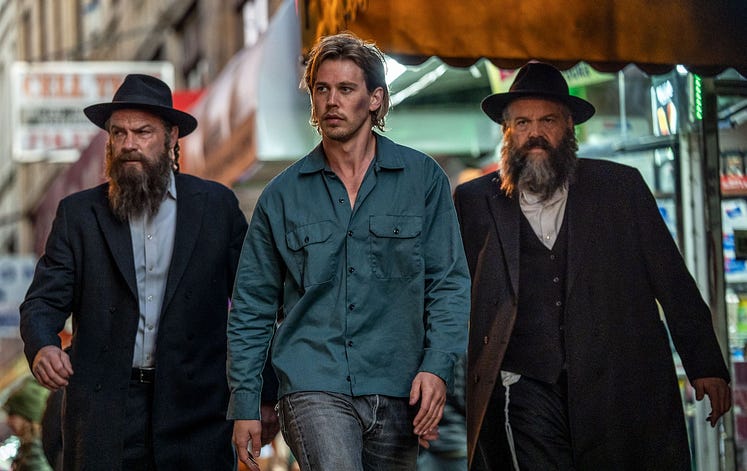
Yet there’s much to be appreciated in terms of on-screen talent. Sure enough, CS is less a feat for Aronofsky than a powerful vehicle for Butler, whose unstoppable talents eclipse a perfectly “good” film. Joining him is the film’s posse of villains — chief among them being the Hasidic duo that is Lipa and Shmully (Liev Schreiber and Vicent D’Onofrio) who, coming in at a close second, operate with all the calm, calculating efficiency of automated killing machines and quickly take up the film’s animus. Matt Smith is equally as beguiling as the perennially in-hot-water Russ (even if his focus-stealing, cockney characterisation further muddies the film’s supposedly New York setting).
Underused, meanwhile, is the role of Colorado — associate of the Russians a few rungs up from them played by the reliably charismatic Benito Martínez Ocasio, aka rapper Bad Bunny — while points must be deducted for the cheap, Bond-ish disposal of Kravitz’s Yvonne (sorry, better you be prepared). A tired and problematic trope, her killing off in the film’s first act — following Hank’s single-kidney bender — is intended to echo the death of Hank’s friend Dale.
Yet it deprives us of a firm anchor in Hank’s life, whose absence is felt like a plane lacking a wing. Regardless of the film’s source material, the very prospect of her murder alone would have sufficed in conveying her death as repeating Dale’s —through hypothetical flash-forwards, say, which superimposed the image of her body over that of his deceased friend on the mangled hood of his car.
And why not keep the infinitely magnetic Kravitz in the fold and give Hank something worth fighting for? Far more effective would it have been to witness Yvonne abducted and used as tangible hero bait, breathing life into what eventually becomes a cat-and-mouse chase short on stakes and lacking in momentum. What’s more, who wouldn’t relish seeing Yvonne wield her initiative as a knowledgeable paramedic and street-smart New Yorker to help free herself (and, in tandem, Hank) — preserving the necessary going-at-it-alone component of Hank’s journey while reinforcing it?
This would have also helped raised the film’s stakes. Indeed, somewhere between the film’s second and third acts, CS plateaus, becomes lost in the farce of its characters’ escapades to the extent that who wants what and why becomes blurred and tedious. Anora, for me, had similar issues, its drawn-out living room hostage scenes testing our patience beyond repair; perhaps such problems are the corollary of translating an antiquated film genre — the farcical crime caper — into lengthy feature films suitable for modern audiences.
Yet where Anora succeeded at painting a vivid picture of contemporary New York (a playground for rich gen-Zers and crooks), Caught Stealing offers an inauthentic and place-less ride through a supposedly ‘90s New York. The overall result is something that feels simultaneously half-baked and overcooked, and which, if it weren’t for the presence of Butler, veers all too close to the telephone pole.
This article was first published on Counter Arts
 Home
Home 
Leave a comment