‘The Name of The Rose’ meets ‘Succession’ in this taut papal showdown
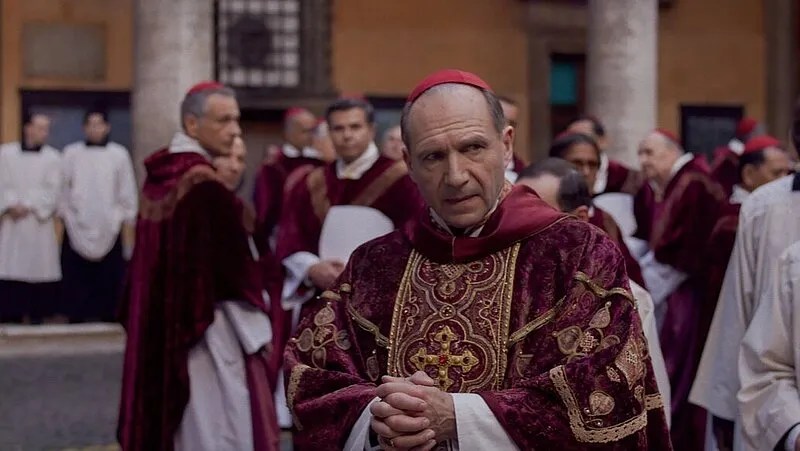
What place does the camp, dated ceremony of the Catholic Church hold in a word splitting at the seams? When the small but grandiose Vatican City of Edward Berger’s Conclave is plunged into political turmoil following the death of the Pope, it falls on Cardinal and Dean Thomas Lawrence (Ralph Fiennes) to oversee the election of a successor — and with it, the future of a rudderless, antiquated institution. As all the world’s cardinals are assembled and sequestered from public life, with each candidate belonging to one of a handful of ideological visions of the church as jarring as the next, the fraught process of voting in a pontiff commences.
Battle lines are drawn and allegiances pledged, with four Popes-in-the-making dubbed leaders in the race to attain a two-third majority and become Pope: Aldo Bellini (Stanley Tucci), an American liberal and realist who, despite having grown skeptical of the church’s antithetical role in modern society, is nonetheless Lawrence’s favourite; Joshua Adeyemi (Lucian Msamati), a popular Nigerian conservative with a skeleton in the closet;Canadian Joseph Tremblay (John Lithgow), a scheming moderate who views himself as the natural successor to the throne; and Goffredo Tedesco (Sergio Castellitto), a die-hard traditionalist and vape-smoking bigot who seeks to pull the church into the regressive past — making him an enemy to Lawrence and Bellini.
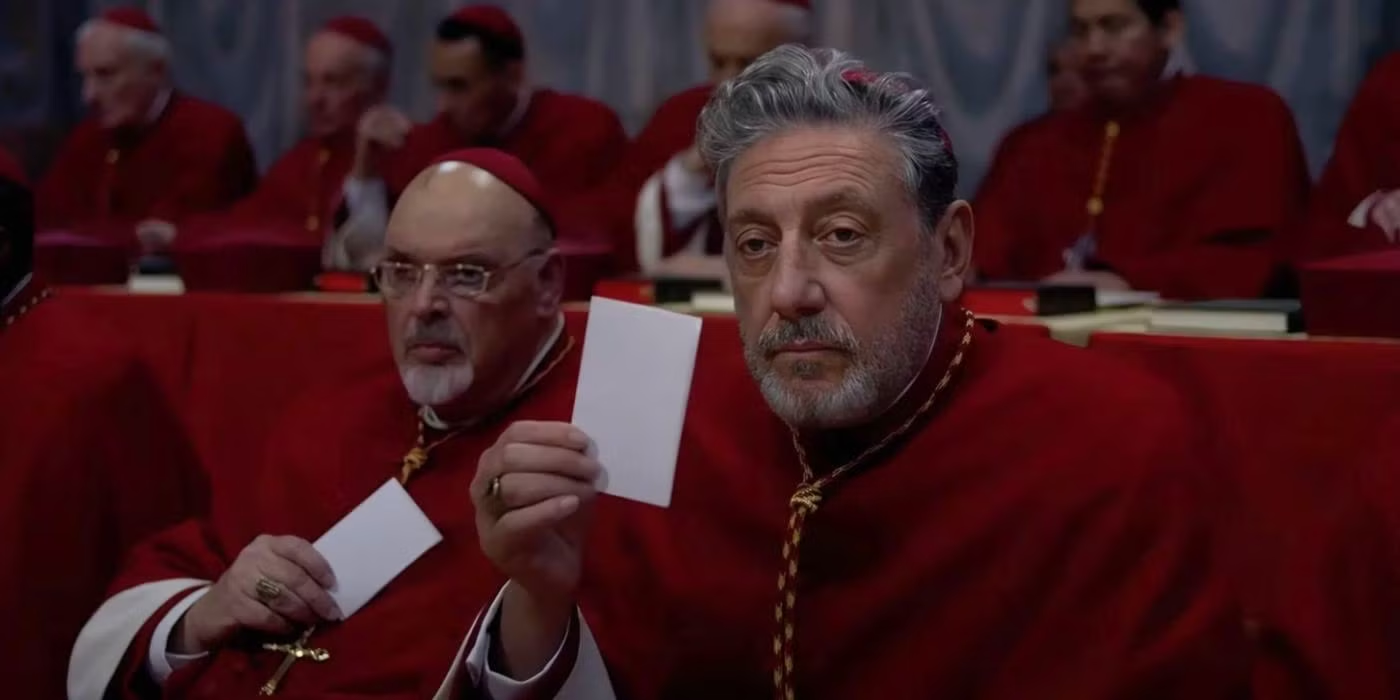
Though he nurses a secret crisis of faith, Lawrence is nonetheless compelled to help shield the papacy from a deeply regressive leadership (and yet more controversy to mire the Catholic church). Aiming to sidestep political chicanery altogether, he takes a gamble by calling for unadulterated faith in his official address to the candidates, shunning the cult politics of the norm. Backfiring, his speech sees conservative candidates close ranks — propelling Adayemi and Tedesco up the ranks in the first round of ballots — while ally Bellini perceives in Lawrence’s words a veiled desire to take the papacy for himself.
For despite professing otherwise, the dean nonetheless betrays a unspoken desire to don the white cassock, a yearning detectable immediately below the surface of his rather shallow protestations and which, as the voting draws out, he must contend with. It is, however, a prospect at odds with Lawrence’s own self-image, one deeply shaped by the late Pope’s dying invocation to him: to continue his legacy as a mere “manager” of the Cardinal College, a man little interested in the glory of becoming pontiff.
And how safe can Lawrence be from the infectious need to rule, himself having been so close to the Pope? Ambition, Conclave shows, is the close cousin of greed. This very human and avaricious need to rule is what reverberates throughout the marbled corridors and frescoed chapels of the Vatican and which Lawrence, Bellini and the steely head housekeeper Sister Agnes (Isabella Rossellini) — whose “eyes and ears” put cardinal in their places despite belonging to a woman — vie to keep in check.
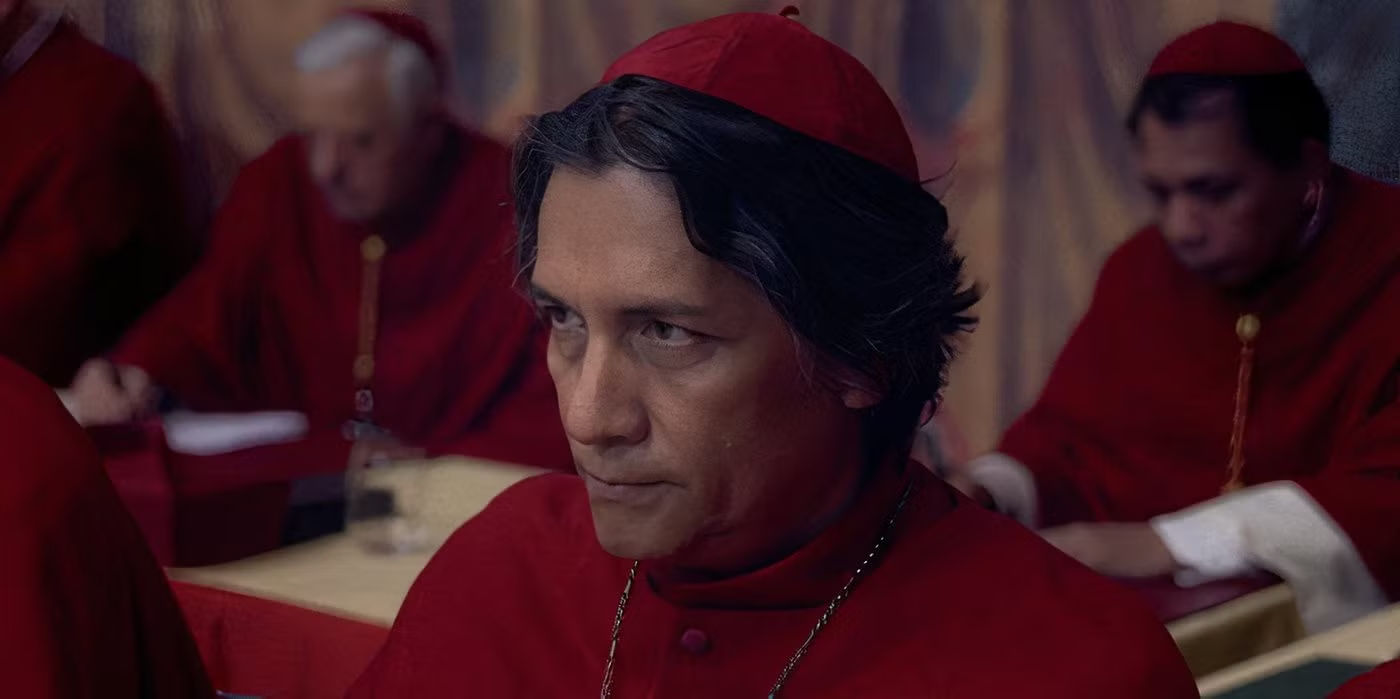
Adding calm to the slowly simmering fracas is the sudden arrival of Cardinal Vincent Benitez (Carlos Diehz), whose unassuming and unambitious character throws the soured thirst for power of his fellow cardinals into sharp relief. Made a cardinal by the Pope “in pectore” — or in secret — the Mexican pacifist has his presence felt less by posturing and political gaming than by his humble, messianic quality that begins, unexpectedly, to win him nominations. Drawn to the Dean’s campaign for tolerance, Benitez confesses that he sees Lawrence as the true papal successor and as such cannot vote tactfully. It is tactics, perhaps, that leads one from ambition to greed.
As the ballots draw on ad infinitum until a two-third majority is reached, risking revealing to the world a church in crisis, controversies spill out and discord divides an already deeply divided institution — fragmented not just by ideological persuasion but by language and country, as the traditionalist Tedesco rightly puts to Lawrence. “The centre cannot hold,” he urges the Dean, quoting Yeats’ dystopian “Second Coming” and gesturing to the busy tables of the cardinals’ canteen where much of the film’s politics is played out.
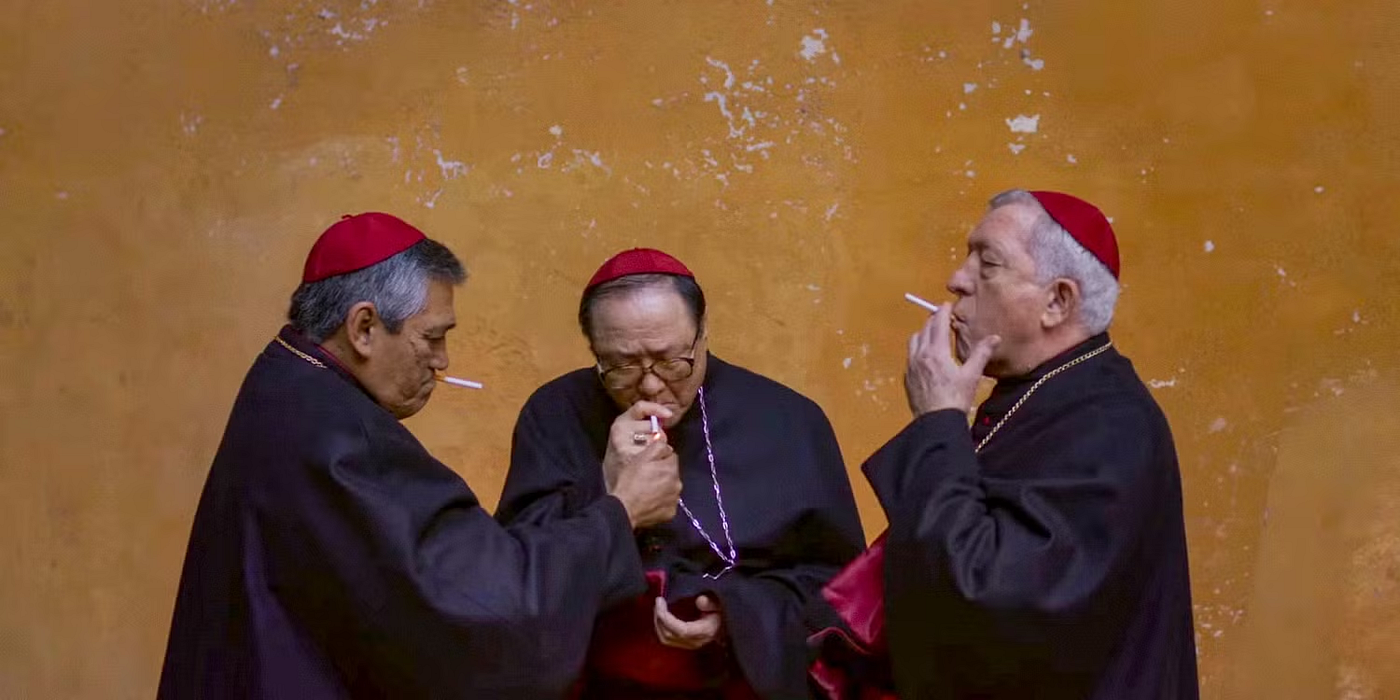
Just as Yeats’ Europe whirls its way up the “widening gyre” and confronts a new, post-World War One era, the Catholic Church — like many of the world’s institutions today — finds itself teetering into a new, uncertain dawn. The world the church once knew is firmly in the past, or perhaps never really existed in the first place. In its place is a world where cardinals drink from nespresso machines, smoke cigarettes and vapes and own smartphones. Where nuns type away at computers and demand, where necessary, to be seen and heard. Where, to the ire of many, “gays” and women’s rights are debated seriously.
Yet such changes are merely symptomatic of the wider systemic alterations felt around the world today. Conclave, admittedly, is less about the Catholic church than it is about contemporary politics — and, specifically, the tension between a romanticised past and an uncertain, fractured future.
Berger is masterful in capturing this sense of teetering between worlds, injecting Conclave with all the suspense of a spinning dreidel whose outcome we cannot predict — a searing tension brilliantly evoked (if a tad excessively in places) by Volker Bertelmann’s volatile, frenzied score and in its absence, Fiennes’ bone-dry nasal breathing that squeals manically like a stovetop kettle chained stubbornly to the fire beneath it.
And yet, like the greatest of drama, Conclave shuns melodrama, instead weaving into its scenes the fifteenth-century farce of Ben Jonson’s Volponeand, four centuries later, the dry, tragi-comedic bite of HBO’s Succession. (Meanwhile, the mundanity of the cardinals’ canteen squabbling comically channels the bitchy groupthink of 2004’s high school drama, Mean Girls. Indeed, Conclave is as “silly,” to quote its detractors, as the Vatican City — its anachronistic pomp and pretence and all — is camp).

This is a balancing act reflected in Stéphane Fontaine’s theatrically resplendent cinematography — a creamy, suitably Neoclassical aesthetic that commands to be viewed on the big screen. The brilliant reds of the cardinals’ scarlet mozzettas, worn over (ironical) bright white cassocks, contrast sharply with the deep, yawning darks of the Vatican’s shadows. Chief among such dark spaces is the auditorium, where the College’s leading cardinals gather, seated in the house, to hash out issues and debate. As they do, ensconced in a spotlight, the surrounding shadows threaten to swallow them whole while underscoring their isolation from the real world.
Such colour play recalls the tensions of Stendahl’s 1830 Le Rouge et le noir, the political meaning of whose titular colours — The Red and The Black — are thought to denote the divide between religious and secular, or channel the red and black tiles of the quickly spinning the socio-political roulette that was France’s tumultuous nineteenth-century caught in the vicissitudes between a feudal state and republic.
And like democracy itself today, the world of the papacy — a fractured, contradictory entity pulled in myriad directions — threatens to become a conc(l)ave, hollowed out by the forces of the “widening gyre” outside of it, a violent force that threatens to strike the Sistine Chapel itself. Who, in our darkening world, will let the light in? Berger asks. Who can mend and lead a sinking ship when, to revisit Yeats’ twentieth-century dystopia, “The best lack all conviction, while the worst / Are full of passionate intensity”?
Only a cast such as Conclave’s could achieve the challenge of fusing tragedy and farce with such skill. It’s mind-boggling to think that Fiennes once played the serpentine Voldemort, who here seamlessly inhabits the role of a good-natured leader faced — like many of our own — with an impossible task. Tucci, suffering from a severe bout of overexposure in my view, redeems himself with his convincing and refreshing performance of an on-the-fence, jaded liberal, while Rossellini’s every facial movement — most especially the whip-sharp darting of her eyes — hints at a magnetism not seen since Judi Dench’s five show-stopping minutes as Queen Elizabeth I in Shakespeare in Love.
A tour de force, Conclave deserves more than it might receive at this year’s Oscars. And if the nominations are anything to go by and Jacques Audiard’s painfully reductive Emilia Pérez takes the lion’s share of wins, then the Academy Awards is a victim of exactly what Conclave makes plain: the perils of groupthink.
· · ·
This article was first published on Counter Arts on 2 February 2025
 Home
Home 
Leave a comment