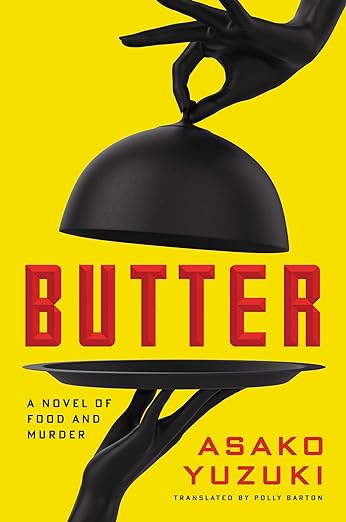
Food, gender and power are the full-fat ingredients in Asako Yuzuki’s frank recipe for navigating female bodily liberation
In the end, every man wants to go home to his mother. So the theory goes, suggesting that men, lacking the ability to feed and nurture themselves, ultimately seek the return of their mother’s embrace found only in the arms of the opposite sex. For Japan-based journalist Rika Machida, the protagonist of Asako Yuzuki’s bestselling Butter (2024), the domestic mother is but one iteration of “woman” on a spectrum ranging from prepubescent virginal “schoolgirl” aesthetic (readily feted by Japanese Manga-style “lolicon”) to the domesticated figure of the nurturing mother.
Physically speaking, the former for Rika finds its home in the slight, girlish figure of her best friend and polar opposite Reiko, whose suburban home she visits for a home-cooked meal after work in the book’s opening. Marrying her partner Ryōsuke and learning that their lack of success in having a child was likely due to the stress of her twenty four-seven career in corporate PR, the newly domesticated Reiko promptly traded in her high-power corporate career world for a life of fecund domesticity and all its trimmings.
Accordingly, Reiko is a whizz in the kitchen, a doting wife and a desperately aspiring mother; when Rika greets her at the door of her welcoming home, she embraces Reiko, who she hasn’t seen in six months, wearing her apron and smelling of lavender. However, by Japan’s strict social standards, these markers are incompatible with her highly youthful, girlish appearance. An amalgamation of the “Stepford housewife” idyl and the passive, prepubescent girl, Reiko awkwardly bends the spectrum so that both polars meet to become a “petite, delicate” waif cosplaying the role of an archetypal domestic goddess.
Rika, meanwhile, despite being a feminist woman (we infer), is tall and masculine in appearance, wholly undomesticated in her barely lived-in apartment. Unlike Reiko, “food and fashion — the things that women were supposed to have a particular fondness for — had always left Rika indifferent.” Deeply committed to the life of work — writing as the only female journalist at the mostly male populated men’s magazine, Shūmei Weekly — Rika lives a life suited to that of a man whose life routine involves working late into the evening on a daily basis.
Yuzuki foregrounds this hybridity when Rika is asked to pick up a packet of nationally rationed butter en route to Reiko’s, and must settle for a 50% margarine blend. Food, she suggests, is a powerful marker for gender identity. Rika, for whom eating is mere function, can perceive no difference between the two. But for Manako Kajii — or “Kajimana,” as she is widely known, the notorious gourmande killer and inmate of Tokyo Detention Centre — anything other than the full-fat “glory” of real butter is repugnant.
· · ·
Inspired by the real-life “Konkatsu Killer,” marriage-site surfer Manako Kajii is alleged to have targeted a string of lonely, comfort-starved men and enticed them with her sumptuous home cooking in order to extract large sums of money from them — only to kill them via means typically attributed to suicide such as death by train and carbon monoxide poisoning. Appealing the jury’s verdict of life imprisonment (an outcome lacking concrete evidence to suggest that she in fact killed the men), the “voluptuous” butter aficionado is up for retrial in the next spring — making her a timely target for Rika’s latest journalistic pursuits.

Fascinated less with the hard facts than by the fatphobic, deeply misogynistic media fanfare surrounding the Kajimana case, Rika routinely writes to the notoriously hostile inmate with a particular distaste for female journalists. Hoping to clinch an interview with her, Rika wants to learn more about what she calls “the social background of it all.” As she tells Reiko and Ryōsuke over dinner,
“What the public found most alarming, even more than Kajii’s lack of beauty, was the fact that she was not thin. Women appeared to find this aspect of the case profoundly disturbing, while in men it elicited an extraordinary display of hatred.”
It’s only when the quick-thinking, would-be journalist Reiko suggests appealing to her love of cuisine by requesting from Kajii the recipe for her bœuf bourguignon (made for one of her last alleged victims on the night of his death) that she succeeds — provided, however, that questions regarding her case aren’t raised.
Her first meeting with Kajii, divided by the acrylic screen of the visiting booth, marks the beginning of an unusual relationship between convict and journalist, highlighted by the narrator’s curiously gendered, fairytale framing of the pair: “Rika imagined that her feeling right now was not unlike that of the prince when he finally got to meet Rapunzel, sequestered away at the top of the tower.” Not the damsel in distress of picture books, however, Kajii harbours an authoritative yet luminous presence that both captivates and catches her audience off guard — her ivory skin, glossy hair and overall feminine appearance jarring with a no-nonsense, masculine energy.
A believer in the notion that “You are what you eat,” Kajii wastes no time in getting acquainted with her captive audience of one by asking Rika to reveal the contents of her fridge at home. When Rika confesses that these begin and end with the meagre staples of fruit, juices, sports drinks and — most egregiously — margarine, she is caught hook-line-and-sinker. It’s here that the book shifts up a gear and something Hannibalarian falls into place; perceiving a certain starved brand of feminism in Rika, Kajii declares — or rather instructs — that “there are two things that I simply cannot tolerate: feminists and margarine”.
Indeed, for Manako Kajii, women must yield to their “god-given” role as a woman with as much urgency as they renounce margarine — and with it their careers, fad diets and other lifestyle choices that fall outside of the rigid category of a comforting feeder of breadwinning men. Butter, it would seem, is a metaphor for giving into the maternal drive to comfort, provide and eat. As she puts it,
“If you scrimp on butter, your food will taste inferior, and if you scrimp on femininity and a wish to serve your partner then your relationships will grow impoverished.”
Kajii instructs Rika to try rice, soy sauce and — most importantly — the crème de la crème of French butter, Échiré. The key ingredient, it will enable Rika to “fall” rapturously into gustatory bliss like a “lift [plunging] to the ground floor.”
By doing so, Kajii initiates a potent master-protegee dynamic that propels the narrative forward: she, the dominant, assigns the submissive Rika strict food-related tasks — cooking and eating to Kajii’s every instruction, whether at home in her unused kitchen or at the Michelin-star restaurants featured in Kajii’s food blog. Postprandial, she is to report back to Kajii her exact sensory experiences through written correspondence or in-person visits to the Detention House, enabling Kajii to live vicariously through Rika’s personal gustatory awakening.
Obligingly, Rika swaps out her soulless diet for the sumptuous foods Kajii instructs her to eat, and her investigation becomes an eroticised journey of epicureo-sexual liberation. The human mouth — with its newfound possibilities for pleasure — becomes an erogenous site on par with the vagina. Giving in to a world of butter-rich sensation she has until then denied herself, Rika becomes demonstrably fuller, healthier, and more satiated, adding meat to her bones, shine to her hair, life to her skin.
Meanwhile, Rika continues the job of attempting to piece together and understand Kajii’s life — her childhood, her family, the motivations for pursuing a lifestyle of sugardating and the potential truth surrounding the deaths of the men she is supposed to have cast under her maternal spell and killed. Did Kajii really lead these men to their death, or, under her thrall, were they somehow led to take their lives? Was someone helping her? What happened in her childhood that might have led Kajii to her to become the man-eating media spectacle that is “Kajimana”?
As Rika’s investigation deepens, her relationship with Kajii becomes fractious, their views of freedom and feminism often clashing. And yet, a token of her ability to subvert established ideas and weed out contradictions, Kajii forces Rika to look inwards at herself and her identity as a woman.
Soon enough, she begins to reevaluate the relationships that make up her life: her all-consuming, unhealthy relationship with work; her dichotomous, increasingly strained friendship with Reiko (who, growing suspicious of her bestfriend’s obsession with the killer, inserts herself into the investigation); her somewhat dormant relationship with boyfriend Makoto, who is troubled by her growing body and sudden foray into cooking; and the relationship she maintains with herself — her changing, gradually awaking body, enmeshed with her identity as a feminist.
Yet through her newfound interest in food and gender emerges the ghost of her deceased, alcoholic father, whom she is less and less able to avoid as the book develops — and which, rather uncomfortably, draws her closer to Kajii.
Try as she might, Rika, like her supposed victims, cannot peel herself from Kajii’s orbit. Befittingly, the real Kajimana, Kanae Kijima, was dubbed the “black widow.” The axis around which the book’s narrative and characters revolve, she is the dark spider at the centre of her own (online) web, luring mother-bound, inept men while baffling misogynistic ones with as much ease as she repels fatphobic women and unsettles the identities of supposedly feminist women who consider their sense of self intact.
Either way, Kajii’s very nature ruffles the feathers of those caught in her web, exposing, in the process, the contradictions and limitations bound up in the frenzied discourse surrounding what a woman can and should be.
The tension between these two modalities — what a woman can be versus what they should be — is where Butter’s tension resides. Yuzuki deftly exposes society’s stratification of women, a process exacerbated by late capitalism’s rigidly defined, often heavily pornified iterations of “girl”/“woman.” Indeed, under the constraining male gaze, women’s identities are determined by the expectations of the men in their lives, depending merely on their physical appearance.
Transgressors of these expectations, Uzuki highlights, will be punished. Rika, for instance, cannot work at a man’s weekly publication and expect to be a feminist, just as she cannot (survivalistically) leverage her femininity when interviewing male sources for her work — deemed inappropriate in her male-dominated workplace. Outside of work, she cannot gain weight and cook in the name of her career for it collapses her boyfriend’s fantasy of the passive and indolent schoolgirl aesthetic he idolises.
Reiko, for her part, cannot pursue the trappings of domesticity (children, cooking, a home in the suburbs) and expect to fall pregnant, because, in seeking to become a mother she also threatens her fetichised youthful appearance that originally attracted husband Ryōsuke to her, leading to a dry spell.
Faced with such repression, female characters in Butter subsume the heteronormative gender binary attributed to men and women, an internalised power structure mediated through cattle. On a visit to Kajii’s family home in Niigata, Rika and Reiko (who accompanies her) visit the local dairy farm, as instructed by Kajii herself. Once there, observing the prized cows (who are artificially impregnated via sperm from only the best bulls), a dairy farmer informs them that:
“There are eighty cows in this shed. In a group that size you inevitably see the emergence of a hierarchy… Hierarchy isn’t a bad thing. You need it, to prevent conflict.”
Yuzuki makes this hierarchy clear herself in the book’s organisation of characters. As we’ve seen, Rika is cast as a prince come to save Repunzel/Kajii from her tower on her first visit to the Detention Centre, while Reiko similarly describes her as having been her “prince” throughout college. Moreover, one of Rika’s female school friends, she recollects, once attempted to kiss her, owing to the fact that she was the most “boyish” girl at the all-girls school they attended.
Meanwhile, Kajii herself is thought of as “more man than as a woman” by a fellow attendee of the women-only, highly exclusive classes held at Salon de Miyuko, where her dominant, controlling presence is felt to subdue those around her in the same way she maintains a hold on Rika, Reiko and her victims.
There’s an inherent power to this hierarchy. At the dairy farm, watching the milk squeezed from the teat of a cow, Rika recalls the The Story of Little Babaji, a popular nursery-style narrative in Japan at the heart of Butter’s discussion of food, power and gender relations. It follows a young boy who encounters four vain tigers in the jungle. When the boy gives the hungry tigers his clothes and belongings in a bid to be spared his life, the tigers give in to bickering over who looks the best in the boy’s clothes and, consumed with jealousy, end up chasing each other round a tree until eventually turning into butter. The boy and his family take the butter home and enjoy it for themselves. As Rika muses, reflecting on Kajii’s victims in relation to the Babaji story:
“Hadn’t they brought about their own destruction out of the jealousy they had come to feel towards one another? She imagined them now, chasing one another in circles around Kajii, until they had met their respective ends.”
This is a power Kajii recognised and quickly learnt to exploit early in her life, refashioning the status quo that dictates women revolve around men (or each other), so that, as an alpha wo/man, men revolve around her, fall into her troubling orbit.
Once there, they find themselves in a queered relationship of sorts, their status as the alpha-male component in a breadwinner-housewife scenario cancelled out by Kajii’s alphaism, a force that reduces them to an emasculating role of the financial dominees under her thumb. While Kajii gives with the one hand, she takes with the other.
So inept, so dependent, so lonely, they need and seek out the nurturing mother figure found in Kajii, but are profoundly emasculated by the typically masculine powers of financial domination she exerts over them. Could this be a level of a need-hate confliction so powerful that it might have driven them to suicide, we wonder?
This suggests a level of freedom amongst women in Butter that men traditionally cannot access — or indeed, fearing the gender plasticity it entails, are led to take their lives over it. And as Kajii evidences, this is a power that can be greatly exploited. But it will come at a profound cost for Kajii.
Indeed, Kajii might have gamified the gender system and won herself fame, men, and financial gain in the process, but she is both the product and champion of modern society’s ills.
As Rika learns from her time attending the Salon de Miyuko course, Kajii’s strict hold on the class is upset during one class when the students vote to cook a roast turkey in the American tradition of Thanksgiving. For Kajii, who insists on cooking only the tried-and-tested, upper echelons of cuisine she associates with full-fat femininity, this goes against her sacred edict that cooking is a bilateral transaction between woman and man. The roast turkey, on the other hand, is a powerful symbol of a level playing field — of family, togetherness, community — that Kajii hasn’t known and which collapses her role as woman-who-feeds-man.
It’s here that Rika unearths the Manako Kajii’s Achilles heel: despite lamenting the costs of women’s ascetic commitment to work she sees reflected in Rika, she too is painfully lonely. Listening closely to Kajii during a visit to the Detention House much later into the novel, she muses:
“The longer she spent with Kajii and heard what she had to say, the more strongly Rika felt it. It was the same as the way that using complementary colours and aromas brought out the flavour of one’s ingredients. The more extreme Kajii’s pronouncements, the more they seemed drenched in loneliness.”
Kajii is a prisoner to her own web, both literally and symbolically. A prize cow in spirit, Kajii represents a sterile, artificial life which she upholds as the gold-standard all women should attain to, but which entraps her. The artificial insemination the cows of the Niigata dairy farm are made to endure is a symptom of an artificial, strictly binary life in which women (as dairy cows) are confined to the domestic sphere, while men (sperm-providing bulls) are restricted to the world of work.
Central to Butter is Rika and Reiko’s concept of finding just “the good amount”, which is to say, experimenting with all the right ingredients that go into the recipe that is their identity as a woman, and sticking with what works. Yuzuki invites readers on a journey of finding this “good amount,” of negotiating between both the freedoms and constraints, the safety and danger that food presents women with. Just how far Rika is willing to “fall” in her journey of self-discovery, of finding her good amount, is up to her.
· · ·
This article was first published on Counter Arts on 24 January 2025
 Home
Home 
Leave a comment