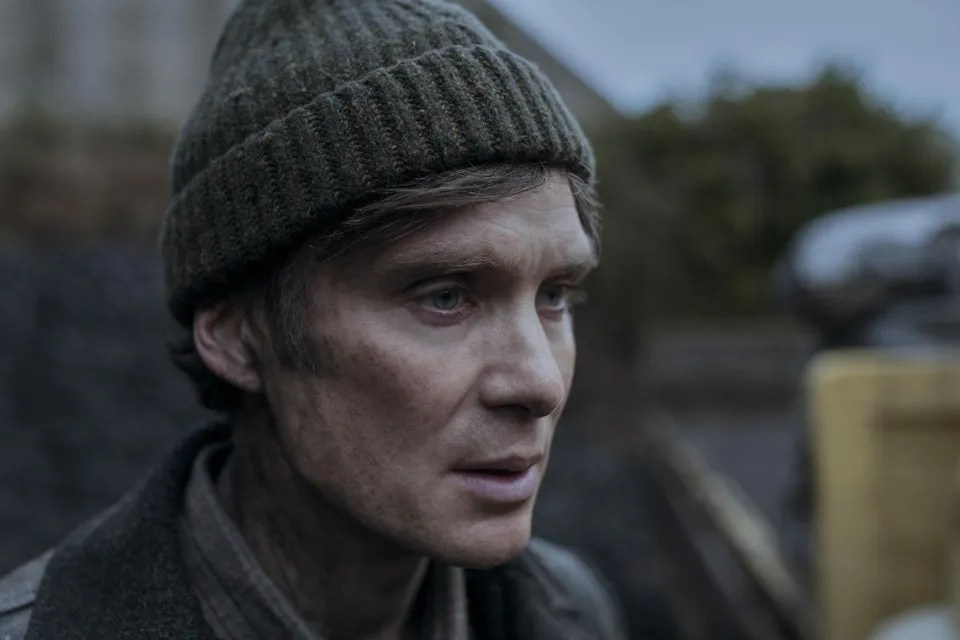
This moving adaptation of Claire Keegan’s novella sees Cillian Murphy captivate as a father haunted by Christmas ghosts
Tim Mielants’s faithful rendering of Clare Keegan’s Booker-shortlisted 2021 novella feels distinctly bookish in a way I wish John Crowley’s rather twee — but otherwise excellent — 2015 translation of Colm Tóibín’s Brooklyn did. The plot of Small Things Like These is sparse and slow-moving, gently coaxed along by muted interactions between characters, and perhaps doesn’t lend itself particularly well to adaptation — as is often the case with novellas. But I’m more than glad it was, even if for some it may feel lacking in drama.
Small Things asks viewers (like Keegan’s readers) to look closer. Set in 1985, we follow Bill Furlong (Cillian Murphy), a coal merchant supplying fuel for the cold, bleak winters that blight the small town of New Ross, south-eastern Ireland. In between managing his strenuous business lugging bags of coal across the town and parenting a family of five girls, the taciturn yet loving Bill is visibly haunted by something. A third version of Bill — who outside of work and family duties —exists, one who, much to the worry of wife Eileen (Eileen Walsh), spends insomniac nights pondering the outside world from the living room chair.

Gradually bubbling over as Christmas approaches, this third version of Bill becomes increasingly drawn to helping the downtrodden youths he encounters on the road, victims of the sharp economic difficulties of 1980s Ireland. It’s through his affinity with the young that we quickly detect a ghostly double of Bill’s own younger self reflected in them, a fact laid bare thanks to the deep wells of anguish and remorse that are Murphy’s endlessly expressive eyes.
The young and needy are, for Bill, the ghosts of his Christmas-That-Could-Have-Been. The son to a mother who fell pregnant outside of wedlock but was fortunate enough to have been taken in by a kind, wealthy woman, sparing her the misery of entering one of Ireland’s notorious Magdalene laundries, Bill very nearly assumed the fate of one of thousands of illegitimate babies — forced adoption, institutionalisation or joining one of hundreds in the undocumented, secret mass graves uncovered in recent years by local historians.
Adopting the status of so-called “mother and baby homes” for new and soon-to-be mothers out of wedlock, the Magdalene laundries exploited the status of “fallen women” by becoming, throughout the twentieth century, non-remunerative Victorian workhouses in all but name. The last laundry in Ireland closed its doors in 1996.
On Bill’s roster of regular local coal deliveries is one such laundry, whose controversial machinations the town — ever fearing the Mafioso-like reach of the Catholic church — has taken to keeping schtum about. Witnessing the forced arrival of a new, kicking-and-screaming recruit, Bill can’t help but see his mother’s Ghost of What-Could-Have-Been in the convent’s workers — just as he can’t resist getting involved.

One morning, when Bill finds a worker intentionally locked in the coal shed during an early delivery, he is invited by all-knowing Mother Superior, Sister Mary (Emily Watson), to traverse the ascetic, cold hallways of the convent and commune with her in her quarters. Over tea and cake beside a roaring fire — fuelled by the coals he himself provides, and whose residue he scrubs from his hand compulsively upon returning home from work each day — Sister Mary deploys her routine charm offensive of emotional manipulation, flattery and mockery, blackmailing him into keeping quiet.
She does so with a steely menace only Emily Watson — whose calculated movements and wicked words perfectly embody the double-dealing, Machiavellian machinations of the Catholic church — can do justice. Scarcely can Bill look into the Mother’s eyes, whose jangling keys, rigid posture and penetrating eyes powerfully betray the matriarchal might at the core of the institution. “Yes, Sister,” is all Bill can reply.
In fact, Bill’s rabbit-in-the-headlight eyes are rarely able to meet those of all the women around him. Sat round the kitchen table with his five daughters — itself a cruel cosmic joke of sorts, as though placed on this earth as constant reminders of the world’s treatment of women — he recounts the Christmas when he received a highly coveted jigsaw while under the care of the generous Mrs. Wilson as a child. In fact a lie (he received a hot-water bottle), Bill narrates his pithy tale directing his gaze solely on the bread he fries, so unable is he to look his daughters in the face and betray the truth: that his childhood remains an unsolved puzzle, a secret the omniscient Mother Superior knows all too well.
This we know thanks to the film’s use of flashbacks, which shed (small) light on Bill’s time living with Mrs. Wilson. It’s here that there’s a slight unevenness to the film’s portrayal of the past, which could have been fleshed out with better acting and more screen time (even if this meant docking from the film’s present in what is a lengthy film).
Murphy does more than enough to compensate, however, and is exceptional as a perpetual orphan caught between the throes of sheer luck and devastation. The protagonist of his very Dickensian tale of survival, Bill is unable to ask for the jigsaw that never was from his wife, settling instead on Dickens’ David Copperfield.
During another of Bill’s childhood Christmases, we see him reading aloud the concluding lines of A Christmas Carol. Just as David vies for independence and growth in his coming-of-age tale, and as Ebenezer reckons with his Yet to Come, can Bill relinquish his ghosts of Christmas past and wash his hands of the trauma once and for all?
· · ·
This article was first published on Counter Arts on 9 January 2025
 Home
Home 
Leave a comment