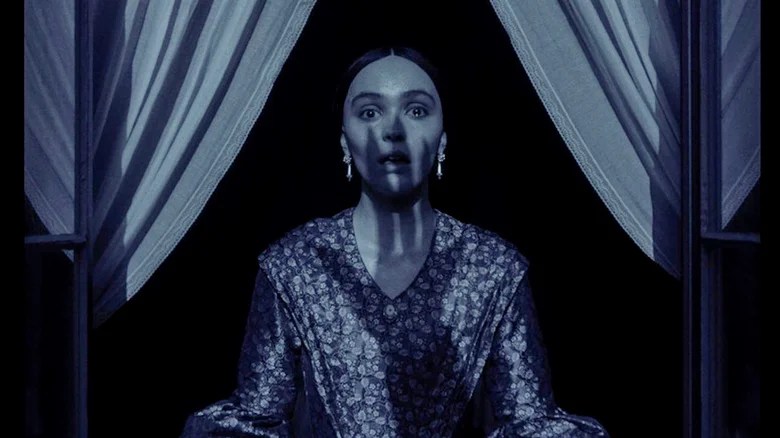
Lily-Rose Depp carries this gorgeous retelling of W. F. Murnau’s silent original, but alone cannot compensate for its confused, unimaginative core
Heavy is the head that attempts to fit Count Orlok — or Nosferatu, the vampire inspired by Bram Stoker’s 1897 Dracula — into a neat, screen-shaped box. The much-canonised demon of shadows is a slippery, synthesised entity, known for his abilities to disembody at will, tele-transport and pierce the minds of his victims. Director Robert Eggers, prior to the release of his arthouse-cum-blockbuster revamp of F. W. Murnau’s 1922 unauthorised silent feature Nosferatu (so named in a vein attempt to avoid copyright infringement of the Stoker estate), highlights as much. As the self-professed vampire stan puts it, speaking of Stoker’s novel in a Guardian article, “I must admit that Stoker was a bit of a hack writer. His brilliance was in synthesising his many sources.” Like vampire, like novel.
Indeed, depictions of the canonical vampire since John Polidori’s 1819 novella The Vampyre — whose charming, handsome bloodsucker was a dark recasting of Lord Byron — have varied greatly. Oscillating from the downright monstrous to the sparkling beauty of Twilight’s Edward Cullen, the vampire — and his many powers — has been moulded and remouled depending on the attitudes, anxieties and expectations of his audience.
For Nosferatu, like Dracula, was less a tangible ‘thing’ in the more tangible sense that vampires and demons are portrayed in today’s glossy productions, than a spectral amalgamation of popular fears and anxieties (not to mention creative whims) of the time. Its enduring nineteenth-century interaction — Dracula — is a thing of the shadows, an incarnation of that which dare not speak its name. A site for cultural hysteria to play out, he is a (dis)embodiment of nineteenth-century addiction and other forms of social transgression (disease, immigration and queer sexualities being common picks; Murnau’s 1922 Germanophile original is in fact rife with antisemitic characteristics of Jewish caricatures prevalent in pre-war Europe).

All of which combines to make adapting Dracula an often controversial, pick ’n mix affair, where authors and directors are free a choose from smorgasbord of source material and innovation, mythology and contemporaneity, arthouse and Hollywood — hence Peter Moffat’s time-hopping, rule-breaking 2020 BBC anthology adaptation of Dracula.
With a vested interest in tradition, however, Eggers’ casts his creative eye back to the very first iterations of the vampire to conjure up the image of the “vampire of folklore” — the “scariest” possible version of the vampire, “a state of terrifying putrefaction and decay” akin to the half-dead, zombie-like ‘draugr’ of Nordic origin.
And he is faithful to Murnau’s thievery, staying close to the (rather awkward) original Stokerian plotline. Clairvoyant-depressive Ellen (Lily-Rose Depp), in her lonely, pained youth, reawakens the spirit of dormant vampire Nosferatu (Bill Skarsgård) through her night-time pleas for comfort, who, visiting Ellen, violates and becomes obsessed with her. Years of harrowing nightmares and visions ensue, interrupted only when she meets and marries estate agent Thomas Hutter (Nicholas Hoult), whom she lives with in the fictional town of Wisborg, Germany. Her haunting fits and visions return, however, when Hutter is instructed by boss Herr Knock (Simon McBurney) to journey to Transylvania and meet with the infirm, castle-residing Count Orlok (aka Nosferatu) in order to negotiate the sale of an abandoned manor in Wisborg.

Once there, the mysterious, foreboding Count Orlok tricks Hutter into signing divorce papers and soon enough reveals himself to be a vampire by feeding from him beside the fire. A terrified Hutter escapes Orlok’s castle by the skin of his teeth, whilst Orlok himself, accompanied by his cargo of plagued-infested rats, sets sail towards Wisborg.
Arriving in Wisborg and spreading a fatal plague throughout the city through his army of vampire rats, Orlok wields his opioidic powers to persuade Ellen, now caught in the full throes of possession, into countersigning her divorce of her own volition within three days and giving herself up to him entirely, thereby fulfilling the pact she made with him as a child. A race against the clock ensues while those ensnared under his power engage in a battle of will against Orlok — all except the double-dealing Herr Knock who is quickly revealed to be Orlok’s maniacal, satan-worshipping minion.
The film’s opening sequence is its finest, a testament to Eggers skills as master of mood. Even though Orlok is barely visible, stunning cinematographic shadowplay, a shrill, wailing score, and Depp’s spellbinding performance as a desperate young Ellen seamlessly unite to depict a sexed-up, sizzling chemistry between damsel and monster. Here, Orlok is at his most “whole” — and most terrifying — whilst his interview with Hutter at the castle later, where we catch a full view of the beast, extols the beguilingly chameleonic talents of Skarsgård.
Yet the narrative’s front-loaded, somewhat reversed storyline (which, personally, has always stymied my enjoyment of Dracula renditions) opens up a chasm between the moment Orlok sets sail to Wisborg and the film’s rather sudden end. Unable to recover from the anomaly, Nosferatu flounders with a cluttered, drawn-out middle, plugged with repetitive jump-scare filler and pseudo-scientific/occult head scratching.
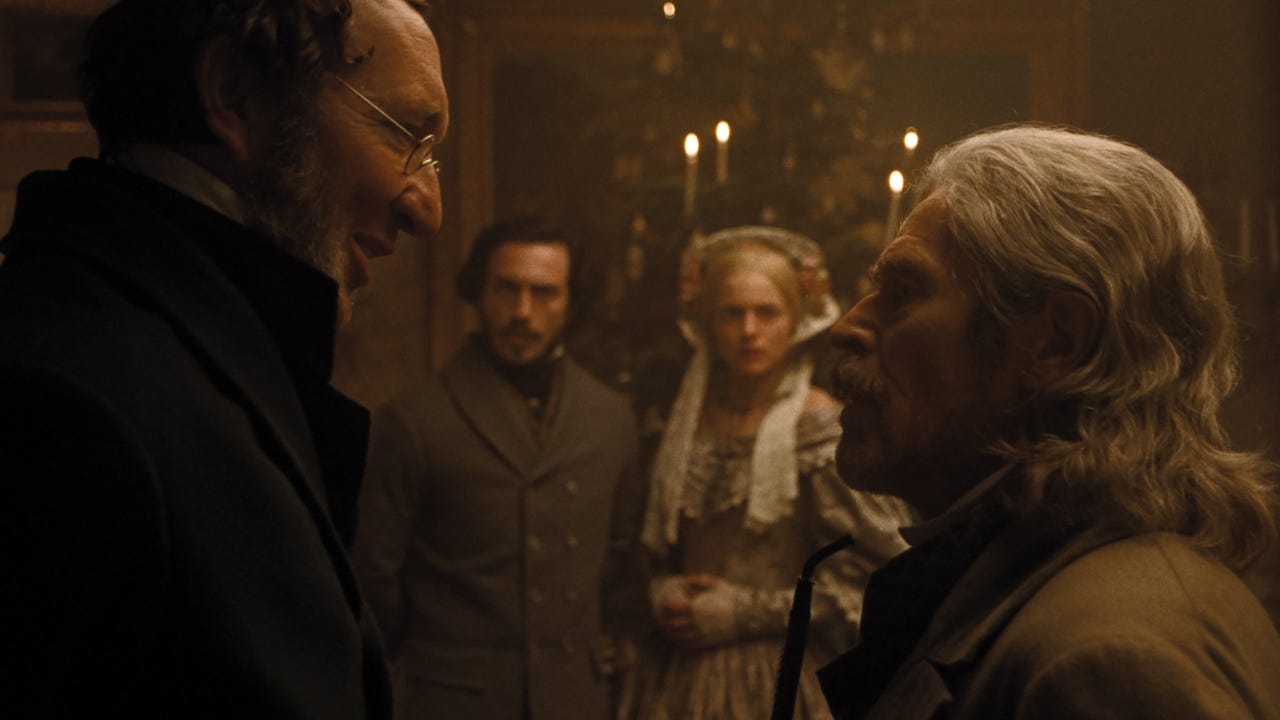
Greatly confusing matters, for instance, is the decision to add to Nosferatu’s already sizeable cast the characters of Friedrich and Anna Harding (played by a miscast Arron Taylor Johnson and rather lost-looking Emma Corrin), whose home Ellen resides at pending Hutter’s return from Transilvania.
Adding nothing to the film but narrative convenience, the pair’s tiresome involvement with Ellen, Hutter and company stalls the film’s advancement, woefully delaying the arrival of disgraced Professor Albin Eberhart Von Franz (Willem Dafoe), the infamous, eccentric Swiss philosopher who is hired by the progressive physician Dr. Wilhelm Sievers (Ralph Ineson). Equipped with his understanding of the occult, only Von Fran can decide what must be done to save Ellen from her rapture—yet, entering an already muddled stage, viewers are hard pressed to appreciate Dafoe’s talents, which here feel robotic and empty.
Like a jar of marbles dropped from a height, what results is an unfocused, scattered melee of activity for an unforgivably long period of time. Repetitive, mechanical jump-scare scenes at the Harding residence are interspersed with boring, inconsequential ramblings from Taylor Johnson’s Friedrich and irritating diatribes from Von Franz. Hutter is mostly forgotten, whilst confusingly, Ellen’s possession/infatuation, as Orlok nears, has her jumping illogically between variating states of thrashing hornily around the bedroom Exorcist-style and a healthy, mobile wife dutifully concerned with the safety of her husband.
By the time Orlok sets sail to Wisborg, momentum has all but evaporated. Neither here nor there, our antagonist lacks the meat needed to flesh out and explore his nefarious powers — obfuscated by a sequence of largely needless scenes and subplots — meaning that the contours of what Orlok is, and isn’t, are poorly defined, too thinly spread (save for a beautifully rendered depiction of Orlok’s trademark powers of shadowplay). Crucially, his powers of control and possession take the biggest hit, the alleged grip he is said to maintain on Ellen and Hutter — and the city of Wisborg — being sketchy at best. This was an easily avoidable but impactful mistake, greatly diluting Orlok’s overall dramatic presence.
Ultimately, Nosferatu lacks the intimate atmosphere propounded in its confident first act, its cumbersome, drawn-out middle section placing Eggers’ addition somewhere between Stephen Sommers 2004 action-horror travesty Van Helsing and Coppola’s 1992 campy hit Dracula.
If only much of the narrative clutter were cut back early on in the creative process, starting with Friedrich and Anna — the former, along with his children, being done away with altogether. This would have allowed the film to expand on the Orlak-Ellen-Hutter triad in exciting, inventive ways, all the while keeping a deserving Hoult in the fold.
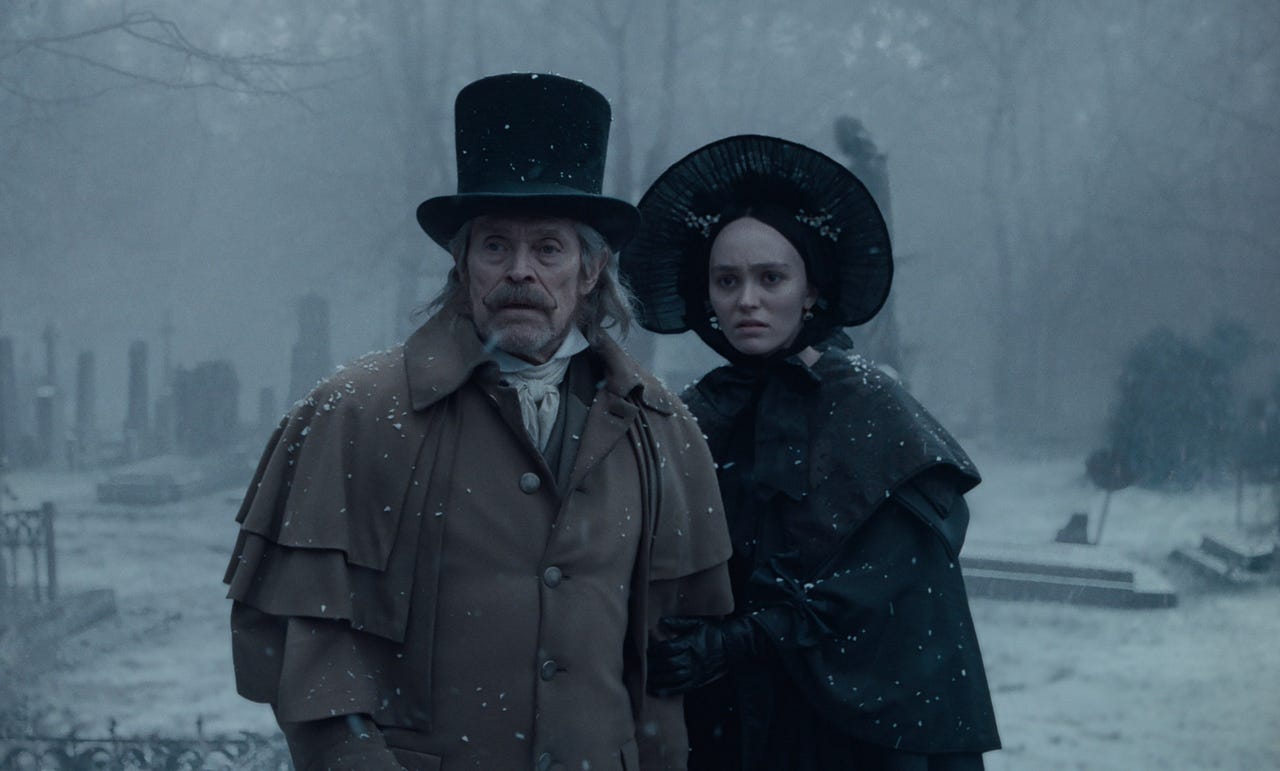
Moreover, barring the sultry, weighty dialogue spoken by its key players, Nosferatu’s script for the most part feels redundant. The movie is at its best, in fact, when very little is said. So visual and aural a film, Eggers would have done better to pay true homage to Furnau’s “masterpiece” by taking inspiration from its silent format by paring down the dialogue dramatically , an aesthetic hinted at in the film’s opening through use of stylised subtitles. If maintained, this would have greatly amplified and sustained the relationship between Orlok and Ellen — itself threatened by the chaos, just about surviving thanks to the stalwart performances of both actors — whilst breathing life into a now tired tale.
Bolstered by Robin Carolan’s chanting, ululating score, the singular voices of both Skarsgård and Depp — one baritone, lento and gravelly, the other breathy, pleading and orgasmic — together could and should have dominated the film’s soundscape. But amidst the chaos, like much else in Nosferatu, they are drowned out. Coming out on top, Jarin Blaschke’s cinematography expertly renders a stark, nineteenth-century aesthetic redolent of Caspar David Friedrich’s Gothic works — serving as the perfect backdrop to a sordid love affair between Depp’s glazed damsel and Skarsgård’s pustulous vampire. All of which makes this rather half-dead, meaningless film nonetheless worth a watch, even if it is, I hope, the last nail in Orlok/Dracula’s oft-opened tomb for another century at least. ∎
· · ·
 Home
Home 
Leave a comment