Pedro Almodóvar’s first foray into English-speaking cinema challenges us to look at life and death in a new, technicolour light
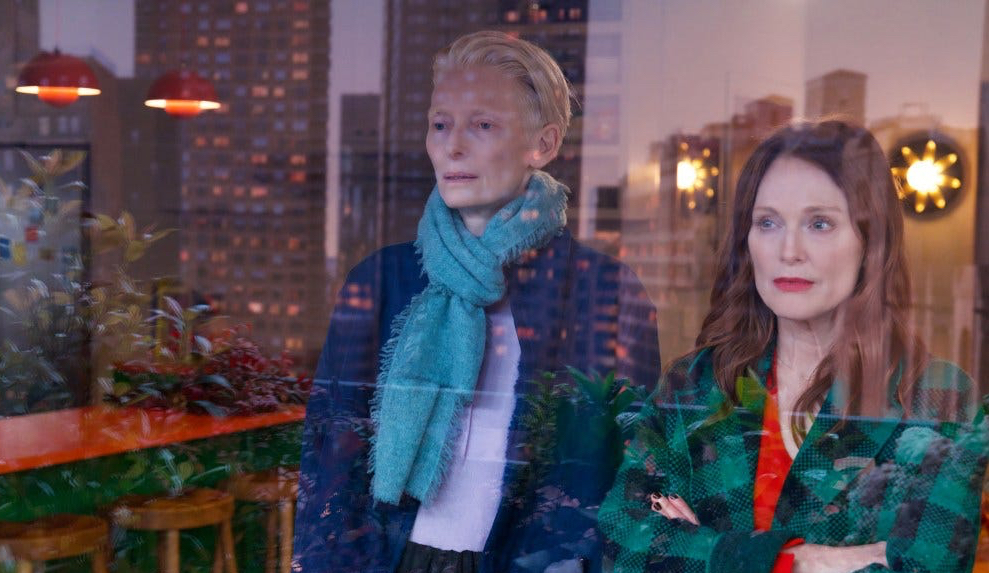
The most telling irony of Pedro Almodóvar’s The Room Next Door, is its titular evasion: when terminally ill but determined-to-die-with-dignity Martha (Tilda Swinton) — on their “final holiday” at a rental in up-state New York — asks that her formerly estranged friend, Ingrid (Julianne Moore), stay in the room next door as moral support, she doesn’t. For the death-phobic writer (whose latest book is a study on her fear of it), knowing that one morning she will awake to find Martha’s door shut, a sign to her that Ingrid has decided to take her illegally purchased euthanasia pill, is simply too much to bear. Instead, taking a lower-level room of their brutally jagged, modernist rental, Ingrid places a comfortable barrier between life and death — dividing two women with starkly different approaches to the latter, but united in their efforts to nonetheless control it in some way.
The film’s actual “room next door” instead becomes a dislocated, invisible space of avoidance (we barely catch a glimpse into the room), a metaphor for our reluctance to talk about death and, ultimately, the end of the world itself. It becomes, for us, as it is for Ingrid, an uncomfortable elephant in the house, but which the stoical Martha is determined to embrace: “Better pass boldly into that other world, in the full glory of some passion, than fade and wither dismally with age,” she quotes from James Joyce’s short story, “The Dead,” whose adaptation the pair watch together on their trip.

Indeed, Almodóvar’s latest film is a stilted exploration of death that refuses black-and-white emotion. It’s tempting to view the so-called emotionless quality of the film not quite as a flaw, which the film has been criticised for, but instead as symbolic of the rather disabling sense of collective inertia we bear as humans confronting/avoiding our demise. Almodóvar’s decision to portray Martha and Ingrid as former friends, brought together in pain, intentionally drives a wedge between us and the raw emotionality you’d expect in their scenario — an estranged friend, last in a list of potentials, invited to help see out the dying days of a former colleague — places us into a strange place. Lacking the close familial bond of, say, Roger Michell’s self-euthanasia study Blackbird (2020), Almodóvar leaves us at odds, challenging us to think about life and death as two sides of the same coin, to think of the bigger picture.
Part of this bigger picture is, in fact, a painting itself. Entering their rental, Martha and Ingrid admire a close replica of Hopper’s sun-baked People in the Sun (1960), standing out from its coolly monotone walls. It depicts a group of tightly clustered, sunbathing hotel guests — not unlike holidayers Martha and Ingrid themselves — who, cornered in the lower left quadrant of the image, observe the vast, arid landscape, baked by a hot, cloudless sky.
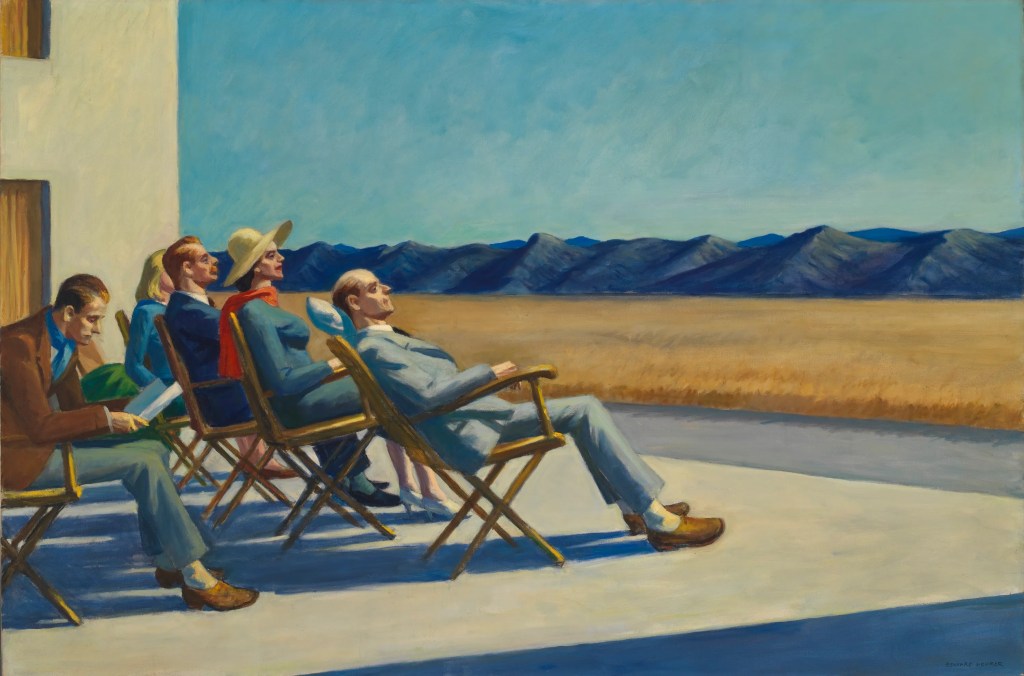
Ever-concerned with our physical and social place in the world, Hopper sharply distinguishes his lifeless-looking subjects from the natural spectacle before them, hinting at our alienation as industrialised, working beings (the guests appear to be donning business attire) with a limited time on this planet. In a contemporary context, however, People in the Sun speaks to the perversity of our condition as humans: doomed as guests wedged uncomfortably into the corners of a planet slowly baking itself.
Like many of Almodóvar’s works, The Room Next Door thus feels quietly Hitchcockian, Alberto Iglesias’s unnerving, spiralling score ever holding something back, keeping unequivocal emotions at bay. And as with Parallel Mothers before it (2022), the pacing and structure of the film is unpredictable and uneven, rejecting a conventional unravelling of events; as if threatening to undo all of its film’s work, upon arriving at their up-sate rental Martha realises that she’s altogether forgotten her suicide pill, resulting in a last-minute trip back to her New York apartment.
Yet all this isn’t to say that the film lacks warmth — Swinton’s life-affirming performance alone forbids this, breathing vibrant life into every scene. Alongside Swinton and Moore’s moving and believable on-screen chemistry is Almodóvar’s signature use of visual splendour — a luscious wardrobe, decadent interiors (Martha and Ingrid, early in their rekindling, drink from Pantone mugs) and a sumptuous use of food — in this case, an abundance of succulent fruit.

Indeed, the film’s exploration of death is saturated with a buffet of rich colours so at odds with the decay that inevitably awaits us all — as if to say, We might be dying, but we can do it in style. During an interview with The Guardian in 2006, Almodóvar revealed that his mother, since the premature death of her father, dressed exclusively in mourning “for 35 years,” even during his birth. Stylistically, for Almodóvar this seems to have manifested in The Room Next Door as a defiant celebration of colour that is hypnotically beautiful to witness, even if it can feel somewhat strained. He goes on to explain that red, seen across all his films, is especially crucial to his work, and it’s tempting to view the very lack of red on lips of terminally ill Martha, deeply contrasting the deep, vivacious red that paints the lips of healthy Ingrid, as homage to his mother’s struggles with grief.
Rejecting the lifelessness of her body, Martha discovers a renewed passion for the natural world around her, a yearning for life — confused and tinged with melancholy though it may be. An electric Swinton naturally captures the determined, vibrant soul behind Martha’s pallid face and thin body, a woman newly attuned with the world around her. How can the mind be so alive in a body that is dying more with the passing of each day, she asks Ingrid.
As such, even though it pains her to water the plants; though she cannot eat the abundance of fruit that sits unused in her kitchen; though it drains her to venture out into the woods and hear up-close the birdsong, faced with imminent death she simply must. The magic of life itself is brought into sharp relief, and the thrills she once found in her career as a stop-at-nothing war-reporter — a career chasing death — is revealed as the perverse thing that it is.
Rather refreshingly, The Room Next Door bravely decries the art’s failure to grasp not our existence as mortals, but as guests in a mortal, finite world. Faced with death, Martha is thus unable to read her favourite works of literature with the literary fervour she once possessed, now so redundant. Instead, all that can speak to her now is Joyce’s “The Dead,” a novella renowned for its ambiguous discussion of life and death.
In it, Joyce’s famed Christmas snow blankets Ireland and bewitches its protagonist, eventually becoming an ambiguous, paradoxical symbol of death, “faintly falling”, quotes Martha repeatedly, “upon all the living and the dead.” Snow, for Joyce, is majestically, infinitely mysterious: beautiful yet cold, white yet technically varicoloured, invigorating yet lethal, translucent yet opaque, and for some even representing rebirth. Indeed, to feel snow on your skin is to be an active, lively participant in life as much as in death — unlike Hopper’s vacant-looking guests who bathe in the dry, lifeless heat.
With spellbinding performances and stunning visuals, The Room Next Door embraces our relationship with dying, its ambiguities, paradoxes and vagaries. Perhaps not to everyone’s taste, Swinton and Moore alone are worth watching in this gentle yet complex study of life and death — and our unknowable place in both.
· · ·
This article was first published on Counter Arts on 8 November 2024
 Home
Home 
Leave a comment