Lanthimos’ latest film exposes man’s farcical attempts to deny our lot as animals in a dying world
*Contains minor plot details*
Hot off the heels of Poor Things (2023), Yorgos Lanthimos returns with a brutally comical anthology-triptych of human suffering and desperation. Bolstered by a diverse ensemble cast headed up by a career-high Jesse Plemmons, Kinds of Kindness depicts three seemingly disparate storylines, each connected by the theme of hierarchical rule found throughout Lanthimos’ growing output.
First off, perfectionist Robert (Jesse Plemmons) strives to meet the demands of his corporate sadist of a boss (Willem Dafoe), who daily cajoles him into gaining weight, cutting his hair and repeating interactions (from trivial to violent) until they’re deemed “perfect”. One day pushed to breaking point, Robert risks losing his job, and the clinically perfect home and wife that come bundled with it. Secondly, cop Daniel, who, when his missing-at-sea explorer wife Liz (Emma Stone) is rescued and returned to him, believes her to be an imposter, against the opinion of all those around him; and lastly, Emily, who, having left her home, husband and daughter, now belongs to a highly exclusive sex cult by the sea whose mission is to find and deify a woman said to possess life-restoring abilities.
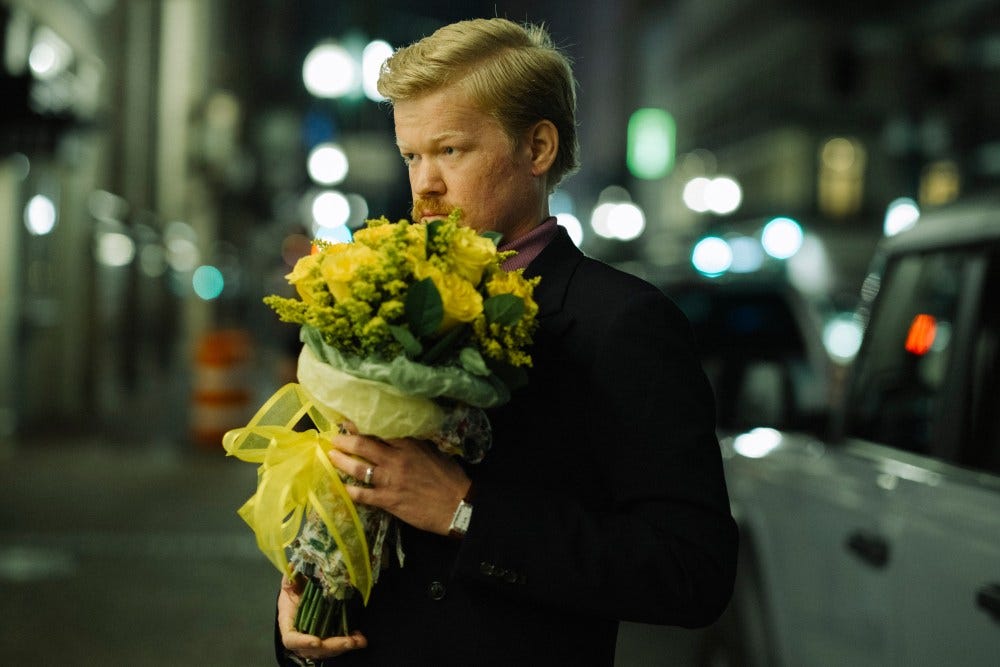
Though distinct in premise, each story contains echoes of the next, both textually and technically. At Kinds’ core, for instance, a sinister un-spokenness reigns, something that dares not speak its name redolent of the stifling silence that haunts the modern world of work and our sickly devotion to it. When, for instance, perfectionist Robert is tasked by his boss Raymond (Dafoe) with crashing into another car on repeat until its execution is deemed of acceptable standard, we’re left to merely wonder at the purpose of the endeavour and the quiet desperation behind it.
Adding to this sense of claustrophobia is Jerskin Fendrix’s unnerving, skeletal score, his jarring piano notes steadily weaving feelings of dread and discomfort throughout all three acts. Seamlessly connecting one part with the next, John Maclean’s slick camera work, meanwhile, advances, retreats, waits in the sidelines, and observes characters from above and below. Untrusting of, but curious about, its human counterparts, the camera shifts snakelike and slyly, as if to suggest that we, too, are animals as spectators.
And this is no coincidence. Lanthimos utilises the theme of submission to skilfully expose the comedy, horror and fallacy of the human condition — which, by so closely approximating humans with animals, he all but eradicates. Animals feature heavily in Lanthimos’s oeuvre, 2015’s The Lobsterbeing its most blatantly anthropomorphic in nature. But never before has Lanthimos’s work felt so inwardly zoological, and watching Kinds feels akin to engaging in a study of human nature, and all its ugly foibles, in the truest sense. This, again, is reinforced by the triptych format, the repetition it entails provoking the feeling of case-study analysis, whilst Lanthimos’ decision to reuse actors — to reincarnate them — shrewdly hints at mankind’s life sentence, doomed to relive its failures ad infinitum.

Where previously Lanthimos’ absurdist world-building has spanned decades, countries and milieu, the grandiose hotels, palatial homes and plush, monied interiors that feature heavily in the first and last episodes of Kinds in particular echo the very modern, lavish world of Hollywood filmmaking (and its Silicon neighbour). Deeply profiteering, Lanthimos seems to portray this world — and those within it — almost as a modern aristocracy, the column-fronted homes of some of its wealthier, authoritative characters certainly evoking the colonial era, one of stark inequality and exploitation that chimes with injustices surrounding the Hurricane Katrinadisaster and its near destruction of New Orleans.
There’s an irony to Lanthamos’ critique of power and privilege here, however, given that Lanthimos himself, an auteur filmmaker with extraordinary creative directorship, assumes something of an autocratic role in the film’s creation. Dafoe’s turn as the hairsplitting micromanager boss says as much. In one memorable scene, he asks subordinate Robert (Plemmons) to leave and re-enter the room and recommence a conversation they were engaged in for a more idealised “take,” and in another, asks his young housewife (Margaret Qualley) to take a picture of a courier’s uniform and send it to him in his absence, his goal being to ensure that the courier conformed to proper uniform etiquette — the “perfect” manifestation of a courier, that is.
Such a level of fastidiousness could be said to closely reflect that of a director, not least an auteur director like Lanthimos (or, say, David Fincher, who is said to have made Amanda Seyfried take one particular scene 200 times). Added to this his penchant for recycling actors across his works, Lanthimos, in a way, himself sits atop an exclusive cult whose power dynamics perhaps mirror those of the L.A.-esque sex cult he analyses in the movie’s third act. (It should be mentioned, however, that Lanthimos prioritises a freer, more relaxed creative environment when working with his cast, using games to encourage creativity).
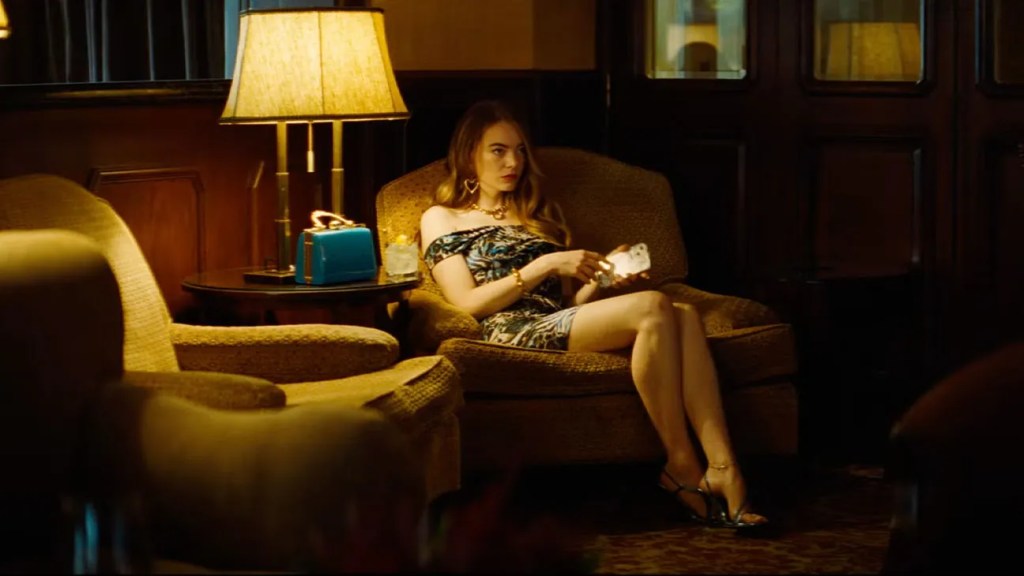
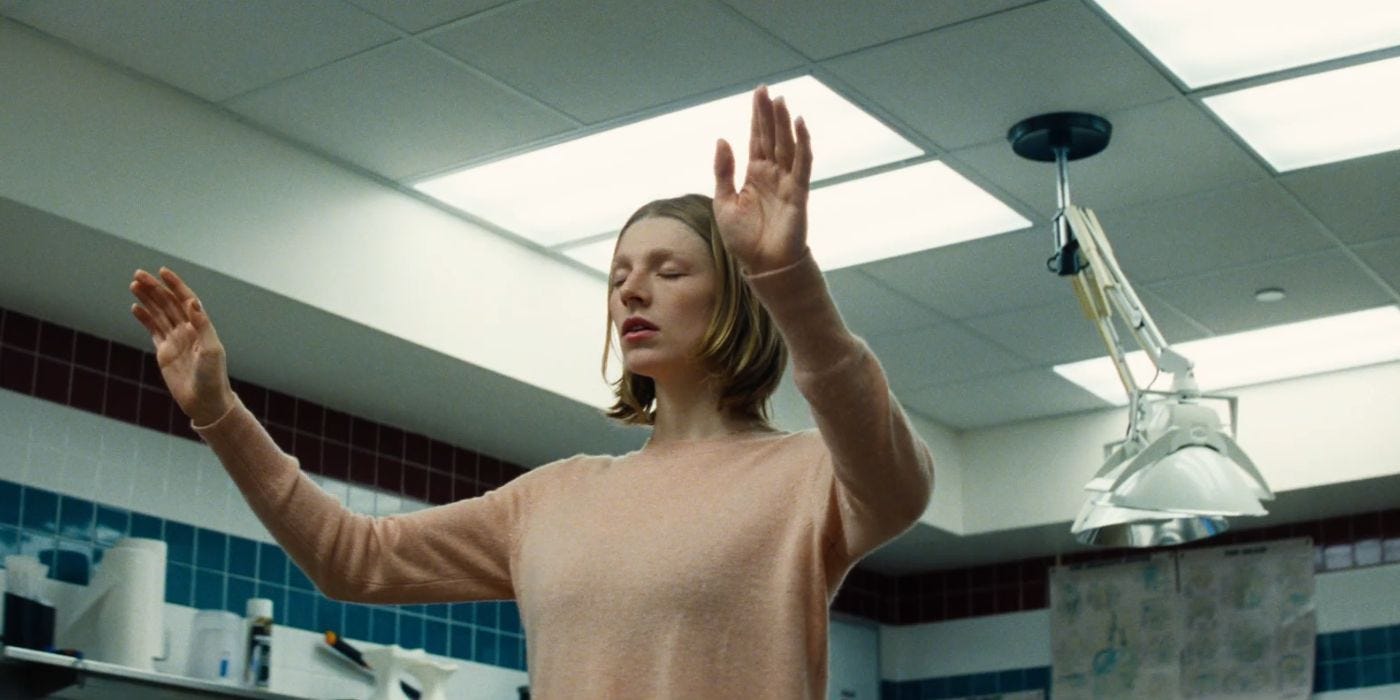
It’s during act three that Lanthimos’ critique of Hollywood is most apparent, analysing through clever analogy the dehumanising, toxic casting processes embedded within it and which form its beating heart. Central to this is the ultra-servile Emily (Stone) who, alongside her fellow cult member and professional partner Andrew (Plemmons), dons trendy sandals and androgynous suits typical of today’s hipstery execs. Between anxious puffs of her vape, Emily (literally) joyrides from A to B in her flashy sports car, ever searching the corpse-resuscitating woman believed to be her cult’s deity. Their plan is simple. After stripping a candidate down and taking her body measurements (down to the distance between each nipple), they have her attempt to resuscitate a cadaver (i.e. audition). If she’s successful, we learn, she will be housed in the super yacht — eternal symbol of both celebrity and wealth, on stand-by for her eventual arrival.
But, instead of centring in on the typically glamorous trappings of ultra wealth, Kinds of Kindness brilliantly reduces its characters to our most basic instincts — food and sex, violence and submission — and exposes our need to routinely distort that which makes us animals in order to be human, to be distinguished from animals.
Eating, sex and procreation, much too trivial in their strictest sense, are refashioned as instruments of personal gain closely bound up with our status as humans. Food and drink in Kinds, like sex, function as a currency of conformity, whether a must-be-perfect choice of drink at a plush hotel bar, self-harvested fingers and internal organs served to one’s spouse, or water, sourced from a well of cult-wept tears and supped from Stanley-sized bottles by on-the-road studio execs. Sex, meanwhile, if not wielded to maintain control over others, is an isolated product to be consumed by spectators (second-act Daniel, missing his lost-at-sea wife, invites couple Martha and Neil to join him in rewatching a sex tape of the four — a degrading group fuck typical of your average porn site — as a form of mourning).
Look to social media now, moreover, and we glimpse this at play in the real world. Bodies aren’t natural entities with organic needs and functions, but, by and large, units of beauty and power to be dissected and controlled in the name of “self-improvement”. Food is a contentious site where identity, status, money and knowledge meet, a fractured world of voices and information in which people are ranked by what they eat. And sex, now a widely monetised product and form of entertainment, is categorised and disseminated across various platforms (OnlyFans, etc.), or hinted at on regular social media as “thirst traps,” becoming, like all else, a form of currency.
All that was once natural, including water, has become fetishised, the absurdity of which is parodied in the movie’s anthropomorphic use of dogs. During the second act’s credit roles, for instance, we witness a montage of scenes portraying dogs acting out human lives — as civilised, non-domesticated beings — implying that humans are the domesticated animal in the equation. This reversal is made all the more clear given that Liz and Daniel’s home, with its wooden interior panelling and bamboo blinds, coupled with an especially verdant garden, stages a very natural world — a humbler abode at odds with the mid-century brutalist bungalows and palatial homes of the first and final acts respectively.
Of course, this fetishisation of our basics needs and urges is symptomatic of our efforts to suppress or deny our mortality, hence our subconscious desire for transcendence — to see our name immortalised on the Hollywood walk of fame. It’s no wonder the Hollywood-style cult of the film’s third act is so preoccupied with harnessing the powers of resuscitation, an antithesis to the natural means of procreation (and by extension, death). Lanthimos’ repeated use of the absence or prevention of children throughout Kinds is thus a rejection of that which makes us most animalistic: new life, and the eventual expiration of the progenitor it entails.
Removed from the customary trappings of the world we know all too well, Kind of Kindness lays bare the (self-)destructive lengths we’re willing to go in order to evade the living-and-breathing, humdrum mortality that defines our lives as animals — or, rather, as domesticated dogs. This is a reality we dare not speak about and instead drown out with desperate acts of distraction (ergo our silence surrounding the climate crisis and the impending doom it is yet to sow). Yet this is a cold reality no amount of fast cars, AI-based technology, or trips to a one-day inhabitable moon can mask, as the people of New Orleans know only too well.
· · ·
This article was first published in Counter Arts on 25 September 2024.
 Home
Home 
Leave a comment