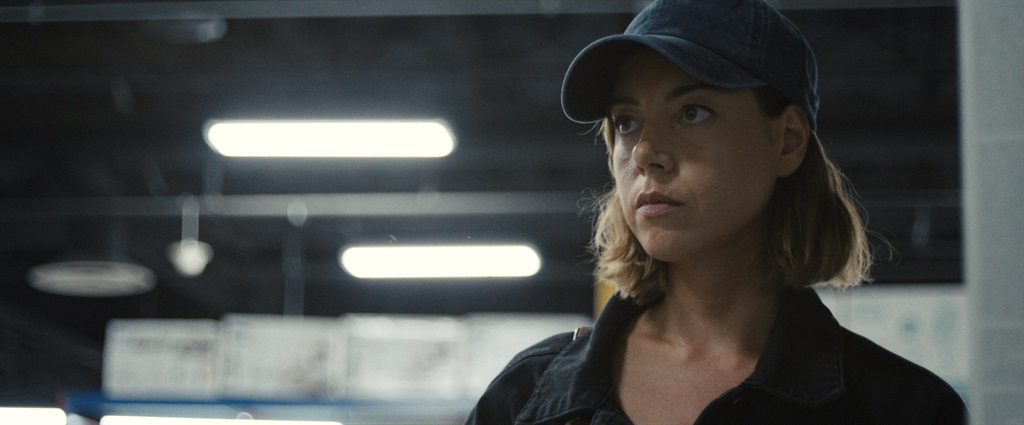
John Patton Ford’s thriller is a tense depiction of survival in a morally bankrupt world
American philosopher and Nobel peace prize winner Jane Addams (1860 – 1935) once quipped that “the essence of immorality is the tendency to make an exception of myself”. Her words are traditionally used to illustrate the innate hypocrisy of humans, highlighting what is perhaps our defining Achilles heel. Today however, during what we might call the age of the ego — in which the ceaseless pursuit of the hyper-consumerist self takes centre stage — the compunction in her words feels somewhat redundant. Reappropriated, Addams’s aphorism could be understood, ironically, to reveal the opposite; we know the extent of our hypocrisy, shrugging off any guilt arising from our fast-living habits with millennial/gen Z “awks, I know…” detachedness.
It’s this very prioritisation of the self which has come to define modern living. Every minute of every day is, or could be, assigned at least productive and at best economic value. Hence the near beatific resonance of the term “productivity” and its cognates, both professionally and privately, with the plethora of self-improvement and productivity apps rammed down the throats of Instagram users a case in point.
Instagram, despite its hippyish origins, is today the defining platform of the modern ego, providing users with an interminable, carefully curated feed of seemingly perfected lives — silently nudging us, of course, to spend. Paid-for celebrity content or not, the pivotal “I-have-something-you-don’t” element of most Instagram profiles nonetheless ultimately results in the subconscious urge to spend (go on holiday, improve your wardrobe, buy better food, etc.).
Thus, thanks to today’s instant-culture, the individual has never had more capacity to generate money in any given second. The exploitative gig economy, made up of predominantly low-income workers, plays a central role in feeding this culture, facilitating the need for instant (and delayed) gratification, all the while lining the pockets of the tech kings at the top and fueling a vicious late-capitalist machine.
This is a system we’re all guilty of supporting, and given the near constant ubiquity of advertisement — offering “users” myriad opportunities to spend — we’re hardly to blame. Just look at the runaway success of ultracheap consumer giants like Shein and Temu for whom worker exploitation and dubious data ethics are baked into their business model. Yet as the controversies mount, consumers worldwide, hooked on the throwaway merry-go-round, continue to purchase their fob-off party-wear in droves — all with an ironic, somewhat trendy air of “oops”.
Likewise, taking advantage of the door-services available to us all, tech giants like Uber and JustEat, which continue to underpay their staff, deliver meals, rides and experiences at the touch of a button (in doing so rather symbolically mirroring the western trend of “picking up”). Cognitive dissonance is a thing of the past, apparent in the curious recent uptick in incidents of “dine and dash” in the UK, a trend not solely put down to the cost of living crisis but an unadulterated desire to obtain life’s finer things for free.
Yet the on-demand business model is not exclusively dependent on cheap, disposable labour. The UK has seen gig work sore following the effects of the cost of living crisis, while a survey of over 1,000 American college graduates concluded that almost 70% of those who had recently graduated have engaged in gig work to make ends meet or pay off gargantuan student debt as quickly as possible.

And as any recent graduate saddled with student loans to pay off in a failing economic and job climate, thrust out from college into an unstable post-financial crisis and -pandemic world, life is an uphill struggle. Culturally, meanwhile, as researcher Eli Joseph wrote recently for Fortune magazine, “young people are experiencing a volatile reality of pressure, anxiety, burnout, and emotional distress. Despite being implored to be patient because they’ve ‘got a whole life ahead of them,’ the overwhelming discomfort settles in as time waits for no one.”
It’s no coincidence that faced with all this, LA-based, debt-burdened graduate Emily Benetto, played by a career-high Aubrey Plaza in John Patton Ford’s sleeper-hit Emily the Criminal (2022), turns to crime in order to make ends meet. Held back by a criminal record (she was involved in an aggravated assault incident during college), Emily is frozen out from well-paying jobs with a future and so endures zero-hours work with a catering company, serving the offices and its personnel who are, if it weren’t for her lower paycheck and job title, her peers.

Fed-up with irregular and low-paid work, Emily follows a tip from a colleague and tries her hand at dummy shopping — the practice of shopping with stolen credit cards, provided by a handler, before they’re reported missing. Learning the ropes, and that she has a knack for the job, she quickly progresses whilst forming an unlikely bond with her handler and operation leader, Youcef (Theo Rossi), who recognises in her a certain penchant for thrill.
Not giving up on her hunt for sustainable work, however, Emily, through a friend, lands an interview at an esteemed LA advertising agency. Faced with the typical corporate interview spiel from the self-made “feminist” boomer who cut her teeth working against the male-dominated marketing work, in a now famous scene, Emily eventually learns the role is an unpaid internship. Challenging the notion of unpaid labour, she’s called “spoiled” by the baffled hustler, highlighting the widening cultural chasm between generations today — those for whom the hustle meant stability, meaning, income and a home; and those who see through the allure of modern work and its exploitative, ultimately meaningless nature. (Recent work trends like “quiet quitting” and landing a “lazy girl” job proves that the Wall Street shine, and the lifestyle it represents, has worn off the office windows, revealing a disillusioned generation of workers).
Moreover, given that 50% of workers in the US report being bored at work, burnt-out, or both, the rather adrenaline-fueled thrill found in clandestine work like dummy shopping hints at a need for something more, higher stakes perhaps. For Emily, the promised thrills and rewards of the modern grind, now somewhat predictable and defunct, are replicated in the dicey games of risk Emily engages in — crucially, free from the suffocating, hierarchical confines of the office.

Crime has gone mainstream. The criminal underworld feels not so ‘under’ anymore, instead diffused across all walks of life — and wholly visible, if not celebrated, in popular film and TV (particularly where women are concerned). Emily the Criminal is one of a long list of high-profile films and TV shows — Breaking Bad, Good Girls, Widows, Griselda, Ozark, Dead to Me, to name a few — that play with the distinction between good and bad.
Much of this is perhaps attributable to the financial crisis. When corporate banks, targeting low-income workers with predatory loans, crashed the economy in 2008 only to be bailed out to the tune of hundreds of billions in taxpayers’ money, such a crime wave is no surprise. When so few at the top reap the benefits of the many, who can blame characters taking matters into their own hands in order to get by? Added to this the impending doom of man-made climate change, the defining symptom of resource-guzzling capitalism, maybe we’re witnessing a certain dine-and-dash, hedonistic glee in seeing on-screen friends subvert norms and stick it to the man.
At times unbearably tense and bolstered by believable, sharp acting from Plaza and Rossi especially, Emily the Criminal captures what it is to live between the cracks, locked out from a thankles, saturated system. Fighting against it, Emily is part of an invisible workforce of people who, in this morally bankrupt age, turn to new, subversive ways of living. It remains to be seen how the prospect (or success) of a convicted felon becoming US president for the second time might further influence the pro-crime craze — the likelihood of which alone would have Jane Addams turning in her grave. ∎
 Home
Home 
Leave a comment