
Alain Guiraudie’s subdued sexo-thriller explores the conflicted, complex world of cruising — one of both sexual freedom and cold disregard for others
When between-jobs Franck (Pierre Deladonchamps) begins visiting a Provençal nudist beach and venturing into the surrounding woods for sex, he one day meets Michel (Christophe Paou)— the “musclé,” tanned stud with a dangerous allure. Spying him from afar one evening, the beach deserted, Franck witnesses Michel drown another man in the lake, kickstarting a lethal, steamy attraction which will test Franck’s notions of safety (both physical and sexual) and community. Set exclusively at the lake, Alain Guiraudie’s subdued sexo-thriller explores the conflicted, complex space cruising — or “la drague” — inhabits: one of both sexual freedom and cold disregard for others.
It’s the verisimilitude with which Guiraudie depicts the quiet world of cruising that makes L’Inconnu such an engaging, tensely voyeuristic watch, capturing the primitiveness of this rather heterotopic space with stripped-back realism. Deladonchamps, meanwhile, is superb as the somewhat inexperienced but willing participant tasked with navigating an ambiguous, voyeuristic world.
Beginning with his arrival at the lake, the film follows lake newbee Franck as he enters into a subdued, gay economy, one governed by unspoken codes of conduct: a lingering stare, an inviting nod, a look of quiet approval. In a clever mise en abyme, we’re invited to watch Franck as he snakes through the “bois,” himself observing participants engaged in various acts of sex.
We also sense, however, a certain detachedness beneath it all, apparent especially on the beach where visitors sit apart, coolly size one another up and largely abstain from striking up meaningful friendships.
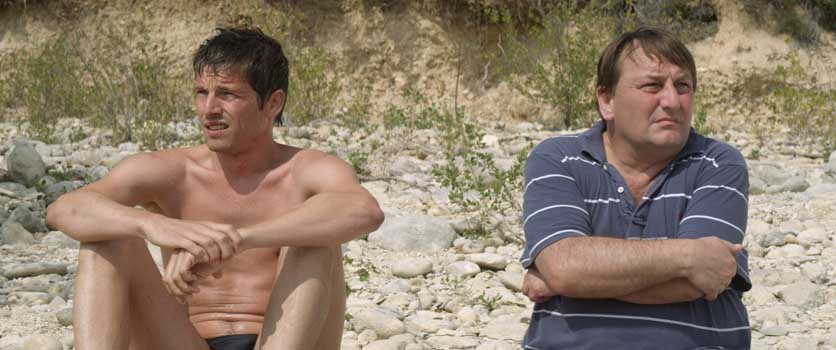
It’s this very coldness which spurs Franck to the safety of outsider Henri (Patrick d’Assumçao) when he first visits the lake. The straight acting aloof, recently separated from his girlfriend, exists on the beach’s periphery, suspicious of the community’s brazen approach to sexuality. Attracted to his kinder and sensitive ways, unlike the transactional dynamics of the beach, Franck feels at ease with Henri, even if puzzled by his refusal to interact with fellow beachgoers or swim in the lake, ever fearful of the cannibalistic (and unmistakably phallic) “silures” he suspects lie within.
But, catching sight of the mysterious Michel, who emerges Bay Watch-style from the water in the distance, Franck cannot help but feel the allure for more. Thus Franck keenly makes himself known to the seasoned swimmer and sought-after cruiser. Bronzed, muscular and clone-like, Michel is Henri’s opposite, emitting an air of dangerous power with his cutthroat swim and sharp, devilishly handsome features.
And it’s with no shortage of brutality that he one evening drowns his lover du jour, Pascal, observed by Franck from the seclusion of the trees. Though disturbed by what he sees, Franck’s attraction to Michel only grows, and thus he remains silent.
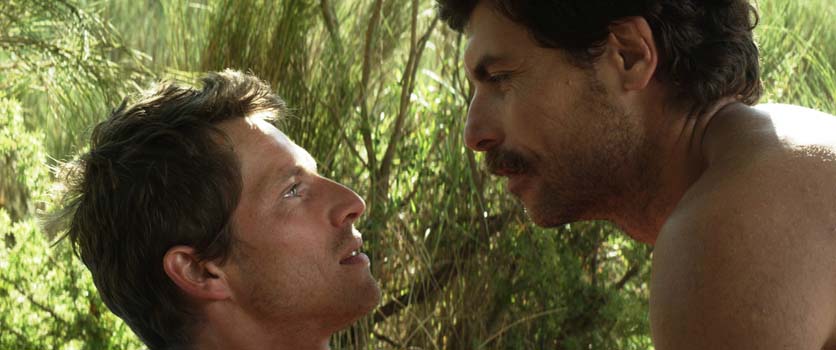
Indeed, there’s a constant tension at play in L’Inconnu between the pulls of safety (and its cognates conventionality and security) embodied by Henri, and the sexual danger posed by Michel. Released before the general availability of PrEP, the pre-exposure drug treatment preventing the contracting of HIV, the film is set in a time in which safer sex meant the use of condoms only. While with one partner, Franck will be viciously judged by his preference not to use condoms, with Michel, once the pair strike up a sexual relationship, his preference for unprotected sex is matched — the pair sharing impassioned, “capote”-free sex together.
Despite their steamy romance — made all the more real by the use of doubles for “unsimulated” sex — Franck nonetheless gravitates back to the safety of Henri. Representing a hetero-adjacent, safer existence, Henri takes pride in his simpler, sex-free life. Keen to get to know Franck at a personal level, he is wary of Michel’s eroticised body and dangerous allure, preferring to keep the lake and all that it encompasses at arm’s length. Michel, on the other hand, seeks out passionate but impersonal sex, located exclusively at the lake (he insists on meeting with Franck only there and reveals nothing of his private life). Wavering between both figures, Franck oscillates between the poles of conformative safety and sexual thrill, moving up and down the beach as he does so.
Yet, when Pascal’s body is discovered days later, the arrival of inspector Damroder troubles the waters. Though sympathetic to the act of cruising, the outsider is dubious of the callousness he witnesses at the lake, leading him to probe into and question the community’s blatant sangfroid. Torn between the forces of Henri, the Detective, and Michel, what will become of Franck? A tense psychological game of cat and mouse ensues as Franck swims dangerously close to the dark, unknowable centre that is a lake-bound romance with a killer — whose next move he cannot gauge.
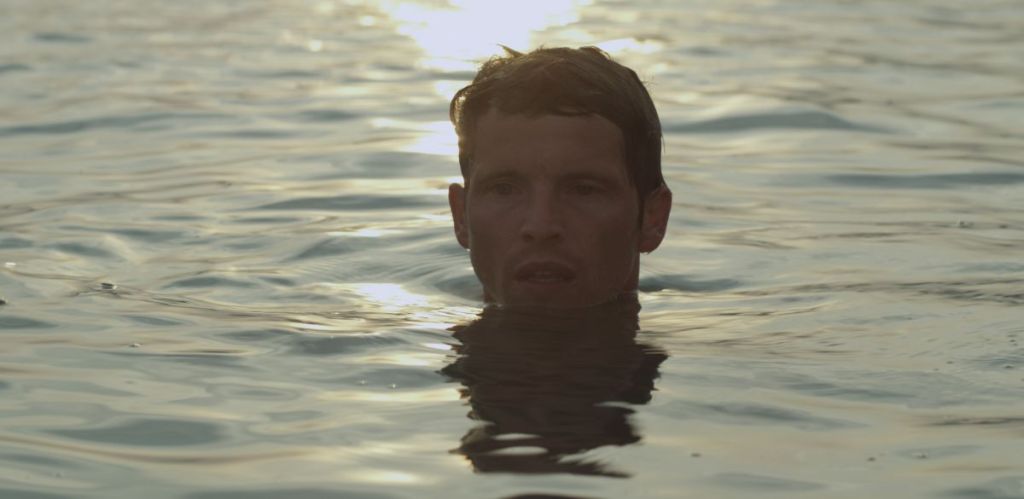
Like entering the deep, expansive lake itself, navigating the dark, unknowable waters of cruising is an alluring thrill. What it is to be part of a seemingly liberated, mutually supportive community is quickly turned on its head; just how safe are we, outsider Damroder presses, when the murder of a gay beachgoer goes virtually unnoticed, with regulars returning the next day as if nothing ever happened? Delving into the enticingly liberated world, Guiraudie tests the yearning for domination that runs deep through the veins of a troubled, perhaps cannibalistic community in this taut, rewarding thriller. ∎
 Home
Home 
Leave a comment