Andrew Haigh’s All of Us Strangers is an oneiric, haunting exploration of modern gay existence

*Spoilers*
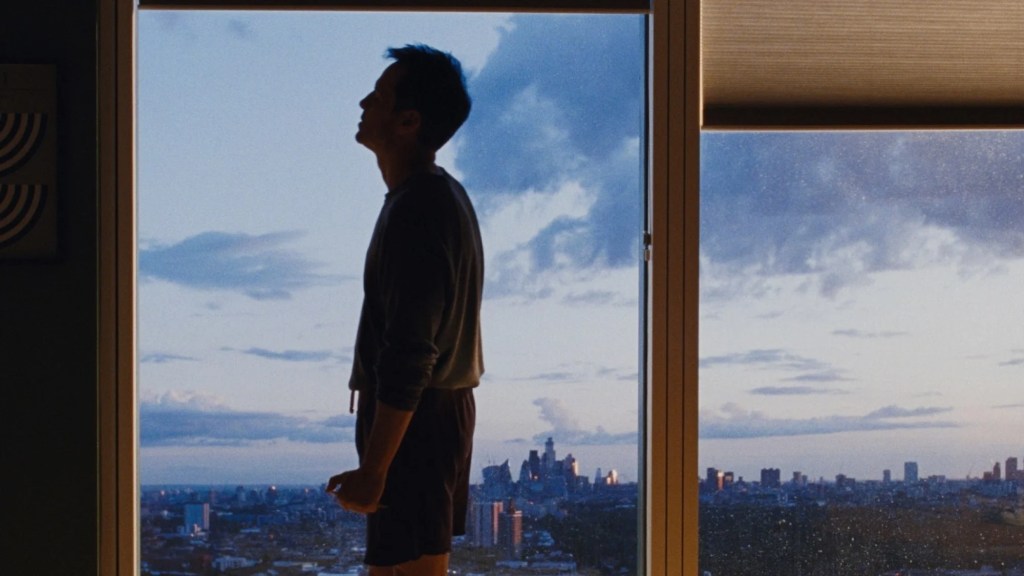
All of Us Strangers — based on the 1987 horror novel Strangers by Taichi Yamada — opens, somewhat dream-like, with a view of London, a timeless could-be-dusk, could-be-dawn skyline dominating the screen. Protagonist Adam’s (Andrew Scott) face gradually appears, a forlorn spectre gazing out from his apartment window. A light appears on the skyline of this view, phosphorus and beautiful, one we might mistake for a shimmering star. Only it grows suddenly, resembling the first blindingly bright split seconds of an atomic bomb’s detonation, threatening to encompass all of London and, eventually, the screen itself.
For the work-from-home screenwriter, the world beyond his apartment is one of perpetual anxiety. Living in a trauma-induced prism of 1980s culture, the threats of nuclear war and AIDS — vestiges of the world he grew up in — ever loom. Thus when he is forced to exit his building one night following a rogue fire alarm, the camera tilts up to display a spectacular night shot of the high-rise building in such a way that it closely resembles the infamous ‘AIDS monolith’ featured in the government’s harrowing AIDS awareness campaign ad.
Perhaps befittingly, then, when Adam looks up and catches sight of Harry (Paul Mescal) above, leaning against his flat window and looking down at him, he cuts a rather ominous figure. The mood is discernibly gothic; the only two inhabitants of the newly developed block of flats, their lit-up windows, levels apart, are mere blips on an absurd tombstone of vacancy — two stars without a centre.
Knocking on Adam’s door later, Adam is forced to switch off the music video to Frankie Goes to Hollywood’s “The Power of Love” he has playing on the TV. Visibly drunk, he asks to come in, not before asking “How do you cope?”, referring to the deafening, space-like silence which pervades their lonely tower-block life. Sceptical, though perhaps not wholly uninterested, however, the long-time singleton is unable to acquiesce, to quite literally let someone in. “There’s vampires at my door,” teases a grinning Harry, pressing his face up against the doorframe and riffing off Holly Johnson’s iconic lyrics. Unmoved, Adam shuts Harry out and returns to the secluded safety of ‘80s television and self-medicating weed.
Less comforted by the presence of real humans, Adam prefers to spend his downtime with his deceased parents (played by Bell and Foy) — killed in a car crash when he was 12. Struggling with writer’s block, the next day Adam browses through old family photos and is prompted to embark on something of a spiritual journey to the family home. Arriving, he meets his parents who welcome him back as though home from the war. Ensconced in a distinctly ‘80s interior (lit cigarettes, low-ball whiskeys, records playing), Adam quickly settles back in — his parents keen to get to know the man before them.
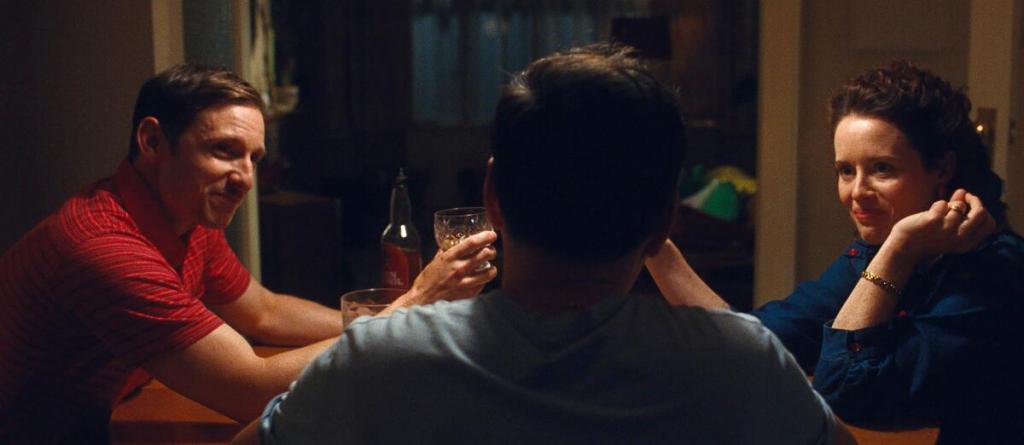
Inspired by his visit home, Adam is able to write again, finally adding meat to the empty stage directions which haunted his page until then. He’s likewise able to approach neighbour Harry, whom he catches in the building foyer, and apologise for his abrupt rebuff — opening up the floor for a meet. Adam’s regular visits home, coupled with his newfound life with Harry, together form the two strands of a beautifully spliced film, interwoven with the aching, hyperbolic threads of sadness, longing and warmth redolent of an imagined, ever-present past. Oscillating between both worlds, we teleport between conversations with neighbour Harry, on the vertical strand, shuttled via the lift, and his parents — sometimes together, sometimes alone — on the horizontal.
Crucially, in revisiting Adam’s youth — moving backwards — Haigh brings together the turbulent world of the ‘80s Adam grew up in and the modern, deeply isolated world he inhabits today in order to highlight that despite progress, the threads of gay loneliness and shame still run far. Coming out to his contemporary mother, then, in his first one-to-one with her, prompts her mention the widely broadcast AIDS monolith ad in panic. “They say it’s a lonely sort of life,” she then prods. “Are you lonely?” Pulling his hand away, his retort is defensive and desperate: “Everything’s different now,” he tries to convince her, highlighting that gay people can marry, have kids, a normal life.
A niggling sense to the contrary pervades. Millennial Harry bridges Adam’s pained youth with the very different present, but, as his frank (if rather cursory) conversations with Adam reveal, the threats synonymous with the ‘80s haven’t gone away, only evolved. There is, of course, the assumption, or even willing, that the trauma most gay experienced in the ‘80s has passed, that the times are healed — due in no small part to the plethora of queer-centric film and TV in existence today.
Yet more than merely understanding one another’s suffering, we find that the pain central to the identities of both Adam and Harry is in fact one and the same. Like Adam, Harry has no “spot in the centre,” he claims, his sexuality exiling him to the “periphery”: times may be better, but “being gay just puts a name to [being different].” Similarly, opening up about the death of his parents, Adam speaks of the “terror of being alone forever” that forms part of his very existence. Asked if he understands, the camera settles on a teary-eyed Harry who confirms that he does — all too well.
If only such scenes were afforded the complexity of those with Adam’s parents, we might have a firmer picture of the somewhat thinly constructed Harry, whose dreamed existence, being too one-dimensional, hits prematurely (and whose strained Yorkshire accent distracts from dialogue). There is, too, a sense that given the film’s intimacy (a cast of four, there being one real character), it is difficult to reconcile the titular “all of us” with the contained world of one man’s imaginary conversations with a ghost.
Nonetheless, after coming out to his parents, though painful, Adam is able to move on and enjoy the life he was never afforded with them. Both strands thus nourish Adam, helping him to both have the relationship with his parents he was denied because of their death, and explore life as a gay man today with Harry. Ultimately, however, the death of his parents is merely a symbol of the inevitability of adulthood and the impossibility of ever truly “going back” to childhood. After all, as Adam gazes into the windows of a moving train having arrived home for his first visit, we see the reflection of the town name panel: heavily distorted and in reverse, it’s an omen for Adam’s backward-facing life.
Not real, then, his fantastical worlds cannot endure. For Adam, this becomes apparent on their night out together, come about when Adam is inspired to go out “into the world!”. Dosed up on ketamine, Adam falls into a K-hole in which he envisions a life with Harry — an intense montage of vignettes based in Harry’s flat: eating together, watching 80’s TV, bathing one another, gazing lovingly at each other from across rooms and activities: it’s a simple, but false and unattainable life.
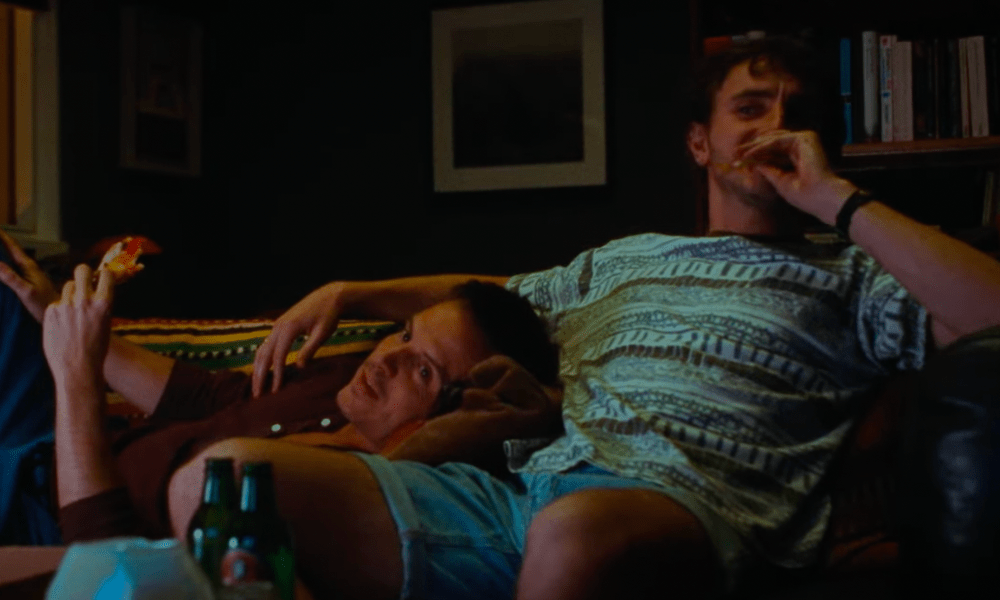
The dream-trip montage therefore collapses in on itself (hence Blur’s doubly symbolic “Death of a Party”). Still hallucinating, in one vignette Adam awakes to the image of an explosion on the London skyline — a giant fireball we barely only just catch a glimpse of — while red and blue police vehicle lights decorate his bedroom walls in a nod to his parents’ death. In another, on the tube, he chases the image of an aloof Harry. Eventually taking a seat, holding back vomit, the screeching, deafening train sounds of the London underground morph into the suppressed screams within Adam, pain so visceral, so deep, they conjure the child-reflection of himself in the train window opposite him: a young boy, screaming, writhing, grasping onto his head in despair.
Thus we come to the crux of it. On the final leg of his trip, adult Adam awakes in his childhood bedroom, pyjama-clad and frightened. Waking his parents, his mother invites him into their bed and reminisces about his late-night habit, “always afraid of something. Nuclear war, rabies” — the razor-sharp fear of existence always germinating in the mind of the prepubescent gay. Laying a hand on his face, she eventually asks, earnest and reaching out to her son perhaps for the first time in her life as a mother, “Are you OK?”.
As Adam begins to sob, “No,” it’s this very unheard, habitually disingenuous question which elicits an agonising breakdown of the world around him. Indeed his mother’s comforts do little to stop the police from arriving outside and banging on the door — red and blue lights again flooding the room. Synonymous with our struggle to grapple with reality, red and blue become symbolic of Adam’s life in the fantasy world, his life of regression. Will Adam choose to move on, live in real life on the hard, cold surface of the earth, or will he continue to exist in a celestial dreamworld, his matrix of make-believe?
Waking in his London apartment the next morning to discover it was all a bad trip, Adam will continue to opt for fantasy. Foolishly attempting to further bend reality and merge his fantasy axes, he brings Harry home, keen to experience the now normalised rite of passage. It will, however, result in the film’s darkest moment: scouring the home’s darkened exterior, frantically looking for his parents, Adam and Harry must settle for their ghostly, haunting image, standing far back from a mottled window, faceless and void of life and unresponsive to Adam’s desperate cries to let him in.
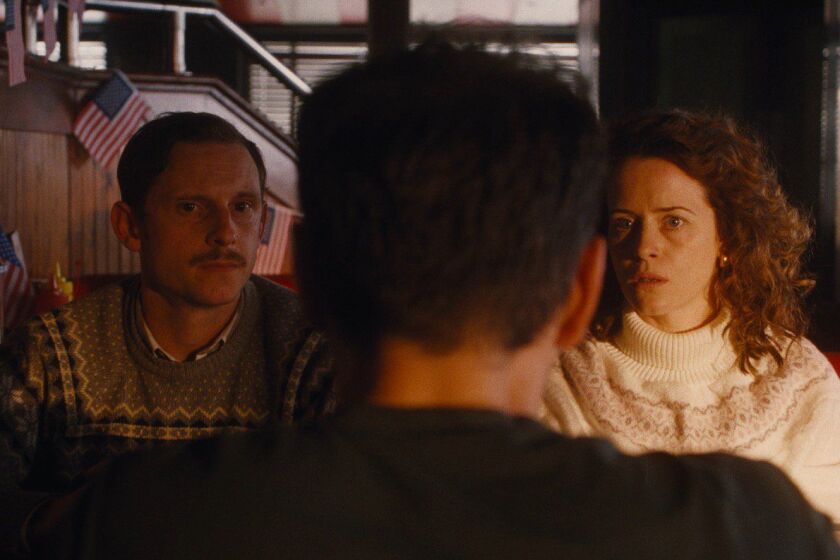
“I don’t think this works like that,” reminds his mother the next day — if we can indeed divide this film’s ethereally timeless structure into units of “days”. Rightly sensing they must leave Adam (and die again) in order for him to live, his parents take Adam out to his favourite childhood diner — ever the ultimate symbol of ‘80s nostalgia. There, they say the goodbyes they were never afforded and give them their blessing to live a happy, love-filled life with Harry, in an impossibly moving yet eerie, uncanny scene.
Returning to London, Adam must confront death again: arriving at Harry’s apartment, he finds the days-dead body of Harry, Japanese whiskey in hand — now empty as the baggie found in his kitchen. Meeting Harry’s ghost in the living room, having just descended from Adam’s first-act rebuff, he calms him, and brings him back up to Adam’s dreamworld. Holding him in the very same position he died, in his bed, they share a last moment together. “It’s so quiet here,” Harry again observes, bookending his time with Adam in outer space.
When Harry asks him to play a record, Adam faces his final red-pill, blue-pill moment: will he break the cycle, change the record, and play something existing outside of his ‘80s doom-loop, or succumb to what he knows too well, but which will kill him? Singing the opening lyrics to “The Power of Love” — “I’ll protect you from the hooded claw / Keep the vampires from your door” — Adam again opts for the latter. Zooming out, their two bodies merge to form the distinctly ‘80s-looking star of Bethlehem depicted in the song’s accompanying Nativity-themed music video. Together they form one, cohesive centre. Bringing Harry in from the periphery, Adam has carved an imaginary centre for them both to exist in — no longer as two blips in outer space, two apartments two worlds apart.
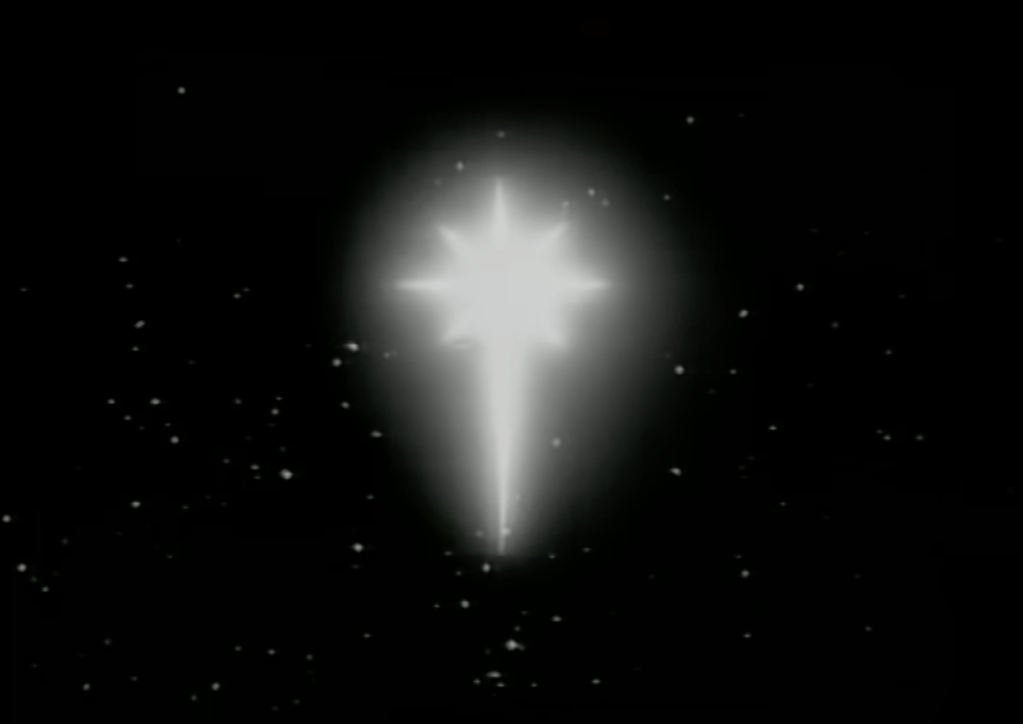
Zooming out further, as the song crescendos, the star transmutates into a shimmering disco ball, iconic symbol of the ‘80s gay scene — one which brought thousands to London on a pilgrimage to safety, inclusion and community. Yet today so large, and infinitely connected-yet-disconnected, it is a community which for some (perhaps not all of us) no longer exists, but is instead a paradoxical, impenetrable sea of strangers, a chorus of deafening silence. ∎

 Home
Home 
Leave a comment