
A twisty take on family breakdown brimming with ineffable rage
How do two adult lives — and all that they encompass — coalesce under the same roof? What lies beneath the quotidian hate shared between a pair, ever growing over the years? What could push a woman, reverse Gone Girl style, to kill her own husband, or a man, suffocated by what he perceives to be an emasculating marriage, to kill himself?
These are just some of the questions placed under the microscope in Justine Triet’s Hitchcockian courtroom thriller Anatomy of Fall when, after her husband Samuel (Theis) is found dead below the attic window of their Grenoble chalet, German wife Sandra (Hüller) is indicted under suspicion of murder. Pried open for public, media and vicious legal speculation, the couple’s relationship is turned inside out. A realist triumph, Triet adroitly explores, on the one hand, how two competing orbits — their egos, professional lives, sexual needs and ambitions — can vie for existence, and, on the other, society’s locust-like need to witness and revel in their collision. Hüller is Oscar-level brilliant as the cool, detached Sandra, the acclaimed author caught in the centre of it all, while Milo Machado Graner delivers a gripping, nuanced performance as son Daniel.
Striking us first off is the film’s strained, detached tone. It begins in media res, pin-dropping us into a gone-off-piste, flirtatious interview between acclaimed Sandra and a female research student. With no discernable structure to their conversation, oscillating between innuendo and vague literary musings, the vibe is uncomfortable and ambiguous, made all the more awkward by her husband’s sudden blaring of a steel-drum cover of 50 Cent’s “P.I.M.P”. Blasting out from the upstairs attic where he DIYs (the couple are converting their attic into an B&B for extra income), it forces Sandra to cut her interview short.
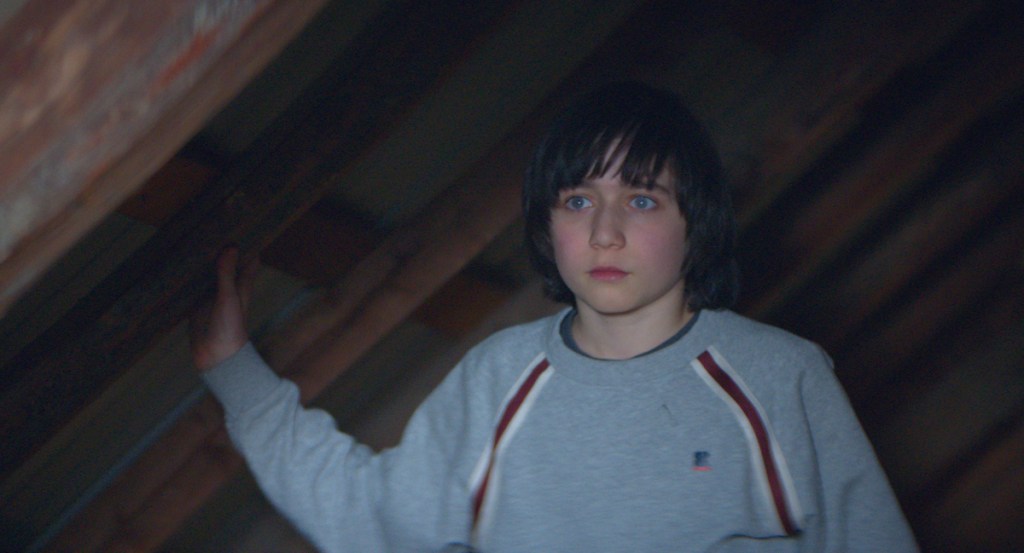
An hour or so passes before their visually impaired son Daniel returns home after walking the dog to find his father dead beneath the attic window, a bloody gash on the side of his head. Daniel’s screams for his mother are only just heard over the steel drums will continue to blare out painfully, and will continue to do so even as the police arrive and conduct preliminary investigations.
It’s this gnawing tension which renders the film such a success. The circumstances surrounding Samuel’s fall (why and, literally, how he fell to his death), for instance, along with the preceding hours, are tauntingly absent — and we’re denied the traditional and signposting typical of courtroom thrillers to aid us through. Equally absent are the years leading up to Samuel’s death, including the vicissitudes and dramas which form the pair’s tempestuous relationship — not least an incident which nearly blinds son Daniel, a tragedy Sandra places largely on her husband. Yet most glaringly absent from is Samuel himself, making only two appearances (alive, that is) well into the film, existing until then as an uncanny non-presence we’re denied the opportunity of knowing. It’s this very not-knowingness which matters. Anatomy of a Fall is about what we cannot see, what we cannot know.
Like seeing, non-verbal sound is crucial to the film too, with language altogether failing: Samuel’s French and Sandra’s lingua franca use of English fail to meet common ground, a token of their inability to coexist.
Instead, loud, violent sound comes to express the space male characters in the film wish to occupy — the desire to be heard, and say what cannot be conveyed through words. Samuel’s obnoxiously loud blaring of Bacao Rhythm & Steel Band’s instrumental (i.e. voiceless) rendition of “P.I.M.P,” for instance, speaks to his status as a pained and struggling author who attributes his wife’s demanding existence to his inability to write. Hence the inherent misogyny in 50 Cent’s hit, while the real-life copyright controversies surrounding the cover will mirror claims of literary perjury between the pair.
Young Daniel, meanwhile, partially sighted, plays somewhat obsessively on the piano, determined to master both Isaac Albéniz’s “Asturia” and Chopin’s prélude no. 4 — both known for their descending, i.e. falling, melodies. Increasingly suspicious of his own mother’s innocence and her relationship with his father, not to mention any personal struggles of visual impairment, Daniel’s frantic, joyless playing — played over the opening credits to a collage of family photos — highlights a boy’s desperate attempts to seek control and make sense of a crumbling family dynamic. (It’s interesting that the fact that actors Sandra Hüller’s and Samuel Theis’s names correspond with their fictional counterparts which, added to the fact that Triet co-wrote the film with her husband, director and screenwriter Arthur Harari, suggests a strong biographical element; that there are visual resemblances between the pairs only confirms this).
Sandra stands book-ended between the two competing orbits, successful and somewhat content in her own skin and therefore feeling no obligation to create such violent sound — though, as we will see, this indeed tested. So absorbed within her own orbit, or “turf” to quote her husband, as a well-published author, are we to believe that Sandra, driven to the edge by a man enraged with jealousy, killed her own husband?
 Home
Home 
Leave a comment