
Ross and Rachel can’t save us in an unrecognisable world
Clay Sanford (Ethan Hawke) has awoken in his New York home to find his bags packed, mere seconds into Netflix’s jarring new film, Leave the World Behind. Why? Observing from her bedroom window the people of New York go about their lives with “verve and tenacity,” wife Amanda (Julia Roberts) explains to the still-rousing Clay, she remembered, somewhat gleefully: “I fucking hate everybody.” And just like that, to echo the city’s editor-in-chief, the Sandfords, along with kids Rose (Farrah Mackenzie) and Charlie (Archie Evans), upsticks and head to the leafy confines of Long Island — blissfully unaware of the global meltdown which awaits them.
Dropping everything and escaping the throngs of the city to vacation in a deluxe Airbnb big enough for 20 or so guests is peak “fucking-hate-everyone” energy. Yet it’s also a testament to the unpredictable, insta-world we inhabit today in which, as for Clay, we can wake up to any number of plot twists — self-governed or not. Queue the surprise arrival at the Airbnb, that evening, of father and daughter G.H. (Mahershala Ali) and the precocious Ruth Scott (Myha’la), owners of the colossal property. Arriving at their upstate pied-à-terre having escaped a blackout-ridden New York city, they request to stay the night — much to the dismay of the misanthropic, untrusting Amanda. Thus the once separate worlds of host and guest collide.
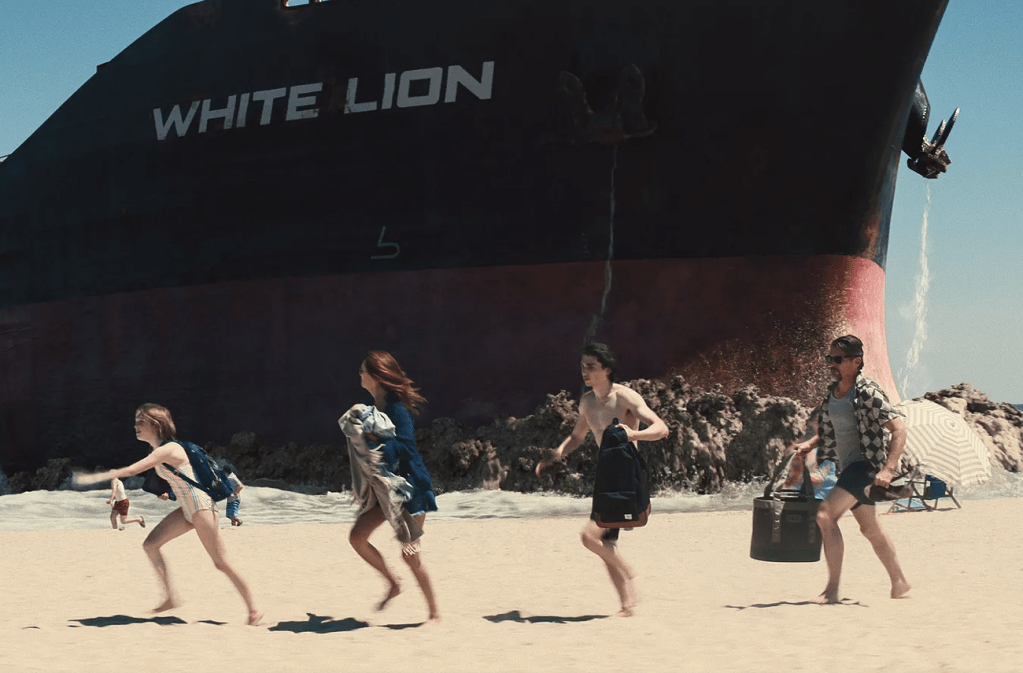
And this is only the beginning. As the six guests muddle on under the same grandiose roof, frictioning over racial microaggressions and yawning generational divides, the world around them begins to disintegrate. From City blackout to no wifi, TV static to scrambled push notifications, things begin to feel decidedly outlandish. The madness only escalates: oil tankers penetrate the shores; planes nose-dive into the ground; rare and exotic animals appear menacingly in back gardens, as if to tell us something; self-driving cars hurtle towards New York City of their own accord, crashing into everything — and each other — in their path. The United States of America, in other words, is self-imploding.
What could be behind these strange goings-on, if not a nationwide cyberattack — which the release of thousands of pamphlets reading “Death to America” in Arabic (and Chinese — or Korean — elsewhere) dropped from a drone, would suggest, and which the savvy G.H. later will confirm thanks to a prior warning from a connection high up in national security. This is a disaster in which the Sanfords and the Scotts, despite their differences, must make sense of together, and work to find answers, medicines and, with members of the group running astray, even one another, testing bonds in the process.
The world the Scotts and the Sanfords inhabit is a world which, like ours, feels less and less recognisable by the day, one changing exponentially before us and becoming evermore uncanny. In this post-Covid, post-truth and profoundly digitalised society, the chaos of LTWB feels familiar, even if it is distilled into a 24-hour national security breach. With the largest war to grace Europe since World War II raging in Ukraine, the ongoing Palestine-Israeli conflict, a Covid-recovering, faltering economy, the prospect of an AI-takeover, and the eerie rise of populists across Europe and South America (not to mention the possibility of a twice-elected Trump), life today feels divided, volatile and nonsensical.
And it’s no coincidence that out of the four, it’s youngest Rose who, sensitive and anxiety-riddled, first spots and flags the approach of a self-driving oil tanker, hurtling directly towards them during a family trip to the beach in an earlier scene from the film. Her concerns at the shorebound vessel fall on the deaf, indifferent ears of those around her in a neat metaphor that echoes the ongoing crisis of Boomer inaction that is climate breakdown, all the while riffing off Speilberg’s famed monster. Only here, the real monster is manmade, a grotesque symbol of the twin forces of rogue technology and climate breakdown, growing ever nearer and more menacing. Indeed the safe world of Friends can’t help us now, despite poor Rose’s efforts to watch the show’s final episode during the vacation, fraught with anxiety about how things end between Ross and Rachel — the golden will-they-won’t-they couple of West. All’s not well that cannot be cosily concluded.
A landmark 90s series firmly branded in the minds of millions, Friends is synonymous with a post-Berlin Wall, pre-war on terror decade of relative (Western) calm in which technology didn’t want to kill us, or, worse still, own us, and 1.5°C just meant “really cold”. More than that, it embodied a way of life which, as most millennials and many zoomers will agree, we were promised: one in which friendships were physical, always redeemable and tight-knit; people were, for the most part, reliable; work-life balance was skewed heavily towards the life category. And set, of course, in what could be called the modern-day epicentre of western civilisation, Friends, like New York, possesses a near religious status as the pinnacle of modern life goals. Amanda’s early-morning ennui faced with its once immortal vivacity signals a cultural shift away from this narrative, a redundancy of all that it represents. In today’s post-financial crisis/-Trump/-Brexit/-Covid world, no longer is the catchphrase “I’ll be there for you,” but simply, “I fucking hate everyone.”
Yet the idealisms of the zeitgeist that was Friends convinced viewers — and continues to do so on a hungover Sunday afternoon — that we can live in a hermetically sealed, comfortable world should we decide to do so. In reality, one which young Rose is coming to get to grips with, we exist in a world which eats itself. “The centre cannot hold,” to echo the now staple twentieth-century adage. Collapsing on itself, life’s boundaries cease to exist. Thus in the film the camera moves ghostly between floors, walls and windows and zips frantically between bickering characters, unable to settle on a speaker, or a stable, concrete opinion. In one resonant scene, when a seemingly lost Latin-American woman bangs frantically on Clay’s car window, himself lost without GPS signal, we’re not afforded the luxury of subtitles to translate her pleas for help. We’re no longer speaking the same language.
Framing, moreover, is often askew, with characters un-centred, hinting at the end of the (American) protagonist; this world is porous and unfixed, a far cry from the ten-season, six-character, symmetrical universe of Friends in which characters took centre-stage. Who holds the power now? Without the comfort of traditional divisions (the walls and cultural boundaries that once separated us) and the comfort of technological connectivity, watching characters move about the house is akin to watching a devilsome bot play the Sims, in yet another hark to simpler times. For where they were once the active, connected controllers in their lives, they now exist as puppets. Its very absence, the film suggests, proves the extent to which technology and the connectedness it brings wields over our lives, and the extent to which we are, ultimately, powerless. Assumed to be impermeable and governed by the inherently good tech forces that be, we’re reminded by the informed G.H. that mere children have succeeded in infiltrating national security systems and wreaking havoc, all from their bedrooms.
It’s a pity that despite its topical premise — especially as democracy is slowly but surely chipped away at, with Russia and China waiting hungrily in the wings — the film’s treatment of encroaching non-Western powers is as vague and reductive as Stranger Things’ fetishisation of an evil, mysterious Russia.
Moreover, the film fails to convey the true sense of horror at the prospect of a Chinese and/or North Korean takeover. This on the one hand feels deliberate, with its boisterous, subversively Hitchcockian opening credit sequence — played to an explicit Joey Bada$$ number — sardonically poking fun at the global chaos to come and obliterating any suspense.
Cutting its head off from the start is a bold move for a film with a whopping runtime of 140 minutes, with strong performances from Roberts, Ali and Hawke only taking us so far. Doing so means that traditionally tension-ramping techniques like cross-cutting sequences — the stitching together of multiple crescendoing scenes at once, used frequently in the film — drag out painfully, lacking momentum altogether. Standing on the shoulders of pacier, shorter, more subtle entries to the horror/sci-fi canon such as Jaws, Cloverfield and Krasinki’s more recent A Quiet Place would have benefited the film, drawing in particular on their success as highly immersive, less-is-more movies which resist the urge to always spell it out (may Netflix’s Bird Box be a lesson in this). This could have been done, all while maintaining, if not bolstering Esmail’s signature off-kilter style.
Yet what’s intriguing about LTWB — and where director Sam Esmail’s true potential lies — is how it taps into worlds past, present and future: it looks back at a world we once knew (epitomised in Friends); the post-Covid, ever-changing and seemingly out-of-control world we know now; and a future in which US, and by extension, Western hegemony is obliterated. In the end, this is far more than one film alone can chew. It’s messaging is thus reductive and confused, if not rather naive, while we’re left with an inevitably inconclusive conclusion — even if it’s rewarding enough to watch it’s characters’ vain attempts at leaving a world which simply won’t allow them to do so. ∎
 Home
Home 
Leave a comment