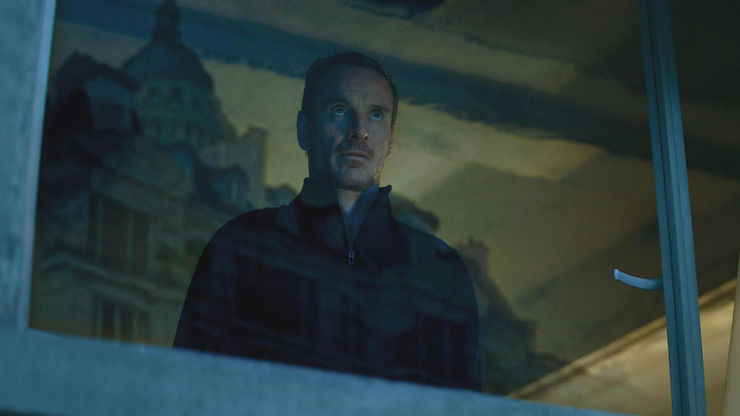
David Fincher’s thriller tests the limits of an inflated ego — and a killer subconscious
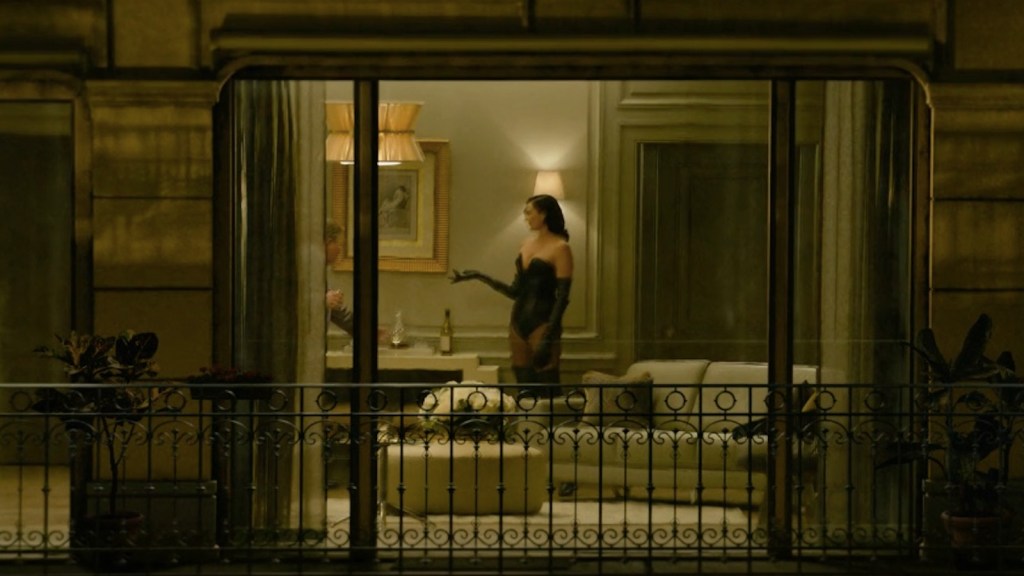
You’d be forgiven for detecting, moments before Michael Fassbender’s titular Killer erroneously takes out a dominatrix from a mid-construction WeWork office in David Fincher’s new Netflix thriller, intending instead to kill her client, a certain look of recognition between both: hired freelancers on the job, two integral parts of the beast that is today’s gig economy. That the dominatrix, moving lithely, goes to shut the drapes but doesn’t, playfully allowing him to watch on, only reaffirms this; it’s as though she’s flirting, engaging the Killer in a high-stakes peep show.
The Killer’s internalised, seemingly routine monologue, in which he describes the required mental preparations for a successful kill with near sexual fervour, likewise unites the pair, his words applicable to the work of both hitman and dominatrix:
“Stick to your plan. Anticipate, don’t improvise. Trust no one. Never yield an advantage. Fight the battle you’re only paid to fight. Forbid empathy. Empathy is weakness. Weakness is vulnerability. Each and every step of the way, ask yourself: ‘What’s in it for me?’ … Do what you must commit yourself to, if you want to succeed.”
Yet, interpreted more broadly, the Killer’s words are a mantra for the modern Holy Grail that is market dominance, the self-serving and unyielding free-market capitalist machine which fuels society. Naturally, there’s an overtly sado-masochistic undertone to his monologue, mirrored, of course, in the sex worker’s leather-clad performance he spies at: sadist in his emphasis on rejecting empathy and weakness (enemies of the machismo, unfettered capitalist machine); masochistic in the ultra self-disciplined and stoical commitment to getting to the grind.
For in this game, both dominance and subservience are key, two sides of the same free-market coin that is 1980s neoliberalism. Hence, when selecting from his “Work” playlist on a now retrograde iPod mini, the Killer’s apt choice of kill music, The Smiths’ How Soon is Now. A relic from ‘80s anti-establishment Britain, their melancholic sounds became synonymous with the Thatcher-Reaganite period which signalled the harsh return to unfettered free market economy. The choice of song reveals more, its title a reference to Marjorie Rosen’s Popcorn Venus. Speculating on the avaricious, highly corporatised male gaze of 20th-century cinema, Rosen writes: “How immediately can we be gratified? How soon is ‘now’?”
This is, afterall, a “dog-eat-dog” world, as the Killer says himself, discarding the bun from his BigMac — no frills allowed — as easily as he does away with the fussy concepts of “luck”, “karma” and “justice,” which, according to him, “simply don’t exist.” Finally taking aim at his target, situated across the street in a penthouse hotel suite, he defends his callous lack of morals by simply concluding, the camera zooming in on his expressionless face: “I. Don’t. Give. A. Fuck”.
It’s ironic, then, that immediately after botching the job and killing his kindred freelancer, his first word — and first spoken word in the film, in fact — is “Fuck,” revealing from beneath the image of a slick, no-fucks Bond a man consumed by hubris. And when, as “blowback,” his girlfriend is put in hospital by fellow assassins as collateral, the stoic who vehemently professess to not believe in “luck,” “karma” or “justice,” suddenly does. Post-botch, and shaken, we thus witness the Killer’s rattled ego in the presence of the city-slicker suit-wearing professional he encounters on his return flight from Paris to the US. Not the potential clean-up agent out to get him as we might suspect — the Killer makes no obvious attempt to hide from him, merely ogling him, mouth ajar — he instead threatens to be the cooler, more successful hustler he no longer is but must view from his cramped seat in economy in their return flight to the US.
Fincher hints at the Killer’s fall from grace in his choice of stakeout, WeWork. Having filed for bankruptcy a mere week before the film’s release on Netflix, the multinational pioneer of coworking spaces has become the unwitting emblem of a failed, cocky start-up culture with a defunct business model — unlike the posterboys of global corporations which permeate the film (more on this later). Notably, both The Guardian’s Matthew Zeitlin and The New York Times’s Amy Chozick speak of WeWork’s “messianic” CEO and founder, the cultish, experimental school-opening eccentric, Adam Neumann — an Israeli-born risk taker who envisioned WeWork as a “capitalist kibbutz.” The latter dubbed WeWork’s spectacular demise “an implosion unlike any other in the history of start-ups,” echoing the response to the Killer’s own implosion: “How could this happen? This is unprecedented,” his handler demands to know over the phone.
It’s difficult not to highlight the slippage between the terms “start-up” and “upstart.” In the same way investors overzealously pumped millions into the startup, leading to an inflated valuation, the Killer suffers from a chronically inflated ego — and with it a flawed, pretentious intellect. In his arsenal of quips and quotes, for instance, reeled off in the film’s dense introduction, The Killer is able to recount Popeye (“I am what I am”), but fails to recall the author of Aleister Crowley’s “Do what thou wilt, shall be the whole of the law,” hinting at a shaky, read-it-somewhere approach to philosophy.
“W-W-J-W-B… What would John Wilkes Booth do?”, he asks himself after botching the job, referring to the séance-attending, superstitious assassin responsible for killing Abraham Lincoln. It’s a revealing choice of Jesus-substitute. US Historian Nora Titone describes Booth as “a lunatic enraged by the Union victory and the prospect of black citizenship,” hypothesising that his assassination of the first US president was the result of an egotistical rivalry with his brother. Historian Benjamin Platt Thomas, meanwhile, concludes that the handsome, athletic and renowned theatre actor “won celebrity with theater-goers by his romantic personal attraction”, but was “too impatient for hard study.” It’s perhaps no surprise that he later bungles his killing of handler Hodges after nailgunning him in the chest, mistakenly believing that he would have a six- to seven-minute window with which to interrogate him. Intended to impress, his ultimately superficial intellect highlights a rudimentary, oddly tech-bro vision of the world in which numbers are gospel and facts unfailingly applied in real life at whim.
Regardless, there’s a discernible cringe-worthiness to the Killer’s monologuing, especially when we consider that it’s diegetic, i.e. within the film’s world. Interrupted by characters on several occasions, what we’re hearing is in fact an ego-stroking, self-psyching monologue worthy of a Patrick Batemen wannabe (and we all know how that ends).
Working in the Killer’s favour, however, as with Booth, is the Killer’s physicality. Smoothly mechanical in nature, Fassbender’s lithe, yoga-trained body advances, slides and swerves like the robotic arms found in large-scale manufacturing — movements mirrored in the supple gait of the dominatrix, who, when she reaches to place her wine down on a table, forms a decidedly perfect 90-degree angle. The smallest of movements, in fact, such as the turn of a head or the shifting of a gaze, are unfalteringly measured, if not preprogrammed, apparent especially when, pre-kill, he voyeurs into the windows of his Parisian neighbours — a humanoid seeking to better understand the human race. Even his heart rate is quasi-digitalised, echoed in Trent Reznor and Atticus Ross’s pulsating, industrial-sounding OST (their opening number, in fact, sounds like the frantic heart beat of modern machinery). It’s telling that during the Killer’s arduous pre-kill wait, in which his sleep is periodically interrupted by his Apple watch informing him of his too-high heart rate, he on one occurrence opens his eyes a mere split second prior to the watch alerting him, preempting the watch and thereby synchronizing with technology.
Just as impressive is the Killer’s ability to seamlessly exploit throwaway culture, one maintained by the avaricious corporate monopolies and their technologically-enabled ubiquity. The Killer’s most lethal weapon? The on-demand/throwaway world around us in which things — from devices and services to new identities — can be acquired and discarded in seconds, one which enables him to seamlessly infiltrate spaces and adopt personas only to shed them later like a coat.
Thus, zipping through the streets of Paris on his hired moped after botching the job, he sheds his killer paraphernalia — yoga mat, tools, weapon, helmet, etc. — by exploiting the world around him: the dumpters, garbage trucks, sewer grates and rivers which make up our towns and cities. Elsewhere, he infiltrates his handler’s coded office building, guised as a recycling collector, after piggy-backing on the entrance of a FedEx driver; hires a Hertz vehicle, disguised as a sun-seeking, blue-collar holidaymaker touring Florida, in order to track down the Brute; orders a fob copier from Amazon in mere seconds, which he uses to gain access to Claybourne’s, aka the Client’s, penthouse apartment (not before posing as a corporate gym-jerk in order to clone his keycard). And he does so with the quiet stoicism and determination of a humanoid — seemingly unfazed by the desparate pleas for mercy from Dolores nor the weighty punches of the Floridian Brute.
Yet when, in the film’s final act, he seamlessly penetrates the Client’s apartment, the Killer cannot kill Claybourne, who he regards as his spiritual and professional equal. Hence his rather off-kilter remarks to the Client: “I came to show you how easily one might get to you, Mr. Claybourne, and to ask, ‘Do you and I have a problem?’.” His question is one between business men, intended to mediate tensions between two professionals on equal footing at the heights of their careers: it’s the equivalent of saying, “Bro, let’s talk this out like men.” The stinging irony, of course, is that the Client views the Killer as the disposable tip of a whole chain of transactions, and accordingly fails to recognise him; the Killer, like most in the gig world, is invisible. And yet he cannot resist. Moments later, before leaving the Client unscathed (but threatened), he remarks: “I’m curious. I break into your home in the middle of night with a silenced pistol. And you have no idea why I might be here?”.
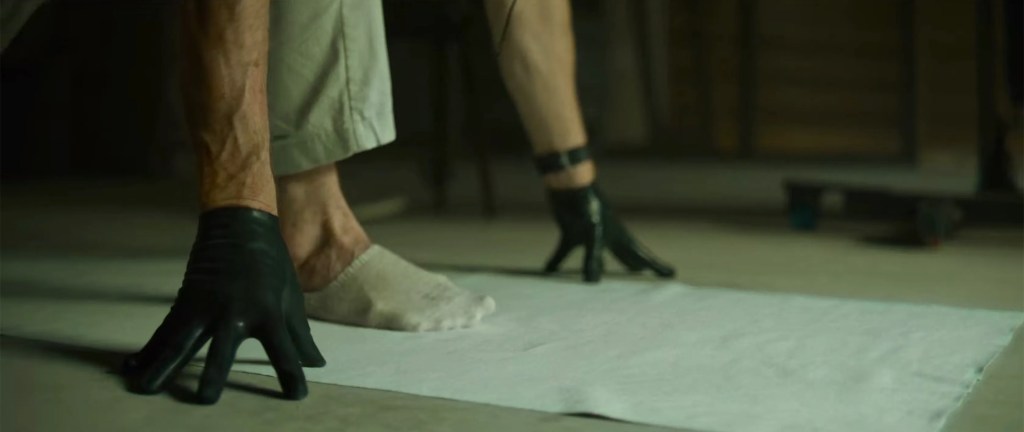
Even to the end the Killer is blithely unaware of the ever-expanding hole he digs himself. “Who needs a Trojan horse when you’ve got Postmates? ‘Cause everything’s airtight, till the billionaire wants densuke watermelon,” he quips, prior to gaining access to the Client’s building, tailing the entrance of a Postmates vehicle. While there’s truth to his words, positioning himself as a Greek warrior seeking to take Troy as revenge for their infamous taking of Helen (i.e., Helen is Magdala) only highlights his Achilles heel: a blindness to the fact that he himself is an integral part of the gig economy; it’s exactly because of his existence within it which enables him to exploit it so adroitly. This is a status he saw mirrored in the nimble dominatrix we assume he killed by mistake, but which, fearing the mirror image of himself she posed, he perhaps did in fact assassinate in an obliterating act of subconsciousness. There’s perhaps no greater symbol in The Killer than the black gloves he dons when preparing for a kill (or practicing yoga): shiny and leather-looking, they resemble the kink outfit donned by his target’s client, playfully aligning the pair whilst underscoring their existence as a physical labourers.
It’s no wonder the Killer takes comfort in listening to the deeply humanising, melancholic stylings of The Smiths. As Morrisey cautions, lamenting the fate of the painfully shy and lonely subject of ‘How Soon is Now’: “I am human and I need to be loved / Just like everybody else does.” We’re tempted to think the Killer may have learnt something in its final moments. Tucked away in his Dominican refuge with a now-recovered Magdala, he informs us that he’s one “one of the many,” like us. If it weren’t for the twitch in his left cheekbone a mere split-second later, a glitch reminding us of his true condition as a technological ghost destined to exist as a loner within the gig economy, we might be convinced. ∎
 Home
Home 
Leave a comment