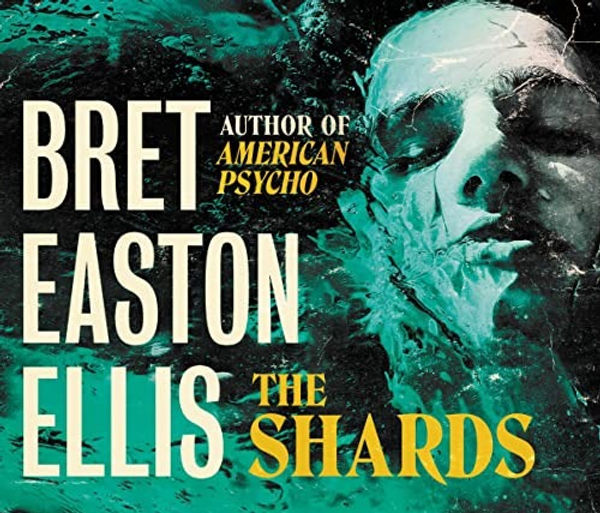
Closeted sexual lust. Enough Valium and cocaine to last a lifetime. A deranged serial killer with a penchant for cleaving into prep-school’s finest. It’s 1980s L.A., and another steamy semester at Buckley High has just begun in Ellis’s carnal, mammoth work of autofiction.
Brimming with energy as violent as it is sexual—sometimes veering into the downright perverse—The Shards plunges us into the first eventful few months of senior year at the elite Buckley Preparatory School (where notable alumni include Kim Kardashian and Paris Hilton). Though hampered by meandering detail and suffering from a much-too-long length, Ellis’s latest work in 13 years nonetheless offers perceptive incites into queer shame, and what read as genuine glimpses into the disillusioned, substance-dependent lives of L.A.’s cream—lives soon to be turned upside-down by the presence of a sadistic serial killer.
Told from the alienated, writerly perspective of Ellis himself, Bret is something of an outsider simultaneously enmeshed within the school’s revered it-crowd: four or five impossibly good-looking, all-American prep-school types. Navigating L.A. prep life and all its complex trappings—jealousy, lust, anger—as a closeted 17-year-old, Bret traces the steps of a sadistic serial killer. Seemingly the only one in his social group to take the issue seriously, he begins to suspect the charming Robert Mallory, a Buckley newbie with a mysterious background, as the potential culprit. Noticeably, The Shards dances a questionably fine line between murderous violence and carnal teenage lust, two narratives sitting side by side and ultimately converging: the burning, drug- and booze-fuelled sexual energy found in and around Buckley, and the disturbing activities of an L.A. stalker and murderer (or murderers), dubbed the Trawler.
Animalistic lust is the driving motivator behind the book, mediated through the eyes of it’s protagonist whose casual voyeurisms—innocuous glimpses in the locker room, inevitable glances at the drunken pool-party skinny dipper, sly peaks at his best friend Thom’s perfect ass as he emerges nude from a hotel shower—echo the work of the Trawler in a daring parallel. Eventually, the line dividing sexual desire and murderous lust, supposing there was one, is crossed. Things get decidedly necrophilic when these two strands meet, and Bret is shown postmortem shots of his classmate’s nude corpse, which, though battered and mutilated, he can’t help but feel a pang of arousal over.
Evidently, this isn’t your average sex-filled, horny adolescent romp. Here, sex is deeply woven into every passage of this oozing novel, as it is perhaps woven into the very fabric of modern society, Ellis is perhaps saying. There’s a dirty frankness to the book little seen today, with sexual desire residing at the core of almost everything (masturbation is the first thing Bret often does when waking up, while darker periods of the novel are marked by an occasional inability to do so). The Trawler, likewise, incorporates sex—or rather erotica—as punitive torment, sawing off breasts, stuffing victim’s vagina’s with dead goldfish, taunting victims about their homosexual relations). As Bret puts it himself, reflecting on a trip with Thom and his father to New York to see a game, during which the just-ended Iran hostage crisis is commemorated, “I was more interested in the perfection of Thom Wright’s ass than anything else on that trip… I was numb to everything except for a flash of nudity in an anonymous hotel trip.” There’s something about this book to suggest that such yearning lies beyond mere “teenage lust;” it’s an integral, very animal part of being human.
It’s a shame, then, that this fictional strand, detailing the ever-encroaching presence of a highly sadistic murderer who picks off the grotesquely privileged students of L.A., fails to generate suspense—even if the Trawler’s actions are at times beguilingly eerie. For the most part, the Trawler plot sits rather clumsily alongside Ellis’s prep-school narrative. They read like hurried add-ons at the end of chapters, conveyed in slapdash lines like “I felt some watching me from the hills” which achieve little more than to propel Bret’s resulting isolation from the group. A saving grace, perhaps, is the book’s bloody conclusion, which creates some effective home-invasion chills worth reading on for.
Working in the book’s favour, however, is Ellis’s knack for capturing modern consumerist life, one which boomed in 1980s America. As such, we’re offered moments of sharp observation into life’s numbing performativity. The roles Bret and his classmates are expected to fulfill, for example, are profoundly coded by the designer clothes they wear, the amount of cleavage they choose to display or the colour of someone’s Polo swimming shorts in such a way that The Shards reads like the prep-school equivalent, or prequel to, American Psycho. But beyond that, the moods characters display become a brand too, something to don, an aesthetic put out into the world. Thus Bret takes creative inspiration from the much-idolised character of best friend Susan Reynolds, prom queen and girlfriend of the lovable, gorgeous Thom. Something of a gay icon-cum-muse, for Bret, Susan exudes a cool, stylish numbness, an aesthetic he at times yearns to attain himself: “I wanted to be where Susan Reynolds was. And I wanted to write like this as well: numbness as a feeling, numbness as a motivation, numbness as a reason to exist, numbness as ecstasy.”
Without a definable self—a centre—Bret is doomed to oscillate between ice-cool Susan Reynolds and her polar opposite best friend, Debbie Schaffer, daughter of a closeted, predatory film producer and girlfriend to Bret. Highly strung, perky, and mad-about-the-boy, it’s Debbie who fosters the “tangible participant” in him—the orthodox conformist who wakes early to workout and swim, eats scrambled eggs for breakfast, coordinates his Gucci with his Armani, makes an effort with his girlfriend, and ceases to be the Valium-popping “zombie” she accuses him of being. The tangible participant, however, when faced with the encroaching presence of the Trawler (whose home invasions, school-statue defacements, and teen stalking only Bret seems to notice), is eradicated: “and I realized I was no longer the tangible participant in not only the life of Buckley but in the outside world as well. Nothing seemed to affect me. I had become numb.”
As the book progresses, it becomes clear that Ellis uses the Trawler’s eroticised murders as a manifestation of Bret’s queer shame. Trapped within the conformist confines of upper-class L.A., Bret, being predominantly gay (it would seem), is forced to live the life of an outsider, a life which parallels that of the murderer. The private relationships he carries out with male classmates, for instance, echoe the Trawler’s secret, erotised killings of people and animals (mutilated horse penises and all). Elsewhere, their actions crossover when, closely following the movements of the suspicious newbie Robert Mallory (to whom he betrays a fierce sexual attraction while also suspecting him of being the murderer), Bret breaks into his former L.A. home and snoops around in such a way as to mirror the Trawler’s breaking and entering of victims’ homes. In another link, a pair of underwear belonging to one of Bret’s former lovers, which Bret secretly stole as a keepsake, are left on his bed—it’s supposed by the Trawler, aware of his closeted sexuality—blatantly for him to see in a mocking jibe which uncomfortably approximates the two. Gay sexuality, for Bret, quickly, if unconsciously, equates perversion.
There’s even a sense of shame conveyed by the fact that he can scarcely muster the courage to read the morning news for fear that he’ll learn about another abduction; it’s as if he might be revealed as the culprit, be outed. And this would be fitting, given that Ellis previously explored (at least a certain degree of) shame in his semi-memoir Lunar Park, a work in which Ellis is haunted by the ghost of American Psycho’s murderous hero Patrick Bateman (said to have been the inspiration behind a number of murders in the U.S.). Indeed, there’s a certain irony to how the Trawler’s eroticised murders are intentionally, even proudly, left for the world to see, while Bret’s homosexual acts are kept confined to secrecy.
For all its meandering detail and 200-page surplus, The Shards succeeds in maintaining an alluring ambience of a prep-school circle closely bound up with the cocaine-fuelled world of rampant wealth and Hollywood. Reinforced with sharp writing, immersive referencing to pop culture and a 70s/80s nostalgia-core soundtrack like none other, The Shards is an enjoyable ride which digs deep beneath the surface of everyday life to offer intriguing, if somewhat drowned-out commentary on a young life of quiet secrecy, shame and paranoia. ∎
 Home
Home 
Leave a comment