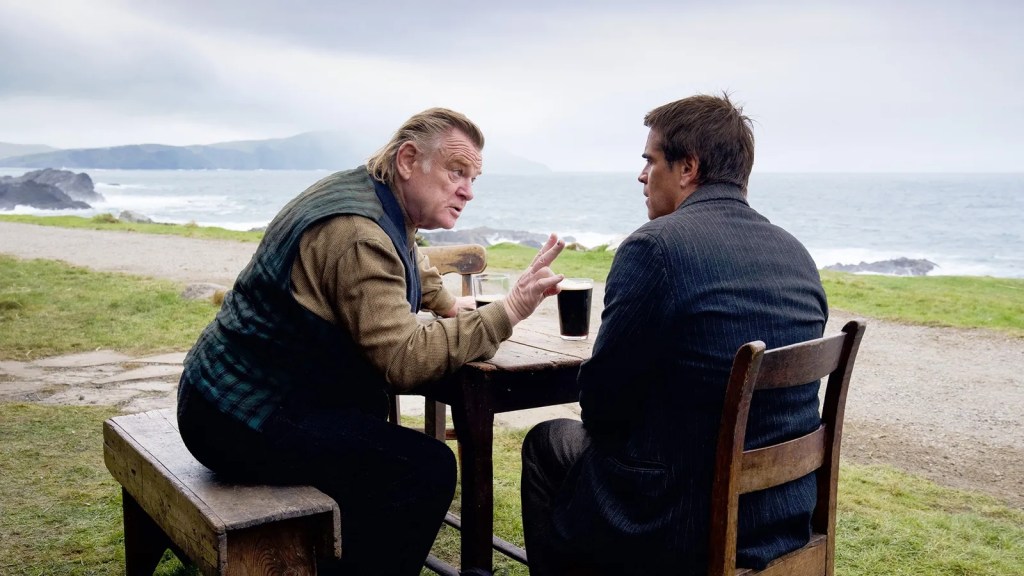
Colin Farrell and Brendan Gleeson return in this frank, fable-like exploration of a broken friendship between two men on a starkly beautiful west coast Isle
*Contains spoilers*
Of the few manifestations of friendship portrayed in director Martin McDonagh’s latest tragicomedy, The Banshees of Inisherin, those with animals remain at the forefront of our mind. For on the desolate, cold island of fictional Inisherin, where healthy relationships are as scarce as the human touch, it’s true that a man’s best friend is his dog… Or his pony, or his cow, or his horse, for that matter. Set against the backdrop of a near-ended Irish Civil War, this gritty, haunting and at times hilarious exploration of male relationship à l’irelandaise begins jarringly when the aloof musician and aspiring composer Colm (Brendon Gleeson) abruptly ends his lifelong friendship with the far simpler cattle rearer Pádraic (Colin Farrell). Superbly paced, subtle (even when it’s not—thankfully we’re spared from witnessing some much-teased self-mutilation), and boasting some stellar performances from Farrell, Gleeson, Kerry Condon and Barry Keoghan (who is especially magnetic at portraying the troubled but kind-hearted ‘village simpleton’), The Banshees is a unique, at times brutal rumination on loneliness and mental health.
Those familiar with McDonagh’s unmistakably sardonic style—one we most closely associate with 2008’s favourite In Bruges, the words ‘You’re a cunt… You’ll always be a cunt’ practically brandished into our minds—will be no stranger to The Banshees. In many ways, not least because of the signature Gleeson-Farrell dynamic and McDonagh’s bleakly comic style, it feels as though we’re picking up from where In Bruges left off, despite The Banshees being set a good 70 years prior (perhaps indeed explaining why).
Yet McDonagh’s decision to directly broach the sensitive, vulnerable topic of male friendship (and all that naturally accompanies it—loneliness, isolation and minimal, if not non-existent communication) feels refreshing, and flies in the face of the over-done and tired formulas which dominate the more conventionally macho films coming before it. Watching In Bruges today, though it deftly touches on some of these elements in addressing the ambiguities of contact killing, it’s easy to wince at the film’s overuse of the word ‘gay’ as an insult—a term used less to convey the mobbish, misogynistic culture of crime than to make us laugh in agreement. Today, films like In Bruges and other comedic crime-thrillers of its kind with outdated attitudes (think recent additions such as Pearce’s The Gentlemen) feel like indulgent glorifications of the very bloke-ish, British crime world. Meanwhile, McDonagh’s unfocussed and meandering Three Billboards Outside of Ebbing, Missouri (2017) proved something of a misfire both in terms of story and treatment of minority issues: namely, the treatment of racial issues in America.
Instead, the Banshees boldly takes as it central theme a toxic way of life unique to men yet so ubiquitous—that of the reclusive, egotistical and self-destructive ‘Undiscovered Great’ we find embodied in Colm. Indeed Colm’s decision to break from his best friend, we learn, is due to Pádraic’s “dull” quality, his mundane, humble existence typical of Inisherin a repellent to Colm’s lofty desires of reaching musical heights. His curmudgeonly behaviour and constant composition-making speaks to a mid-life-crisis yearning to be known, leave a mark in the world and attain a level of musical greatness he sees cancelled in the presence of simple Pádraic, and thus he threatens to cut off his violin-playing fingers should Pádraic keep attempting to talk to him.
As the film progresses, Colm struggles to maintain the solitary life of an artist while Pádraic’s despair at the loss of his best friend deepens—despair being a key word here as it’s what Colm’s priest uses euphemistically to describe his depression during confession: “How’s the despair,” he asks at each meeting, not without a pinch of tired sarcasm. And this is no coincidence, for there’s an infectiousness to Colm’s despair which envelops all those around him, spreading like a contagion.
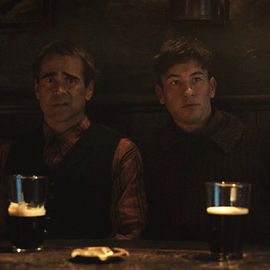
Beginning with Pádraic, Colm’s acts of self-mutilation are the final straw—if not the instigator—behind Siobhán’s decision to leave the island (Colm’s throwing his fingers at her door a not-so-subtle hint to do so). Moreover, might Siobhán’s decision to leave have caused the potential suicide of Pádraic’s friend Dominic (Keoghan), found drowned in the lake? Regardless, it’s Pádraic’s tit-for-tat behaviour which leads a disappointed Dominic to cut him off, furthering Pádraic’s isolation.
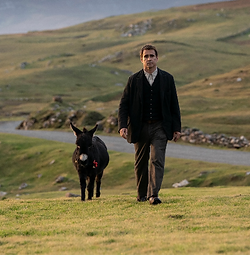
But of course, Colm’s corrosive arrogance finds its most obvious and heart-wrenching manifestation in the death of Pádraic’s beloved pony, Jenny, who dies after choking on one of Colm’s self-mutilated fingers left strewn in the yard. As elsewhere in the film, here Colm’s self-destruction violently pierces through the film’s comic surface and lays bear a disturbing reality: An unspoken and inevitable instinct within men to harm themselves and the lives of those around them in a bid for greatness. And for what? What is Colm, like the soldiers waging the Irish Civil War, really fighting for, the film asks?
All the while, Colm’s stubborn silence and needless self-mutilation mirror the breakdown of communication and senseless killing synonymous with war. By paralleling the two, McDonagh adds an ironic cautionary quality to the film, as though a fable, one bolstered by Carter Burwell’s folklorish, nursery rhyme-esque score and, of course, the illusive presence of a rumoured banshee.
It’s telling that as the old friends meet on the beach at the film’s close, Colm having survived Pádraic’s vengeful 2pm arson, Colm can only apologise for inadvertently killing donkey Jenny and thank Pádraic for sparing his beloved dog. Animals have become the last remaining arbitrator between men—the only language in common and only thing worth breaking silence over, a silence for which Colm, in his despair, was willing to maim himself in order to maintain whilst handicapping his musical career. As the men part ways, Colm reaches out in attempt to make a truce. But alea iacta est, the die is cast (in the truest sense of the adage). Pádriac, too betrayed, is unable to reconcile—and thus, as Colm speculates whether the war has ended (the irony that it hasn’t and probably never will speaking for itself), Pádraic instead draws the battle lines with a brutal snub: There are some things we just can’t move on from.
As the camera zooms out on a lonely Colm and we’re confronted with the mysterious silhouette of the film’s eponymous banshee-figure who looks on at the pair, we’re warned of the age-old tale: The story of man, one doomed to repeat itself ad infinitum. ∎
 Home
Home 
Leave a comment